As the saying goes, "10 chestnuts can replace a bowl of rice," which shows that chestnuts are relatively high in calories. Chestnuts are also known as a "treasure of winter," being both delicious and economical. Have you eaten chestnuts this winter?
Sugar-fried chestnuts
Although chestnuts are nuts, their nutrition is similar to that of tubers. Chestnuts belong to the nut category, with a high starch content, but they are not as rich in oil as other nuts. Dried chestnuts contain 77% carbohydrates, similar to grains like rice, flour, and beans. Even fresh chestnuts have up to 40%, nearly twice that of sweet potatoes. Fresh chestnuts contain plant-based protein, a small amount of fat, and abundant carbohydrates. They are also rich in minerals such as calcium, potassium, magnesium, and zinc. Every 100 grams of chestnuts contains as much as 442 milligrams of potassium, making them a high-potassium food.
10 chestnuts can replace a bowl of rice, so don't eat more than six or seven at a time. Chestnuts are rich in starch. As the saying goes, "10 chestnuts can replace a bowl of rice," but in terms of nutritional content, rice is not as rich as chestnuts. Although chestnuts are good, you shouldn't eat too many at once, as it can cause bloating or affect your regular meals. Furthermore, when sugar-frying, a small amount of sugar and oil seep in, making the calories even higher. Therefore, it's best to limit yourself to six or seven a day, and appropriately reduce your staple food intake, or burn off the calories through exercise.
Don't buy sugar-fried chestnuts that are cracked, as it's unhealthy and unhygienic. Oil chestnuts, a type of chestnut, are more suitable for sugar-frying. Traditional sugar-fried chestnuts use malt sugar. If saccharin and inferior oil are used to fry the chestnuts, the cracked parts will stick to "syrup," along with impurities like charcoal and dust. This is both unhealthy and unhygienic, so it's best not to buy them.
Eating them raw can easily cause gas. When picking raw chestnuts, note that naturally ripe chestnuts have a bright, clean red surface, a smooth base, and a top with very short, gray-white fluff without insect holes. They have naturally formed small pits, and the chestnut flesh inside is white after peeling. Eating chestnuts raw can better preserve their nutrients, but their high starch content makes them difficult to digest or can easily cause gas. In home cooking, they are often made with other ingredients. Classic dishes include jujice-stewed chestnut chicken and braised pork with chestnuts.
Although chestnuts are good, they are not suitable for everyone. People with poor gastrointestinal function, those who often experience indigestion, frequent constipation, and diabetics should not eat too many chestnuts.
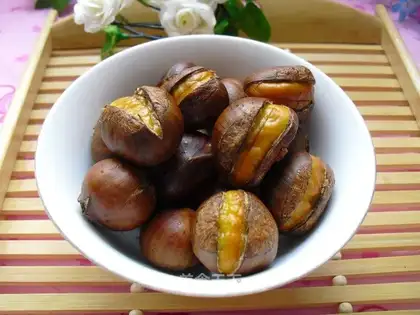 Chestnut