When eating raw salmon, it is customary for everyone to add wasabi to the soy sauce dish. Many people believe that a bit of wasabi can kill parasites. Is that really the case? Experts remind us that adding a little wasabi when eating salmon cannot kill parasites; it requires high-temperature and freezing methods.
Salmon Sashimi
Beware of Parasite Risks When Eating Raw Salmon
“Whether eating it raw or cooked, the key lies in the handling before consumption. It is unscientific to rely on killing parasites and bacteria during the eating process.” Experts state that scientific experiments have proven that only by soaking salmon in a very high concentration of wasabi for more than 55 hours can a small number of Anisakis worms possibly be killed. Therefore, the short-term contact with a trace amount of wasabi sauce that we have during normal consumption cannot kill any parasites.
Anisakis is a relatively common parasite, with larvae about 1 to 3 centimeters long. Once infected, the parasite can cause inflammation and edema of the gastric mucosa, and even lead to bleeding and allergic reactions, damaging the gastrointestinal tract and causing diarrhea, vomiting, and other symptoms. In severe cases, it can be life-threatening.
How to Eat Salmon Safely and Healthily?
To eat salmon safely and healthily, you must first kill the parasites. So, how can you kill the parasites in salmon? Actually, high temperatures and freezing can kill parasites.
High Temperature: Generally, the parasites in salmon are divided into nematodes and cestodes, and they exist in the anus, abdomen, and tail. High temperatures can effectively eliminate parasites. A temperature of 70°C is generally sufficient to completely kill them.
Freezing: Some environmental and health departments in various countries have introduced targeted food safety regulations. For example, the U.S. Food and Drug Administration (FDA) stipulates that fish must be frozen at -35°C for 15 hours or at -20°C for 7 days before it can be consumed. The EU standard is to freeze at -20°C for more than 24 hours. The Centre for Food Safety in Hong Kong stipulates that when selecting raw materials, storing fish at -20°C for 24 hours can generally kill parasites in the fish.
Reminder: Most salmon imported into China undergoes strict inspection and is generally free of parasites, so it can be eaten raw in moderation.
For some salmon that may contain parasites, it is recommended to steam or cook it at high temperatures to kill the parasites. When paired with other seasonings, the taste is also quite good.
Next, let's share some methods for selecting high-quality salmon.
1. Look at the Appearance
Farmed salmon often has markings or spots on its head, while wild salmon has a very smooth and uniform appearance.
2. Look at the Flesh
In supermarkets, some salmon is sold in sections, which facilitates processing and preservation, and also makes it easier for consumers to assess its quality. If the flesh has one or several white streaks, it is farmed. Conversely, wild salmon has firm flesh with almost zero fat content, so you cannot see any white fat lines.
3. Look at the Texture
Generally, the flesh of wild salmon is very firm, with a similar texture to lean meat, while the texture of farmed salmon is relatively "loose."
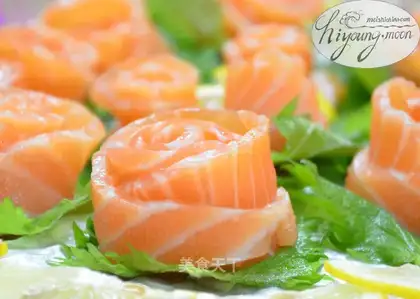 Sashimi salmon