Cilantro has a very unique flavor, and it is precisely this flavor that leaves people with mixed feelings about it. Those who love it can't get enough of it, while those who dislike it feel uncomfortable just from smelling its aroma. It is said that one in seven people in the world dislike it, which is quite a large number. Don't you like cilantro? Read this article before you decide.
Cilantro is a treasure from root to leaf! The efficacy and effects of cilantro
In Traditional Chinese Medicine, cilantro is considered pungent and warm in nature, and it acts on the lung and spleen meridians. It is known to induce sweating and promote rash eruption, aid digestion and promote the downward flow of qi, and stimulate the spleen to harmonize the middle jiao. It is primarily indicated for the initial stage of measles with poor eruption, food stagnation, poor appetite, and prolapse of the rectum.
1. Harmonizing the stomach and regulating the middle jiao
Cilantro's pungent and aromatic nature helps it to ascend and disperse, promoting gastrointestinal peristalsis and thus acting as an appetite stimulant and spleen tonic.
2. Treating colds
For healthy individuals with good constitutions who occasionally catch a cold, cilantro can be used to treat it.
3. Expelling cold
Since cilantro is warm in nature, people with a cold spleen and stomach can moderately consume it to warm the stomach, expel cold, aid digestion, and relieve stomach pain. You can make cilantro porridge by adding dried tangerine peel (to aid digestion and regulate qi) and ginger (to warm the stomach and expel cold) while cooking, and then sprinkling chopped cilantro just before serving.
4. Removing fishy and gamey flavors and enhancing taste
Cilantro contains many volatile oils, and its special aroma is released from these oils. It can remove the fishy and gamey taste from meats, so adding cilantro to certain dishes can uniquely serve to eliminate these odors and enhance the flavor.
5. Inducing sweating, clearing heat, and promoting rash eruption
Cilantro extract has the significant function of inducing sweating, clearing heat, and promoting rash eruption. Its special aroma can stimulate sweat glands to secrete sweat, promoting perspiration and rash eruption in the body.
The effects of cilantro roots
Many people discard cilantro roots when eating cilantro, but the roots also have their own effects and benefits.
1. Deodorizing
When preparing strongly flavored dishes like beef or seafood, you can pound the cilantro roots in a mortar beforehand. Using cilantro roots for marinating can make the dish's flavor more natural and significantly reduce the异味 (strange smell) of the meat or seafood.
2. Strengthening the spleen and stomach
Cilantro roots have the effect of strengthening the spleen and stomach. Children often have recurrent fevers due to weak spleen and stomach function. Therefore, drinking cilantro root juice can achieve a "dual-effect" solution.
3. Treating urticaria (hives)
Cilantro root extract has the significant function of inducing sweating, clearing heat, and promoting rash eruption. The special aroma of cilantro roots can stimulate sweat glands to secrete sweat, promoting perspiration and rash eruption in the body.
4. Aiding digestion
Cilantro roots have the effect of harmonizing the stomach and regulating the middle jiao because their pungent and aromatic nature helps them to ascend and disperse, promoting gastrointestinal peristalsis. Cilantro roots can stimulate the appetite and promote gastrointestinal digestion.
5. Promoting blood circulation
Cilantro roots have the effect of promoting blood circulation and can help induce sweating to reduce fever.
Auxiliary Prescriptions
For initial stages of acute mastitis: 250g of cilantro roots, pounded into juice, taken in three doses with warm wine.
For weak spleen and stomach, indigestion: 6g cilantro roots, 10g massa fermentata, 10g Agastache rugosa, 12g Atractylodes macrocephala. Decoct in water and drink twice daily.
For treating colds: 30g cilantro roots, 15g malt sugar, add half a bowl of rice water. Steam until the sugar is dissolved and then consume.
For stomach cold pain: 1000g cilantro roots, soaked in 500ml of red wine. After 3 days, strain and drink 15ml when pain occurs.
For urinary retention: 50g cilantro, 30g fresh bamboo leaves, 30g cogon grass rhizome. Decoct in water and drink twice daily.
For treating measles: 10g cilantro roots, decocted in water can help promote the eruption of measles; or use 500g cilantro, boil in water for a short while, add a little wine, and use the steam to fumigate the trunk, hands, and feet (do not fumigate the rash area), which can also help promote the eruption of measles.
For insufficient lactation postpartum: 30g cilantro, 2 pig's trotters, 10g Tetrapanax papyriferus. Add appropriate amounts of scallion, ginger, and salt. Simmer over low heat until the trotters are tender. Eat the meat and drink the soup for its effect of promoting menstruation and stimulating lactation.
Contraindications
1. People with bad breath, body odor, severe cavities, stomach ulcers, or sores should eat less cilantro. Additionally, as cilantro is warm in nature, it is not suitable for those whose measles has already erupted or for those with heat toxin accumulation even if the rash has not yet appeared.
2. Cilantro has the drawback of being detrimental to one's spirit and eyes, so it should not be consumed in large amounts or for long periods.
3. Eating too much or for too long can deplete qi and harm the spirit, leading to or aggravating qi deficiency. For those with a usual tendency to spontaneous sweating, fatigue, lassitude, and who are prone to colds—especially qi-deficient patients and pregnant women—cilantro should not be eaten.
4. It is particularly suitable for those suffering from external cold contraction, rectal prolapse, loss of appetite, and children with measles.
Dietary Therapy Menu
1. Cilantro Root Decoction
Effectiveness: Can help reduce fever in children, cleanse the kidneys, and also treat the pain and swelling of hemorrhoids.
2. Tossed Cilantro
Method:
1). Wash and drain the cilantro, chop it into small pieces and place in a bowl;
2). Add light soy sauce to the bowl and mix well;
3). Then add chicken powder and drizzle with sesame oil and mix well (you can add chili sauce if you like it spicy);
4). This dish is very popular after eating greasy food.
3. Cilantro Thin Pancakes
Method:
1). Beat one egg, wash and chop the cilantro, peel and dice the carrot. In a small cup of flour, add the beaten egg and mix with chopsticks. Then add water slowly, stirring continuously as you add, until the batter becomes a thin, liquid consistency where a spoonful can flow off in a stream. Add the chopped cilantro and carrot, add some salt, a little white pepper, and a small amount of chicken powder, and mix well;
2). Take a flat-bottomed pan (a non-stick one is best), place it over cold heat, pour in cold oil, and swirl the oil to evenly cover the entire bottom of the pan. Then pour out the oil and pour the batter into the pan (be careful not to pour too much at once). Swirl the pan with your hand to spread the batter thinly and evenly across the bottom, just enough to cover the bottom;
3). Turn on low heat and cook for about one minute. Once one side of the pancake is set, flip it over and cook for another minute. Once both sides are set, remove from the pan.
Now you must be convinced, cilantro is a treasure from root to leaf! Every part of it has its own effects, and different preparation methods can change its benefits. Quickly start to accept its aroma again. Eat a little bit from time to time, and it will be greatly beneficial to your health.
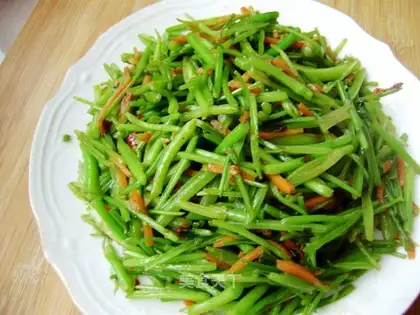 stir-fried cilantro with vegetarian vegetables