Dampness in the body can be considered the root of ten thousand illnesses. The method to remove it is very simple, requiring only two "medicines." These two can be drunk as tea or eaten as a meal, and they can solve major problems. They are Job's tears and red beans.
Job's Tears and Red Bean Congee
These two ingredients do not need to follow a specific ratio. Just grab a handful of each each time, wash them, put them in a pot with water to simmer, and what you get is a superb remedy for removing dampness and strengthening the spleen—Job's tears and red bean congee.
Job's tears and red bean congee has a benefit: it never becomes sticky or thick no matter how long you simmer it. The bottom will be the simmered, soft red beans and Job's tears, and the top will be a light-red soup. Most of the effective components of the Job's tears and red beans are in the soup. When you make the congee, use more water, and this soup will be enough to drink for half a day, perfect for drinking as tea.
As for its effects, they are truly remarkable. Job's tears, known in Traditional Chinese Medicine as "Yi Yi Ren," is listed as a superior herb in the "Shennong Ben Cao Jing." It can treat dampness impediment, benefit the intestines, reduce edema, strengthen the spleen and stomach, and long-term use can make the body light and boost Qi. Red beans, known in TCM as "Chi Xiao Dou," also have significant effects of promoting urination, reducing swelling, and strengthening the spleen and stomach. Because they are red, and red corresponds to the heart in the Five Elements theory, they can also nourish the heart. Modern people are under great mental stress, have deficient heart Qi, irregular diets, and little exercise, leading to a deficient spleen and excess dampness. To remove dampness, nourish the heart, and strengthen the spleen and stomach, nothing is better than Job's tears and red beans. Simmering them into a congee is intended to allow their active ingredients to be fully absorbed by the body without placing any burden on the spleen and stomach.
The "swelling-reducing" effect of Job's tears and red beans is also very interesting. We must not think that swelling only refers to edema. Look at people today; at least five or six out of ten are overweight. This is also a type of swelling, called a bloated physique. In TCM, whether it's obesity or edema, it means there is dampness in the body. Fluids cannot flow along with Qi and blood, stagnating between the body's cells, causing the body to swell rapidly. This is true for both edema and obesity, the only difference being the degree. Substances with strong dampness-removing properties can expel these stagnant fluids from the body, thus reducing swelling. Therefore, red beans are a must for treating edema, and practice has shown that Job's tears and red bean congee has excellent weight-loss effects. It can help with weight loss without harming the body, especially for middle-aged and elderly individuals.
Dampness is the root cause of various modern chronic and stubborn diseases, and Job's tears and red bean soup is the best remedy for it. You can simmer Job's tears and red beans into a congee to serve as the main course for dinner.
Some people add a handful of rice when making Job's tears and red bean congee, and the congee becomes thick. In fact, you must never add rice because rice grows in water and contains dampness itself. Dampness has a sticky nature, so rice becomes thick when simmered. Both Job's tears and red beans are dampness-removing and do not contain dampness themselves, so they never become thick, and the soup remains clear. TCM utilizes this clear property to remove dampness from the body. Once you add rice, it's like adding dampness, so the entire congee becomes thick. Although the taste might be better, it is not good for health. Because of that one handful of rice, all the effects of the Job's tears and red beans are wasted.
In addition to Job's tears and red bean congee, you can also learn more about the nature and flavor of various foods, draw inferences from one case to another, and make your own adjustments to create more dietary prescriptions that suit your constitution. This way, food can truly become a treasure for health preservation.
Dull complexion, lack of energy, even palpitations, drowsiness, and a feeling of emptiness in the heart: Job's tears, red beans, and longan. Irritability, insomnia, or red rashes, acne on the face: Job's tears, red beans, lily, and lotus seeds. Stomach pain due to cold, poor appetite, aversion to cold: Job's tears, red beans, and ginger. Kidney deficiency: Job's tears, red beans, and black soybeans. Athlete's foot: Job's tears, red beans, and soybeans. Cough: Job's tears, red beans, and pear. Poor appetite and weak body: Job's tears, red beans, and Chinese yam. Diarrhea, abdominal pain, diabetes: Job's tears, red beans, and pumpkin. Body weakness, premature ejaculation, spermatorrhea, excessive urination at night: Job's tears, red beans, and Euryale ferox seeds. Pregnant women: reduce Job's tears, add a small amount of Astragalus and Codonopsis root. Postpartum women: reduce Job's tears, add red dates and millet.
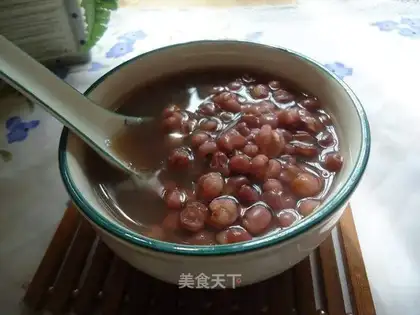 red bean glutinous rice porridge