There has always been a saying in folk culture, "Eat dumplings during the cold solar terms." In the past, people, regardless of wealth, enjoyed a plate of hot dumplings on cold days. Do you know why people eat dumplings when it's cold?
Colorful Pepper and Fresh Meat Dumplings
Now, let's talk about the TCM story behind eating dumplings during the Winter Solstice. This story starts with the sage of medicine, Zhang Zhongjing. Legend has it that he invented dumplings to treat people. He had them eat "Jiao Er" (a type of dumpling) and drink "Qu Han Tang" (cold-dispelling soup) to warm their bodies, make their ears feel warm, and even cure frostbite on their ears.
Later generations learned to make food in the shape of "Jiao Er," which came to be called "dumplings" or "Bian Shi." Eating dumplings is a way to remember the kindness of the "Sage of Medicine," Zhang Zhongjing, and his "Qu Han Jiao Er Tang." To this day, there is still a folk rhyme in Nanyang that goes, "If you don't hold a bowl of dumplings, your ears might freeze off, and no one will care."
Four Benefits of Eating Dumplings
Benefit 1. From the perspective of culinary science, steaming and boiling dumplings uses water (steam) as the cooking medium. The temperature is only around 100°C, which is enough to cook the food and sterilize it, avoiding the formation of strong carcinogens like benzopyrene that can be produced under grilling and frying conditions, thus ensuring food safety. Moreover, the nutritional content of the food is not lost due to oxidation or hydrolysis during the steaming and boiling process.
Benefit 2. From the perspective of dietary structure, the dumpling filling is wrapped in the dough skin, allowing for a suitable combination of grains with vegetables, fruits, and meats. This creates a reasonable pairing of staple and non-staple foods that is nutritious, balanced in acidity and alkalinity, and has a structure like the "Dietary Pagoda."
Benefit 3. From a nutritional perspective, dumplings are cooked by steaming and boiling with water (steam) as the heat transfer medium. This allows the polysaccharides in the food to break down fully, which is beneficial for human absorption.
Benefit 4. It suits the Chinese digestive system and eating habits. It aligns with the health principles of "moderation in diet and drink," "carefully harmonizing the five flavors," and "being in harmony with the natural order."
Which cooking method for filled foods is the healthiest?
1. "Steaming" is the best. Compared to pan-frying, it doesn't contain excessive oil. It has a low boiling point, so more nutrients can be retained. The penetrating power of steam is strong, food cooks quickly, and it reduces nutrient loss.
2. For "boiled" foods, most water-soluble vitamins will dissolve into the water. If you don't drink the soup, the nutrients are lost for nothing. There has been a folk saying since ancient times, "Drinking dumpling soup is better than a prescription." It not only replenishes the lost nutrients but also has the effect of "original soup digests original food." In this regard, wontons are a healthier way to eat. Not only do you drink the soup, but ingredients like seaweed and dried shrimp are often added, which is beneficial for calcium supplementation.
3. "Water-frying" is much healthier than oil-frying, as seen in foods like pan-fried dumplings and potstickers. A small amount of oil is used to sear the ingredients, then water is added to steam them using the generated steam. After the water evaporates, a small amount of oil remains at the bottom, crisping up the base of the dumplings. This method uses much less oil than deep-frying, resulting in a crispy bottom and a soft top, with a fragrant outside and tender inside.
Generally, filled foods with more vegetables and less meat have a high water content and can easily fall apart. Consider water-frying or steaming them. Filled foods with more meat and less vegetables are suitable for boiling or steaming. Try to avoid cooking methods like pan-frying or deep-frying to avoid adding extra fat.
Little Tips About Dumplings
1. Dumpling Skin
When making the dough, add one egg per 500 grams of flour. This not only adds nutrition but also prevents the dumplings from making the broth cloudy when boiled. Adding a little salt to the dough can increase its gluten strength and prevent the skin from breaking when cooked.
2. Dumpling Filling
When preparing the filling, chop the vegetables first, mix them with oil, and then add other ingredients. This can prevent the filling from releasing water. When mixing the meat filling, add a little water soaked with Sichuan peppercorns and star anise. This not only removes the gamey smell but also makes the meat filling fresh and tender. Before wrapping the dumplings, you can put the filling in the freezer for a short while. This will prevent it from releasing water as you wrap. For meat dumplings, you can add a little soaked tea leaves to freshen the palate, remove the gamey smell, and eliminate any unpleasant odor.
3. Boiling Dumplings
After the water comes to a boil, add a little salt and let it dissolve before adding the dumplings. This will prevent them from sticking to the pot or sticking together. Adding a little vinegar while boiling also has the same effect.
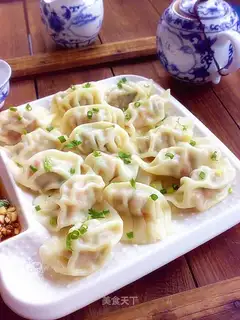 Fresh pepper dumplings