Adding a few pieces of dried tangerine peel to soup in winter not only enhances the flavor but also helps relieve stomach discomfort and treat coughing with excessive phlegm.
In Traditional Chinese Medicine, dried tangerine peel is considered to have a spicy, bitter taste and a warm nature. It is believed to warm the stomach to dispel cold, regulate qi, and strengthen the spleen. It is suitable for people with symptoms such as bloating, indigestion, poor appetite, and coughing with excessive phlegm. Modern research indicates that dried tangerine peel contains a large amount of volatile oils and hesperidin. The volatile oils it contains have a mild stimulating effect on the gastrointestinal tract. About 10 grams of dried tangerine peel is sufficient when added to soup.
Dried tangerine peel is considered warm and drying, so individuals with a yin-deficient constitution, especially those with symptoms like a dry cough with no phlegm and a dry mouth and throat, should not consume it excessively. Fresh orange peel cannot be used as a substitute for dried tangerine peel.
What are other effects and benefits of dried tangerine peel?
Benefits of Dried Tangerine Peel:
1. For symptoms such as chest and abdominal bloating. Dried tangerine peel is pungent, aromatic, and effective at regulating qi. It acts on the spleen and lungs, so it can both disperse stagnation in the lung qi and relieve qi stagnation in the middle jiao. It is used for conditions like lung qi stagnation with a sensation of fullness in the chest and diaphragm, as well as spleen and stomach qi stagnation with epigastric and abdominal bloating. It is often used in combination with medicines like Radix Aucklandiae and Fructus Aurantii Immaturus.
2. For dampness obstruction in the middle jiao, epigastric and abdominal bloating, loose stools, diarrhea, as well as excessive phlegm and coughing. Dried tangerine peel is bitter and warm, drying dampness while strengthening the spleen and moving qi. Therefore, it is often used for dampness obstruction in the middle jiao with symptoms like epigastric bloating, a dull sensation, and loose, greasy stools. It can be used in combination with Rhizoma Atractylodis and Cortex Magnoliae Officinalis. It is also good at drying dampness and transforming phlegm, making it a common key medicine for treating damp-phlegm obstructing the lungs with symptoms of excessive phlegm and coughing. It is frequently used with Pinellia Tuber and Poria.
3. For reduced appetite due to spleen deficiency, indigestion, as well as nausea and vomiting. This product dries dampness and can strengthen the spleen to whet the appetite. It is suitable for spleen and stomach weakness with reduced appetite, indigestion, and diarrhea. It is often used in combination with Ginseng, Atractylodes Macrocephala, and Poria. Because it can both strengthen the spleen and regulate qi, it is often used as an assistant in qi-tonifying formulas to prevent stagnation and distension. Furthermore, dried tangerine peel can harmonize the stomach and treat disharmony of the stomach qi leading to nausea and vomiting. For vomiting due to stomach cold, it can be used with fresh ginger; for vomiting due to stomach heat, it can be used with bamboo shavings and coptis.
Effects of Dried Tangerine Peel:
1. Effects on the digestive system: The volatile oils in dried tangerine peel have a mild stimulating effect on the gastrointestinal tract, promoting the secretion of digestive fluids and expelling gas from the intestines, demonstrating the effects of aromatic stomach strengthening and expelling wind and qi downward.
2. Effects on the cardiovascular system: Decoctions and alcohol extracts of dried tangerine peel can excite the myocardium, but excessive doses can have an inhibitory effect. Additionally, it can cause mild contraction of blood vessels, rapidly increasing blood pressure. The pectin in dried tangerine peel also has a certain preventive effect on arteriosclerosis caused by a high-fat diet.
3. Effects on the respiratory system: The volatile oils in dried tangerine peel have an irritant expectorant effect, making phlegm easier to expel. The decoction of dried tangerine peel has a weak bronchodilatory effect. Its alcohol extract has a higher anti-asthmatic potency.
4. Effects on the urinary and reproductive systems: The decoction of dried tangerine peel can cause contraction of renal blood vessels, leading to a decrease in urine output.
5. Anti-inflammatory effect: When used with Vitamin C and Vitamin K, the decoction of dried tangerine peel can enhance its anti-inflammatory effect.
How to Use Dried Tangerine Peel
Dried Tangerine Peel, Winter Melon, and Old Duck Soup
Dried Tangerine Peel, Winter Melon, and Old Duck Soup:
Ingredients: A small amount of dried tangerine peel, 500g of winter melon, 50g of Job's tears, half an old duck, a small amount of ginger, and a small amount of salt.
1. Clean the old duck, remove内脏 and tail, and cut into pieces. Soak the dried tangerine peel and Job's tears for 2 hours. Cut the winter melon (with skin) into thick chunks. Slice the ginger.
2. Place the old duck, dried tangerine peel, Job's tears, and ginger in a clay pot. Add enough water to cover. Bring to a boil over high heat, then reduce to low heat and simmer for about 1.5 hours. Season with salt before serving.Dried Tangerine Peel Ribs:
Ingredients: 10 pieces of cleaned pork ribs, each about 7cm long; 1 small piece of dried tangerine peel; 5g of salt; 3g of MSG; 4g of chicken powder; 5g of liquor; 3g of sesame oil; 1 spring onion; 1 slice of ginger; 0.1g of white pepper; 2g of sugar; 10 small sheets of aluminum foil.
Method:
(1) First, soak the dried tangerine peel in water until soft, then chop it finely. Place the ribs in a large bowl. Add the chopped dried tangerine peel along with the soaking water into the bowl. Then add salt and MSG. Mix well with your hands. Next, add liquor, chicken powder, chopped spring onion, white pepper, and ginger slices. Mix again. Marinate for 30 minutes (or refrigerate) before use.
(2) Cut each sheet of aluminum foil into a 10cm x 10cm square. Toss the marinated ribs with sesame oil. Place each rib separately on a piece of aluminum foil and fold it into a packet shape.
(3) Clean and heat a wok. Add cooking oil and heat to about 180°C. Carefully place the foil-wrapped ribs into the hot oil and fry over low heat for 8 minutes, or until cooked. Remove, drain, and arrange on a serving plate.
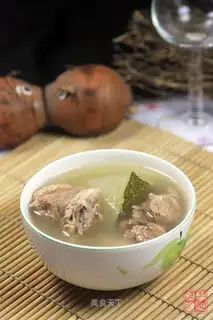 tangerine peel and white gourd and old duck soup