For home cooking, what should the oil temperature be when stir-frying? Is it true that "more oil never spoils the dish"? What are the actual effects of "smoke and fumes" on the body? These seemingly simple kitchen questions are actually closely related to the dietary safety, health, and nutrition of your family.
Salt should not be added too early when cooking meat.
The main component of salt, sodium chloride, can easily cause the proteins in the meat to coagulate, making the meat pieces shrink and become hard, and thus difficult to cook until tender.
Braised Pork with Lotus Seeds
The wok oil should not be overheated.
Frequently consuming "deep-fried foods" can easily lead to stomach ulcers, which can even turn cancerous if not treated in time.
When boiling meat or bones, avoid adding cold water.
Meat and bones contain a large amount of protein and fat. If cold water is suddenly added during boiling, the temperature of the broth will drop sharply, causing the protein and fat to solidify rapidly. The spaces in the meat and bones will also suddenly contract, preventing them from becoming tender. Moreover, the natural flavor of the meat and bones will also be affected.
Undercooked soybeans should not be eaten.
Soybeans contain a substance that interferes with the activity of trypsin in the human body. When people eat undercooked soybeans, it is difficult to digest and absorb the soy protein, and it can even cause diarrhea. However, eating soybeans that are thoroughly cooked will not cause any problems.
Monosodium glutamate (MSG) should not be added when frying eggs.
Eggs themselves contain glutamic acid, the same component as MSG. Therefore, there is no need to add MSG when frying eggs; MSG will destroy the natural umami of the eggs and is simply a waste.
MSG should not be added to acidic or alkaline foods.
When MSG is added to acidic food and then heated at high temperatures, the glutamic acid in the MSG loses water and turns into sodium pyroglutamate, which is harmless but has no umami flavor. In alkaline food, when the solution is in an alkaline condition, MSG (sodium glutamate) will convert into disodium glutamate, which also has no umami flavor.
Oil that has been used for repeated frying should not be consumed.
The thermal efficiency of oil used for repeated frying is only about one-third of that of ordinary cooking oil. Furthermore, the unsaturated fats in the oil produce various harmful polymers when heated. These substances can stunt human growth and cause an enlarged liver. In addition, the vitamins and fatty acids in this type of oil are destroyed.
Frozen meat should not be thawed at high temperatures.
When frozen meat is thawed near a stove or in boiling water, the moisture in the meat tissue cannot be quickly absorbed by the cells and will leak out. This prevents the meat from restoring its original quality. At high temperatures, the surface of the frozen pork will form a hard layer, which hinders the diffusion of heat to the inside of the meat, giving bacteria a chance to multiply, and the meat can easily spoil. Frozen meat is best thawed naturally at room temperature.
The skin of eggplants should not be removed before eating.
Vitamin P is a very useful vitamin for the human body. Among all vegetables in China, eggplants contain the highest amount of Vitamin P. The place where Vitamin P is most concentrated in eggplants is at the junction of the purple skin and the flesh. Therefore, eggplants should be eaten with the skin on, and it is not advisable to peel them.
Aluminum and iron cookware should not be used together.
Aluminum products are softer than iron ones. For example, if the wok for stir-frying is iron and the spatula is aluminum, the softer aluminum spatula will wear out quickly and mix into the food. Consuming excessive aluminum is very harmful to the body.
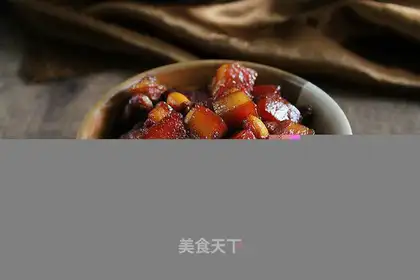 Lotus meat