From childhood, we've basically eaten fruits raw. One reason is to better absorb the nutrients in fruits, and the other is that the texture of raw fruit seems more "authentic." However, in the cold winter, eating raw, cold fruits seems to upset our stomachs. This is especially true for friends with weak gastrointestinal functions, who probably have a love-hate relationship with this. So, what can be done?
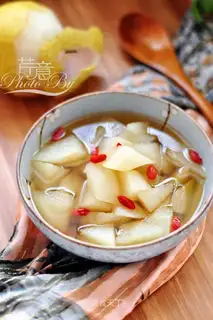
Tangerine Peel and Pear Soup
Most fruits are suitable for cooking
Wang Chengsheng, Deputy Chief Physician and Secretary-General of the Health Industry Professional Committee of the National Health Commission's Health Industry Committee, believes that there is a certain health rationale to eating boiled fruits in winter, and most common winter fruits are suitable for this. When boiling fruit, the water temperature is generally maintained at around 100°C, which does not significantly affect the nutrients in the fruit. Antioxidant substances like polyphenols can also be mostly preserved in their "original state." From this perspective, the health benefits of cooked fruits, such as moistening dryness, promoting bowel movements, and aiding digestion, are not much different from those of raw fruits.
Secretary-General Wang Chengsheng explained that in winter, the human stomach prefers warmth and dislikes cold. Drinking a hot "fruit soup" during the cold season not only helps replenish fluids but also makes it easier to obtain rich nutrients, while also avoiding the irritation of raw and cold fruits on the stomach. However, not all fruits are suitable for boiling or for boiling for too long. For example, kiwi, oranges, grapefruits, and strawberries should not be boiled for too long to prevent the destruction of their vitamin C.
The "King of Fruits" relieves coughs, resolves phlegm, and alleviates winter dryness
Professor Guo Haiying, a nutrition and dietary therapy expert from Nanjing University of Chinese Medicine, introduced that pears are known as the "King of Fruits." Because they are fresh, juicy, and have a sweet and sour taste, they are also called "natural mineral water." The glycosides and tannic acids in pears can help expel phlegm and relieve coughs, and they are also beneficial for the throat. Pears are cooling and can clear heat and calm the mind. Regular consumption can help normalize blood pressure and improve symptoms like dizziness.
Professor Guo Haiying explained that in winter, the cold climate often leads to colds, coughs, and acute bronchitis. She recommends preparing one raw pear, washing it, chopping it with the skin on, and steaming it with rock sugar. Eat it once in the morning and once at night for three consecutive days for excellent results.
In addition, due to the dry winter climate, Professor Guo also recommends a homemade "paste" for readers: pear paste. The method is as follows: prepare two kilograms of pears, chop and crush them, and squeeze out the juice (or simmer it to extract the juice). Simmer over low heat until it thickens, add an equal amount of honey, mix well, and bring to a boil. Let it cool, and it's ready. Take one spoonful at a time, dissolved in warm water. This remedy comes from "Puji Fang" (A Collection of Universal Prescriptions) and has excellent effects for nourishing yin, promoting body fluids, moisturizing dryness, and quenching thirst.
For stomach discomfort, try boiled apple soup
When winter arrives, inadequate protection from the cold can trigger diarrhea in babies, lowering their body's resistance and making them susceptible to various diseases. Director Bian Xun from the Chengdong Branch of Nanjing Children's Hospital recommends an apple soup to help parents.
The preparation is very simple: cut fresh apples into small cubes, place them in a small pot, add a small amount of boiling water, and simmer over low heat for six to seven minutes. Once the soup turns slightly yellow, pour it directly into a baby bottle to cool, and it's ready for the baby to drink. The apple soup is sweet and sour, and most children love it. A child can drink it several times a day, but the amount should be reduced if the stool is hard. Director Bian Xun reminded that this dietary remedy is only suitable for physiological diarrhea or common intestinal discomfort. It is not the first choice for treating viral or bacterial diarrhea but can be used as an auxiliary treatment.
Boiled grapefruit peel for beauty and health
Many girls like to eat grapefruit, but the thick peel is often discarded. Dr. Wang Dongxu, Director of the Department of Traditional Chinese Medicine at Nanjing Integrated Traditional Chinese and Western Medicine Hospital, introduced that grapefruit peel is actually a treasure. It can not only be used as an air freshener in the home but can also be eaten, offering excellent therapeutic effects. Because grapefruit peel contains flavonoids such as naringin and rutin, it has antioxidant effects, can reduce blood viscosity, decrease thrombus formation, and is effective in preventing cerebrovascular diseases like cerebral thrombosis and stroke. It is especially suitable for middle-aged and elderly people. Additionally, the rich pectin in grapefruit peel has beauty and skin-nourishing effects.
Director Wang explained that there are many ways to eat grapefruit peel. To avoid its bitter taste, the green-yellow outer skin must first be removed, and the middle soft white spongy part should be sliced and boiled in boiling water for 10 minutes. Then, it can be boiled with honey to make a tea. This tea has functions like aiding digestion, resolving phlegm, sobering up, and beautifying the skin. Regular consumption has a辅助 therapeutic effect on high blood pressure, arteriosclerosis, and obesity.
 Pear soup