In recent years, fern shoots, known as "longevity vegetables," have been all the rage. Legend has it that they are not only "safe" and "unpolluted" but also rich in various nutrients and even have "anti-cancer" properties. However, rumors that ferns can cause cancer have been widely circulating online recently. What is the truth of the matter?
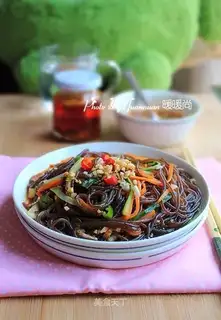
Cold Fern Root Noodles
Studies suggest ferns may cause cancer
Fern (fern shoots are its young fronds) is one of the most widely distributed plants in the world. In many places, its young fronds are eaten as a vegetable, and starch is extracted from its roots. Over a hundred years ago, people noticed that this plant could cause poisoning in cattle. Cattle that ate large amounts of fern would die in as little as a few weeks. Those that ate less would gradually lose bone marrow function, leading to symptoms such as leukopenia, thrombocytopenia, and acute hemorrhage. Sheep that ate ferns would gradually go blind. Numerous studies using various animals like rats have confirmed that fern can indeed cause cancer in animals.
Science has confirmed that "ptaquiloside" in ferns may be the main culprit for the aforementioned symptoms. Biochemical experiments have found that ptaquiloside can react with amino acids and also damage genetic material DNA. In the 1970s, a survey was conducted in the mountainous regions of central Japan on the relationship between eating ferns and esophageal cancer. It was found that among the local residents, eating ferns increased the incidence of esophageal cancer in men by 2.1 times and in women by 3.7 times. In the region of North Wales, UK, the incidence of stomach cancer has always been high. A study conducted in 1990 also showed that eating ferns in childhood increases the risk of developing stomach cancer later in life. Similar studies have been conducted in other parts of the world, and the results have been largely consistent.
Ptaquiloside is present in all parts of the fern, and the content is even higher in the young, edible parts—fern shoots. However, fresh fern shoots are bitter and astringent. Except for a few individuals who relentlessly pursue the "original flavor" and "all-natural" approach, people usually process fresh fern shoots with methods like using plant ash, lye, or blanching before eating. This process greatly reduces the content of ptaquiloside. However, this treatment only reduces, but does not completely eliminate, it.
How to choose fern root noodles?
You can generally buy fern root noodles in most supermarkets. They come in both thin, vermicelli-like shapes and wider, noodle-like shapes. When you open the package, it will have a medicinal smell. The price is slightly higher than that of white vermicelli. The best quality varieties are those produced in places like Guangxi and Sichuan. You can buy a large quantity at home during the summer. For each meal, use one small bag (commonly around 100 grams). The specific method of preparation is: pour an appropriate amount of fern root noodles into boiling water and cook for about 5 minutes (making sure there is no hard core), then remove and rinse with cold water, just like with vermicelli. Then, you can flexibly change the preparation according to your family's preferences, such as cucumber shreds with fern root noodles, sour and spicy fern root noodles, or chicken shreds with fern root noodles.
3 major tips for making fern root noodles
1. Blanch until there is no hard core, then rinse with cold water (this makes them chewy), and drain the water.
2. Slice red chili peppers, and slice pickled wild peppers (available in supermarkets). Crush and mince garlic. Put the garlic into vinegar, add a little soy sauce (recommend Liu Yue Xian), an appropriate amount of salt, a small spoonful of sugar, and some of the pickled pepper brine. Mix well to make a seasoning sauce, then add the sliced chili peppers and minced garlic to the sauce and stir.
3. Pour the seasoning sauce from step 2 into the fern root noodles from step 1 and mix well.
 Frozen root powder