Health-conscious Chinese people have always held the health benefits of honey in high regard. What are the benefits of honey? How can you tell the difference between real and fake honey? This article answers all your questions about honey, tells you about the best nutritional partners for honey, and teaches you how to create the most versatile "natural drink".
Honey is rich in nutrients
(1) Carbohydrates. The sugars in honey are mainly monosaccharides (glucose and fructose), with a small amount of other sugars like maltose. The total sugar content accounts for over 95% of the dry matter in honey. Compared to regular sucrose, the monosaccharides in honey have clear advantages. Pure sucrose is high in energy, while the glucose and fructose in honey can be directly absorbed and utilized by the human intestinal wall cells, making them more suitable for the elderly, children, and women.
(2) Vitamins. Honey contains a variety of vitamins, with the highest content being B vitamins, at 300-400μg/100g. The contents of VB1, VB2, VB5, and VB6 are respectively: 2.1~9.1μg/100g, 35.0~145.0μg/100g, 25.0~190.0μg/100g, and 227.0~480.0μg/100g.
(3) Acids. Honey is rich in a variety of acids, which contribute to its high acidity; the normal acidity of honey is below 3, and does not exceed 4. The presence of acids plays a significant role in adjusting the taste and flavor of honey. The acids in honey are divided into inorganic and organic acids. Inorganic acids mainly include boric acid, phosphoric acid, hydrochloric acid, and carbonic acid. Organic acids mainly include acetic acid, butyric acid, formic acid, gluconic acid, citric acid, malic acid, and amino acids. Honey contains 17 amino acids, mainly arginine, histidine, and threonine, with an amino acid content of 0.1%~0.78%.
(4) Minerals. Honey contains a variety of minerals, but in low amounts. These include potassium, which is beneficial to the body; calcium, which strengthens bones; phosphorus, which is good for the brain; magnesium, which has a sedative effect; and iron and copper, which help with blood nourishment.
(5) Enzymes. Honey contains various enzymes such as sucrase, reductase, amylase, phosphatase, and glucose oxidase, which are added by bees during the honey-making process. These enzymes give honey some special physiological functions. Among them, Superoxide Dismutase (SOD) is a metal ion-rich, biologically active protein that acts as an oxygen free radical scavenger and has an anti-aging function.
Honey and Pear Juice
What are the benefits of honey
Moisten the lungs: Honey has anti-inflammatory, expectorant, lung-moistening, and cough-relieving effects, with loquat honey being the most effective for coughs. How to use: Take one snow pear, slice it thinly, and mix with honey. Consume several times a day.
Sober up: Honey contains a fructose not found in most fruits, which can promote the decomposition and absorption of alcohol, thus helping to sober up quickly and relieve hangovers. How to use: Eat 50 grams of honey or a few pieces of honey-coated biscuits or bread before drinking, and drink honey water after drinking.
Calm excited nerves: The glucose, vitamins, magnesium, phosphorus, and calcium in honey can regulate the nervous system, relieve nervous tension, and promote sleep. Moreover, honey does not have the side effects of other medications, such as suppression, fatigue, or distraction. Apple honey has the most prominent calming effect. How to use: Take one spoonful of honey before bed each night.
Treat occasional wounds: The acidity of honey, after removing its sugar content, is similar to vinegar, which prevents bacteria from surviving in the wound. Even without bacteria, it can greatly reduce swelling and pain, remove dead tissue, and speed up wound healing. How to use: Wash the wound with a 10%-15% honey solution, and apply and bandage with pure honey.
Honey is better when paired with another ingredient
Honey + Pear – Moistens the lungs and relieves dryness
Pears are fresh, sweet, juicy, and rich in vitamins A, B, C, D, and E. They are commonly used to moisten the lungs, and the effect is even better when paired with honey.
Use one pear, wash it, cut it into pieces, cook it in a pot until it becomes juice, then add two spoonfuls of honey. Drink once in the morning and once in the evening to moisten the lungs and relieve dryness.
Honey + Chrysanthemum – Brightens eyes and nourishes the liver and kidneys
Chrysanthemum is a herbaceous plant and a common traditional Chinese medicine. Ancient Chinese medical texts describe it as sweet in taste and slightly cold in nature. Soaking it in water to drink is said to brighten the eyes and nourish the liver and kidneys, and its effects are doubled when consumed with honey.
Prepare 3 grams of chrysanthemum, place it in a cup with boiling water, and steep for about ten minutes. After the water cools, add two spoonfuls of honey and drink. This drink has the effect of brightening the eyes and nourishing the liver and kidneys.
Honey + Banana – Relieves constipation
Bananas are fragrant and rich in various trace elements and vitamins, such as calcium, phosphorus, iron, carotene, niacin, vitamin C, and vitamin E. Regular consumption can relieve fatigue, prevent high blood pressure, and relieve constipation. When paired with honey, its effect on relieving constipation is doubled.
Use 200 grams of banana, cut it into pieces, heat it in a pot with a small amount of water, then add an appropriate amount of honey. After it cools, eating it can help relieve constipation.
Honey and Pomelo Tea
How to distinguish real from fake honey
1. Smell
Monofloral honey has a unique floral scent from its source plant, while polyfloral honey has a natural mixed floral aroma. Fake honey may smell like sucrose or artificial flavorings.
2. Observe
1. Check the viscosity: Insert a chopstick vertically into the honey and lift it up. High-quality, thick honey will drip slowly and can be drawn into long, viscous threads. Fake or low-quality honey, even if it can be drawn into a thread, will break without elasticity and will not retract into a droplet.
2. Drop a small amount of honey on a piece of paper. High-quality, pure honey will form a semicircle and not easily soak through the paper. Low-quality or fake honey will soak through the paper easily.
3. Add a small amount of honey to a glass of water. Real honey will sink to the bottom and dissolve slowly. When stirred slowly with a chopstick, it will show a stringy, viscous texture. Fake honey will dissolve quickly in the water.
4. Check for crystallization: The crystallization of honey depends on the plant source and temperature. Generally, pure natural honey crystallizes easily at 13-14°C. Honey that crystallizes completely usually has low moisture content and high concentration, making it less likely to spoil and therefore considered high-quality. Pure crystallized honey feels fine and smooth when rubbed between the fingers, with no grainy texture. Fake honey either does not crystallize easily, or only partially crystallizes with hard sediment that is difficult to crush.
3. Taste
Pure, natural honey has a sweet, mellow taste with a slight sourness, a soft and delicate texture, and a refreshing aftertaste with a slight tingling sensation in the throat and a long, fresh finish. Adulterated honey may be sweet, but it often has a sugary or artificial flavoring taste, a weak throat sensation, and a short, bland aftertaste.
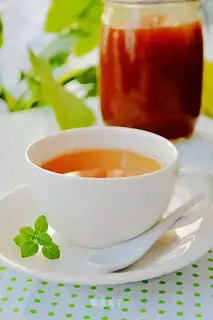 Honey tea
 Cheese and potatoes