As a "new favorite" in healthy eating, many people find okra's taste a bit strange. In fact, you just haven't mastered the right way to eat it!
Nutritional Value and Health Benefits of Okra
1. The tender pods of okra contain a viscous mucilage, arabans, galactans, rhamnans, and proteins. Regular consumption helps with digestion, boosts energy, protects the liver, and promotes gastrointestinal health.
2. Okra is rich in various nutrients such as iron, calcium, and carbohydrates, and has the effect of preventing anemia.
3. It contains vitamin A and beta-carotene, which are beneficial for retinal health and maintaining good eyesight.
4. It is rich in trace elements like zinc and selenium, which can enhance the body's ability to prevent and fight cancer.
5. It also contains abundant vitamin C and soluble fiber, which not only has a health-protecting effect on the skin but can also whiten and refine it.
6. The calcium content in okra is also very rich. And because its oxalic acid content is low, its absorption and utilization rate is higher than that of milk, making it an excellent source of calcium for vegetarians and growing children.
7. The mucoprotein in okra has the effect of inhibiting sugar absorption, so in recent years, it has also been used as a folk remedy for treating diabetes.
8. Okra also contains special medicinal ingredients that can strengthen the kidneys and tonify deficiency, and has a辅助 therapeutic effect on male organic diseases, earning it the reputation of "plant Viagra".
How to Select Okra
1. Look at the length: Compare it to your middle finger. The smaller the okra, the more tender it is. It is generally harvested 3-5 days after the flowers wither. Delayed harvesting increases coarse fiber and reduces its edible value. A length of 5-10 cm is best (a person's middle finger is generally about 8 cm, which can be used as a reference). Longer okra is only suitable for seed saving or as feed.
2. Squeeze for firmness: Gently squeeze it with your hand; it's best if it's not hard and has a bit of resilience. The harder the okra, the older it is. The seeds inside have become hard and the flesh fiber is excessive, making it completely lack the unique aroma and tender texture.
3. Check the surface: It should be smooth and wrinkle-free, without spots or bruises. The color should be uniform and bright. Green okra is best when it's naturally fresh green or with a touch of pale yellow. Shriveled or faded okra is not fresh. Dark and dry color means it's old. The surface of okra has a fine layer of fluff, which is a sign of freshness. If the fine hairs on each ridge are intact, it means it hasn't been squeezed.
4. Smell for a fresh aroma: Fresh okra has a natural fragrance, similar to the smell of fresh grass after rain. Old and stale okra lacks this fresh aroma.
5. Break with a fingernail: This method works for all kinds of melons and fruits—a gentle scratch with a nail that breaks and releases juice means it's the freshest.
Side Effects of Okra
1. Okra contains calcium oxalate, so people with kidney stones and high uric acid are advised not to eat it.
2. The surface of okra has some fine fluff, which can damage the stomach and intestines if eaten raw, so it is not recommended to eat it raw.
3. Okra has a cool nature, so it is not suitable for people with diarrhea.
Several Recommended Ways to Eat Okra
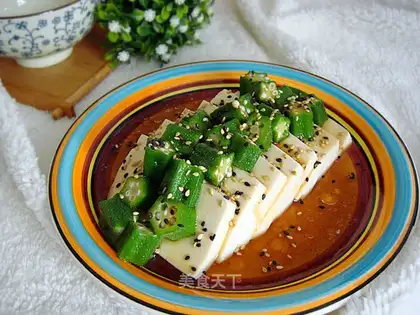
Okra with Tofu
1. Scallion-flavored Okra
Main ingredients: 350g okra
Seasonings: 20g green onion, 8g light soy sauce
Preparation method:
1) Wash the okra, blanch in boiling water until cooked, then remove;
2) Rinse the okra in cold water, remove, and cut into pieces;
3) Wash the green onion and cut into flowers for later use;
4) Place the okra pieces in a plate, sprinkle with chopped scallions, drizzle with light soy sauce, and mix well.
Cuisine and benefits: Home-style recipes, Anti-cancer recipes, Teen recipes, Athlete recipes, Gastritis recipes
2. Tofu with Okra
Main ingredients: 300g okra, 1 block of tofu
Seasonings: 1 spoon salt, 1/2 spoon vegetarian seasoning powder
Preparation method:
1) Blanch the okra until cooked, drain, and cut into star shapes.
2) Grind the tofu and seasonings in a mortar until smooth, then mix in the okra and combine well.
Cuisine and benefits: Refreshing cold salad
3. Italian Vegetable Salad
Ingredients: Lettuce (as needed), Onion (as needed), 5 black olives, 2 okra, 1 baby corn, Cucumber (as needed), Almond slices (as needed), Croutons (as needed), Tomato (as needed), 3 tablespoons Balsamic Vinaigrette dressing (it is recommended to use egg-free salad dressing).
1) Wash and prepare all the vegetables separately.
2) Place the lettuce in a transparent bowl, then arrange the other ingredients in order. Finally, place the black olives and croutons on top. Drizzle with balsamic vinaigrette and sprinkle with almond slices to complete.
3) The ingredients in the dressing must be finely chopped.
 Autumn tofu