As we all know, staple foods account for 55%-65% of the total energy in our diet. This rule, established by our ancestors throughout history, is based on sound reasoning. However, many beauty-conscious girls skip staple foods to lose weight. Is this approach right or wrong? In fact, staple foods are very important for us. To lose weight, it's best to eat staple foods reasonably. Let's learn more about it below.
Five-Grain Congee
The Role of Staple Foods
The role of staple foods is multifaceted: 1. To supply and store energy to maintain various human activities and behaviors. 2. To form tissues and important life substances, participating in cell composition and various activities. For example, every cell contains carbohydrates. 3. To spare protein. 4. To have an anti-ketogenic effect. The breakdown of fat for energy requires the participation of carbohydrates. 5. To detoxify. Glucuronic acid is an important detoxifying agent that can combine with various harmful toxins in the liver. 6. To enhance intestinal function. Different types of staple foods elicit different reactions.
Is It Advisable to Skip Staple Foods?
Let's talk about skipping staple foods from the perspective of weight loss. The reason people get fatter is an excess of total energy, leading to fat accumulation. Some people fall into the misconception that since staple foods provide the most energy, they are the biggest enemy of weight loss, so they completely eliminate them. But have they considered the dangers of not eating staple foods? For instance, when you don't eat staple foods, your body first burns fat for energy. However, the process of converting fat into energy requires the carbohydrates found in staple foods. Without carbohydrates, fat cannot be completely burned, leading to the production of ketones, which can cause ketonemia and ketonuria, manifesting as a rotten apple-like smell in the mouth.
Once the fat is depleted, does the body start using protein for energy? Protein is a vital substance that makes up our entire body; no part of us is without it. Therefore, using protein for energy is like burning high-quality wood as firewood. This can lead to, for example, the loss of collagen, sagging skin, and the appearance of wrinkles. Therefore, for beauty-conscious women, true beauty lies not only in a good figure but also in a healthy and beautiful complexion. People are eating more and more refined and whitened staple foods, which are absorbed quickly and lead to faster weight gain. So, how should we eat staple foods? First, let's look at the digestion and absorption mechanism below.
Digestion and Absorption Mechanism
The main component of staple foods (carbohydrates) provides the majority of the body's energy. Carbohydrates are classified into monosaccharides, disaccharides, sugar alcohols, oligosaccharides, and polysaccharides. They are all eventually broken down into monosaccharides for absorption and utilization. Due to their different molecular structures, their digestion speeds and absorption sites vary. For example, monosaccharides (like glucose, fructose, and galactose) are digested directly and absorbed in the upper small intestine. Polysaccharides, especially non-starch polysaccharides (dietary fiber), stay in the stomach for a long time and are often not fully digested in the small intestine. They are further digested by fermentation in the large intestine, with a portion being absorbed and another portion stimulating intestinal peristalsis to be excreted in feces. Therefore, the structure of the staple food determines whether it provides a lot of energy.
How to Eat Staple Foods Reasonably
1. Ensure the intake of staple foods. The dangers of not eating staple foods have been emphasized multiple times, so their intake is essential.
2. Choose coarse grains over refined ones. The structure of a grain includes the hull, bran, aleurone layer, endosperm, and germ. Refined rice removes the hull, bran, and germ, leaving only the endosperm. The endosperm contains few beneficial nutrients like minerals, vitamins, protein, and dietary fiber, but is rich in starch. Starch is a carbohydrate that is digested, absorbed, and utilized very quickly, thus converting to energy rapidly. Coarse grains, however, have the outer layer removed, retaining many beneficial nutrients like dietary fiber, B vitamins, minerals, and antioxidant substances like vitamin E. Eating coarse grains not only provides antioxidants but is even more beneficial for those who are overweight, as B vitamins are inseparable from energy metabolism. Coupled with dietary fiber's role in promoting bowel movements and reducing absorption, it is a very powerful tool. Examples of coarse grains include oats, millet, sorghum, purple rice, wheat bran, and buckwheat.
3. Substitute part of your staple foods with miscellaneous grains. Miscellaneous grains refer to mixed beans such as mung beans, red beans, black-eyed peas, kidney beans, scarlet runner beans, and peas. They can be used in dishes like two-rice rice or congee as a staple food.
4. Replace staple foods with tubers. Many older generations, including myself when I was young, don't consider tubers as staple foods. For example, we often had rice as the staple food with shredded potatoes as a side dish. Recently, I told an overweight aunt that eating tubers as a staple food could help with weight loss. She replied, "You're wrong. I grew up eating sweet potatoes, and look how fat I am!" I asked, "Auntie, did you eat sweet potatoes as your staple food?" She said, "No." I asked why. The reason is that tubers can replace staple foods, but they are not classified as such because their nutritional profile is similar to vegetables. They are low in fat and rich in vitamins, minerals, and dietary fiber. However, they are also rich in carbohydrates, so they can be eaten as a staple food. Their biggest advantage is their low fat content, which is very beneficial for weight loss. Plus, with their various trace elements, they are even better. Common tubers include sweet potatoes, potatoes, yams, and taro.
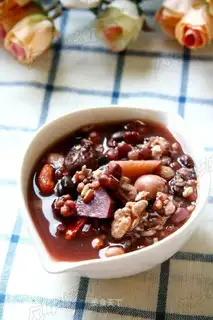 Five grains of porridge