The invasion of dampness can lead to symptoms such as loss of appetite. If not removed in time, it has a significant impact on both physical and mental health. The primary method for removing dampness is dietary therapy, and many foods in daily life have the effect of removing dampness. So, can Job's tears remove dampness?
Can Job's tears remove dampness?
Job's tears enter the spleen and can strengthen the spleen to remove dampness. According to their nature and flavor in traditional Chinese medicine, dampness-removing herbs are either pungent, aromatic, warm, and drying, or sweet, bland, and渗利 (diuretic and dampness-draining). Pungent, aromatic, warm, and drying herbs, like dried tangerine peel, can dry dampness and transform phlegm, which is like using a torch to evaporate water. This has both pros and cons: the advantage is that dampness is removed quickly, but the disadvantage is that if the "fire" is too strong, it could easily burn the pot dry.
Job's tears, on the other hand, have a sweet and bland flavor, and their function is to渗利 (diuretic and dampness-draining), like clearing a waterway to drain water away. They are generally considered to be cool in nature. Fruits, seeds, and heavy substances in Chinese medicine are often descending herbs, and descending action allows for渗利. Job's tears are cool and descending, making them a common diuretic and dampness-draining herb. As stated in "Ben Cao Zheng": "Job's tears, with a sweet and bland flavor, a slightly cool nature, and a slightly descending and渗利 quality, can therefore remove dampness and promote urination." Compared to drying dampness, the characteristics of Job's tears are渗利 and safety. Most importantly, the manifestations of dampness pathogens vary, and the methods to address them are not all the same, but Job's tears are more widely used for removing dampness.
Quail Egg and Fig Sugar Water
The best way for Job's tears to remove dampness is to use toasted Job's tears to make tea or to boil them in soup.
To toast Job's tears, take clean Job's tears and stir-fry them over a low flame until they turn slightly yellow and puffed up, then remove them, let them cool, and they should have slight scorch marks and a subtle fragrance. Another method in Chinese herbal processing is to stir-fry the herb with wheat bran, which is known as bran-toasted Job's tears. Heat the wok, first scatter in the wheat bran, using one-tenth the amount of Job's tears. When it starts to smoke, add the clean Job's tears and stir-fry until the surface is yellow and puffed up, then remove, sieve off the bran, and let it cool; it will have a slight aroma. A brief explanation of this aroma: depending on the degree of toasting in Chinese herbal medicine, it is generally divided into yellowing, charring, and carbonizing. Yellowing refers to stir-frying over a low flame until the herb emits its inherent aroma, or until it puffs up and bursts. Yellowing can moderate the extreme properties of the herb, and the released aroma also has the effect of regulating qi and relieving depression.
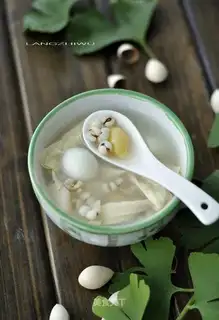 Quail protein sugar