Dried tangerine peel is the dried mature peel of the fruit of the Rutaceae plant Citrus reticulata and its cultivated varieties. It is mainly produced in Guangdong, Fujian, Sichuan, Zhejiang, Jiangxi and other places, with the most authentic variety being the Guang Chenpi from Xinhui, Guangdong. Guang Chenpi mainly comes from the varieties of Citrus reticulata 'Chachigan' and 'Sihui Gan', and is the product of dried orange peel. Because it gets better with longer storage time and its medicinal effects and functions become more potent, it is called "Chenpi" (old peel).
Honey Tangerine Peel Tea
As a medicinal material, dried tangerine peel has a long history, first recorded in the "Shennong Ben Cao Jing" (The Divine Farmer's Materia Medica Classic). It has a fragrant aroma, a pungent and slightly bitter taste, and functions to regulate qi, strengthen the spleen, dry dampness, and transform phlegm. The "Ben Cao Gang Mu" (Compendium of Materia Medica) states: "It treats vomiting, retching, nausea, regurgitation, a sensation of epigastric fullness and emptiness, occasional spitting of clear water, phlegm stagnation, cough, malaria, constipation, and mastitis in women. When used as a food ingredient, it detoxifies fishy odors." "Its treatment of various diseases is always based on its function of regulating qi and drying dampness. When used with tonifying herbs, it tonifies; with purgative herbs, it purges; with ascending herbs, it ascends; with descending herbs, it descends." Dried tangerine peel is pungent, dispersing, warm, and unblocking, with a fragrant aroma. It excels at regulating qi and can enter the Spleen and Lung meridians. It can both disperse Lung qi stagnation and strengthen the spleen to relax the middle jiao. It is used for symptoms such as Lung qi stagnation, chest and diaphragm fullness, and Spleen and Stomach qi stagnation with epigastric and abdominal distension, often combined with Mu Xiang (Aucklandia lappa) and Zhi Qiao (immature bitter orange). Dried tangerine peel is bitter and warm in nature, used to dry dampness and is often used for dampness obstruction in the middle jiao, epigastric and abdominal bloating and fullness, loose stools, and a greasy tongue coating. It can be combined with Cang Zhu (Atractylodes lancea) and Hou Po (Magnolia officinalis), as in the formula Ping Wei San. For damp-phlegm obstructing the lungs with excessive phlegm and cough, it is often used with Ban Xia (Pinellia ternata) and Fu Ling (Poria cocos), as in the formula Er Chen Tang. For Spleen and Stomach weakness, reduced appetite, indigestion, and diarrhea, it is often combined with Ren Shen (Ginseng), Bai Zhu (Atractylodes macrocephala), and Fu Ling (Poria cocos), as in the formula Liu Jun Zi Tang. Because it can both strengthen the spleen and regulate qi, it is often used as an assistant or envoy in qi-tonifying formulas, preventing stagnation and allowing the tonification to work without causing distension.
However, everyone should note that it is not recommended to drink water infused with fresh orange peel. Because of improvements in cultivation and preservation techniques in recent years, after picking oranges, growers mostly soak them in preservatives before they go to market. Preservatives are a type of chemical agent. While the soaked orange has no effect on the pulp, the preservatives remaining on the peel are difficult to wash off with plain water. If you use such orange peel to make tea, the damage to your health is obvious. Even if you use fresh orange peel that has not been soaked in preservatives to make tea, it will not exert its proper therapeutic effects.
The reason why orange peel is called "Chenpi" (old peel) in Chinese medicine is that it generally needs to be stored for a year before it can be used. Tao Hongjing, a famous physician of the Northern and Southern Dynasties, proposed: "Old tangerine peel is the best." Research has shown that the water decoction of dried tangerine peel contains components similar to adrenaline, but these components are stable and are not destroyed by boiling. After several years, the content of its volatile oil is greatly reduced, while the content of flavonoids is relatively increased. Only then can the medicinal value of dried tangerine peel be fully realized.
Orange pith, another treasure of the orange. It is the fibrous network inside the peel. The "Ben Chao Chong Yuan" (Original Text of the Materia Medica) states, "The fibrous membrane on the orange pulp is very effective in treating thirst and vomiting from alcohol. Drinking it as a decoction is highly effective because it can move the fluid in the chest and let it flow to the skin." Orange pith is neutral in nature, sweet and bitter in taste, and enters the Liver and Spleen meridians. Its most important medicinal function is to regulate qi and transform phlegm. It can usually be used for treating various diseases such as qi stagnation in the meridians, lingering cough, and coughing up blood with phlegm. Orange pith can invigorate blood, soften blood vessels, accelerate blood flow, and reduce cholesterol production. Regular consumption can prevent coronary heart disease and cardiac ischemia. Orange pith is a natural anti-cancer substance. It contains a substance called rutin, which, after entering the human body, can increase cell activity, reduce damage from viruses to cells, and thus inhibit the generation of cancer cells. Regular consumption can have a good preventive and anti-cancer effect. Therefore, when eating oranges, do not remove the veins on the orange segments too thoroughly.
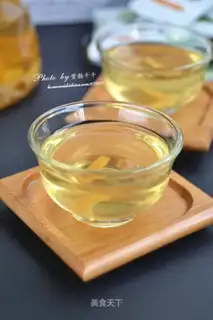 Honey tea