Introduction: Mulberry leaf has the effects of clearing lung heat, improving eyesight, and promoting the production of body fluids, while cogon grass root can clear heat, nourish yin, and promote urination. The two work together synergistically and are very effective for dry-type colds such as the flu. Rock sugar can be added to improve the taste without making it unpleasant.
Colds are prevalent in spring, and even those who appear to be in good health are getting sick. Are there any dietary remedies to help recover from a cold faster? Let's see what the experts recommend.
Porridge and noodles are easy to digest
Dr. Hu Bo, Associate Chief Physician of the Internal Medicine Department, Bayi Children's Hospital, Beijing Military Command General Hospital: Parents always get anxious when their children frequently catch colds. Besides coming to the hospital for injections and medicine, they always ask, "What should my child eat when they have a cold?" In fact, I have always advocated that children should not be spoiled. A common cold is not a big deal and doesn't require any major supplements. However, since the body is weaker during a cold, you should generally pay attention to three dietary points: easy to digest, non-irritating, and rich in Vitamin C.
Egg Noodles
Based on these points, I recommend that the staple food during a cold should be mainly porridge and noodles. Both are easy to digest and won't burden the digestive system. You can alternate between them for variety. Spicy and greasy foods can irritate the digestive tract and should be avoided. Additionally, to supplement Vitamin C from your diet to boost your immune system, you can eat some green vegetables. It's best to stir-fry them quickly; do not cook them in the porridge, as that will destroy all the Vitamin C.
Freshly squeezed orange juice is high in Vitamin C
Gao Jian, Director of the Nutrition Department, Zhongshan Hospital Affiliated with Fudan University, Shanghai: The spring climate is variable, and various pathogens can spread easily, leading to more colds. What should you drink after catching a cold?
My first recommendation is to drink plenty of water, plain boiled water is sufficient. Of course, drinking some fruit juice to supplement Vitamin C can also be beneficial for recovery. By juice, I mean freshly squeezed juice, not bottled drinks from the supermarket (which have low juice concentration and high sugar content).
Freshly Squeezed Orange Juice
Among fruits, oranges are high in Vitamin C and relatively easy to juice. Making your own fresh juice is the healthiest option. When juicing, remove the seeds. Drinking the pulp along with the juice can increase dietary fiber to aid digestion and slow down absorption to prevent a rapid spike in blood sugar. Besides oranges, I also recommend kiwis, which can be added to the juice for flavor.
Mulberry leaf and cogon grass are good for reducing dryness
Wang Dongxu, Director of the Traditional Chinese Medicine Department, Nanjing Integrated Traditional Chinese and Western Medicine Hospital: The colds during this period are generally caused by influenza viruses. The flu is often accompanied by high fever, which, in terms of Traditional Chinese Medicine, is classified as a wind-heat cold, characterized by damage to yin fluids, thus requiring the nourishment of yin and the reduction of dryness.
Kiwi and Soy Milk Smoothie
For this type of cold, I generally recommend drinking a tea made by boiling 15 grams of mulberry leaf and 18 grams of cogon grass root in water. This not only helps counteract the damage to fluids from heat-related illnesses but also eliminates residual heat. You might as well buy some from a Chinese herbal pharmacy to use at home.
Mulberry leaf has the effects of clearing lung heat, improving eyesight, and promoting the production of body fluids, while cogon grass root can clear heat, nourish yin, and promote urination. The two work together synergistically and are very effective for dry-type colds such as the flu. Rock sugar can be added to improve the taste without making it unpleasant.
Furthermore, this herbal tea is not limited to wind-heat colds; it is also suitable for springtime heatiness and symptoms like nosebleeds.
Mulberry Leaf and Pork Rib Soup
 egg noodles
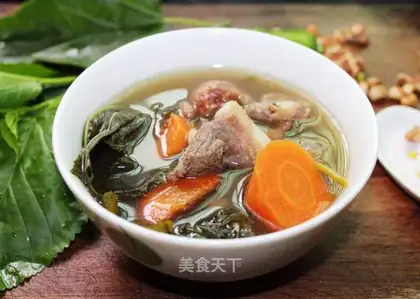 Salvatore bone soup
 Fresh orange juice
 Monkey Peaches shake