Winter is indeed a good season for nourishment. Since ancient times, people have always regarded bear's paw as a delicacy from the mountains and sea cucumber as a delicacy from the sea, while pig's trotters are considered nothing more than a very common dish. This is a very mistaken belief and prejudice. Pig's trotters are not only a delicious delicacy but also a "panacea" for prolonging life.
Braised Pig's Trotters
In folk tradition, eating pig's trotters in winter has always been considered an excellent food remedy for nourishing qi and blood, and this is indeed scientifically sound. Traditional Chinese Medicine (TCM) believes that as people get older, phenomena such as kidney essence deficiency, soreness in the lower back and legs, a hunched back, and an unsteady gait can easily occur. At this time, consuming pig's trotters can replenish kidney essence, strengthen the waist and legs, and make the feet more powerful. Pig's trotters are nutritious. According to measurements, every 100 grams of pig trotters contains 15.8 grams of protein, 26.3 grams of fat, and 1.7 grams of carbohydrates. In addition, pig's trotters also contain a certain amount of nutrients such as calcium, phosphorus, iron, vitamin A, vitamin B, and vitamin C. Notably, the content of 11 amino acids, such as cysteine and arginine, produced from the hydrolysis of protein in pig's trotters, is comparable to that in bear's paw.
TCM believes that pig's trotters are sweet and salty in taste, and neutral in nature. They have functions such as nourishing the blood, promoting lactation, moisturizing the skin, and replenishing kidney essence. At the same time, pig's trotters are rich in large-molecule collagen protein. After people eat pig's trotters, their bodies can absorb a large amount of collagen protein, which has a certain effect on improving the physiological functions of various organs and resisting aging. Furthermore, after the collagen protein in pig's trotters is absorbed by the human body, it can promote the skin's absorption and storage of water, prevent dryness and wrinkling of the skin, and make facial skin appear full and lustrous.
Frequent consumption of pig's trotters can also effectively prevent nutritional disorders, has a certain therapeutic effect on gastrointestinal bleeding and hemorrhagic shock, and can improve the body's microcirculation, thereby preventing or alleviating coronary heart disease and ischemic brain diseases. Some medical scientists have also found that pig's trotters have a significant effect on treating neurasthenia.
Pig's trotters are delicious. If stewed with peanuts, soybeans, daylilies, etc., they are more nutritious and have a better nourishing effect on the body when consumed regularly. There is a folk saying, "Eating pig's trotters in winter is as good as eating bear's paw." Therefore, eating pig's trotters in winter not only satisfies the palate but also strengthens the body and treats illnesses, which can be described as killing two birds with one stone.
A friendly reminder: everything in moderation. As the digestive function of the elderly weakens and pig's trotters are high in fat, it is best not to eat too much at a time to avoid indigestion. Elderly people with chronic hepatitis, cholecystitis, or gallstones should avoid eating pig's trotters, as it may aggravate their condition or trigger a relapse of old illnesses. Also, do not eat pig's trotters before bedtime to avoid increasing blood viscosity.
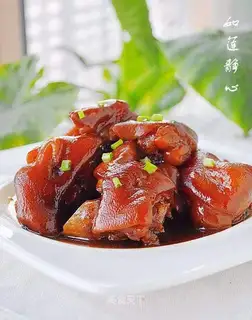 Red burning pig hoof