Broad bean is an ancient food, native to Africa, the Mediterranean coast, and Southwest Asia, but it has been cultivated in various parts of the world for centuries and is also a staple food on the tables of many countries. A food that can help control high blood pressure.
Broad bean is a cold-hardy annual herbaceous plant with large pods that can grow up to 12 feet (30 cm) tall. Typically, broad beans are shelled for cooking; young broad beans taste better than old ones, but Italians also eat fresh, tender pods when the beans are young and the mature beans themselves when they are ripe.
Garlic Sautéed Young Broad Beans
Broad beans are rich in nutrients. One cup of raw broad beans provides 47% of the daily value for folate, 42% for manganese, and 20% for protein. Additionally, broad beans are rich in vitamins A and C, fiber, niacin, riboflavin, thiamine, iron, potassium, copper, and manganese. They are also high in plant sterols, which can lower cholesterol levels in the blood.
Due to their rich content of folate, fiber, potassium, and vitamins A and C, broad beans have the ability to prevent cardiovascular and cerebrovascular diseases. An article published in the British Journal of Nutrition showed that broad beans have a cholesterol-lowering effect, and the review noted that broad beans in the daily diet have a good therapeutic effect.
One cup of raw broad beans (126g) provides 111 calories (466kj), 10g of protein, 0.9g of total fat, 0.1g of saturated fat, 22.2g of carbohydrates, and 5.5g of fiber.
Because broad beans contain folate, which is sensitive to high temperatures, it is best to cook them for as short a time as possible. Try cooking broad beans in the microwave with a little water; the cooking time doesn't need to be long. Turn off the heat when the beans are slightly softened but still crisp and tender.
Broad beans are rich in L-DOPA, a nutrient that can help control high blood pressure and Parkinson's syndrome.
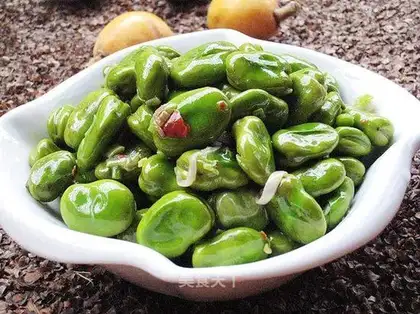 Garlic fragrant tender broad beans