Tofu is a healthy green food invented by our country's alchemist, Liu An, the King of Huainan. To this day, it has a history of over 2100 years and is deeply loved by everyone.
Pan-frozen Tofu
Frozen tofu has a more delicious flavor
The nutritional components of tofu are very rich. Both frozen and fresh tofu are rich in a large number of nutrients such as soy protein, soy isoflavones, soy lecithin, and minerals. The interior of fresh tofu has countless pores of different sizes; some are interconnected, while others are closed off into small containers, all filled with water. Water has a peculiar property: at 4°C, its density is greatest and its volume is smallest; when it reaches 0°C, water turns to ice, and its volume does not shrink but expands, being about 10% larger than the volume of water at room temperature. When the temperature of the tofu drops below 0°C, the water inside freezes, and the original pores are expanded by the ice, causing the entire block of tofu to be pressed into a network. After the ice melts and flows out of the tofu, many pores are left behind. This gives the tofu a honeycomb-like structure with many pores, a grayish color, making it easier to absorb flavors during cooking and resulting in a more delicious taste.
Frozen tofu can better retain nutrients
Fresh tofu contains a large amount of water, and its water-soluble nutrients, such as minerals and vitamins, can easily be lost along with the seeping of its juice. In contrast, frozen tofu is better at preserving nutrients. In frozen tofu, the water exists mainly in the form of ice crystals, which can promptly lock in the juice of fresh tofu and retain its water-soluble nutrients. Some people worry that nutrients are lost during thawing. In fact, as long as the tofu is cooked with fresh vegetables to make a light stew before it is fully thawed, the loss of nutrients with the juice can be prevented.
Fresh tofu contains large amounts of flavonoids and lecithin, components that are not reduced by freezing. Supplementing with flavonoids and lecithin helps prevent senile dementia, osteoporosis, breast cancer, and prostate cancer, making it a preferred food for menopausal women. Current test results show that for the same weight, frozen tofu has less moisture than fresh tofu.
People with abnormal blood lipids should eat frozen tofu
About 60% of the fat in frozen tofu is linoleic acid and polyunsaturated fatty acids. Unsaturated fatty acids can lower the total cholesterol level in the human body. In addition, the lecithin contained in unsaturated fatty acids can form choline in the human body, which helps prevent arteriosclerosis. Meanwhile, compared to fresh tofu, frozen tofu is richer in dietary fiber, which can promote gastrointestinal motility and help excrete fat. At the same time, the many pores in frozen tofu can absorb oil, and to a certain extent, also have the effect of reducing fat and expelling oil. The structure of frozen tofu is relatively loose, making it easier to absorb flavors. When cooking, it is best to use less salt and oil. For patients with high blood lipids, it is best not to cook frozen tofu with meat, because the honeycomb structure of the tofu will absorb a large amount of fat, which can instead cause blood lipids to rise.
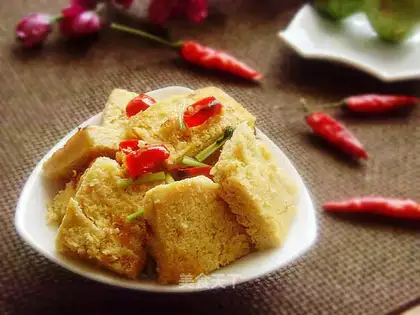 Frozen tofu