Vegetables are an indispensable food in people's daily diet, rich in a variety of mineral elements. However, many people do not know how to eat vegetables properly. Improper consumption can lead to significant loss or destruction of beneficial substances.
Boiled Chinese Kale
Calcium is the mineral element that the human body is most likely to be deficient in. Vegetables contain oxalic acid, which can hinder calcium absorption. However, due to their high consumption, vegetables remain an important source of calcium. For vegetables high in oxalic acid, blanching them in boiling water before eating can remove most of the oxalic acid, thus not affecting calcium absorption. Based on the calcium content in fresh vegetables, those with over 200 milligrams of calcium per 100 grams are considered high-calcium vegetables, such as shepherd's purse, radish leaves, and potherb mustard. Those with 100-200 milligrams of calcium per 100 grams are considered rich-calcium vegetables, such as edamame, amaranth, rape stalk, Malabar spinach, and Chinese kale.
It is well-known that high blood pressure is closely related to salt intake. Reducing salt in daily life not only involves using less salt when cooking but also choosing appropriate low-sodium vegetables is a good way to control salt intake. Vegetables containing over 100 milligrams of sodium per 100 grams are considered high-sodium vegetables, including fennel, crown daisy, celery stalks, kelp, and laver. Less salt should be used when cooking these.
Conversely, potassium has the effect of lowering blood pressure. Patients with high blood pressure should eat more potassium-rich vegetables while following a low-sodium diet. Vegetables containing over 250 milligrams of potassium per 100 grams include potatoes, taro, spinach, radish leaves, bamboo shoots, and snake beans. Additionally, soaking vegetables in water or boiling and discarding the cooking water will reduce potassium content.
Iron is the most abundant essential trace element in the human body. However, most iron in vegetables is in the form of non-heme iron, which has a low absorption rate of only 5%. Studies have shown that vitamin C can reduce iron to ferrous ions, which is beneficial for the absorption of non-heme iron. The intrinsic factor in meat, fish, and poultry can also promote the absorption of iron from plant-based foods. Therefore, iron-rich vegetables can be consumed together with foods rich in vitamin C or meaty foods. Vegetables with higher iron content per 100 grams, in descending order, are daylily, water celery, amaranth, shepherd's purse, pea tips, pea sprouts, edamame, mustard greens, spinach, and cilantro.
Generally, animal foods contain more zinc than plant-based foods. Among plant-based foods, various legumes and nuts are relatively high in zinc. Among fresh vegetables, daylily has the highest zinc content, at 3.99 milligrams per 100 grams. Broad beans, edamame, peas, garlic stalks, Chinese kale, and celery leaves contain over 1 milligram of zinc per 100 grams. Cowpeas, pea sprouts, bok choy, small rapeseed, spinach, and bitter vegetables contain around 0.8 milligrams of zinc per 100 grams.
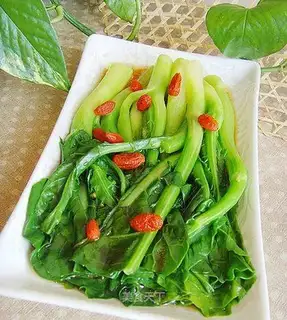 boiled kale