The Lantern Festival, also known as the Shangyuan Festival, the Little New Year, the Yuanxi Festival, or the Lantern Festival, is the first major festival after the Spring Festival. It is one of the traditional festivals in China, as well as in regions with Chinese character culture circles and among overseas Chinese. Below, the editor will introduce the origin and customs of the Lantern Festival.
Cat Claw Tangyuan
The Origin and Customs of the Lantern Festival
The Lantern Festival on the 15th day of the first lunar month, also known as the "Shangyuan Festival" (the Lantern Festival), the Spring Lantern Festival, is a traditional folk festival of the Han ethnic group in China. The first month of the lunar calendar is called "Yuan," and the ancients called the night "Xiao." Since the 15th day is the first full moon night of the year, it is called the Lantern Festival. It is also called the Little New Year, Yuanxi, or the Lantern Festival, and is the first important festival after the Spring Festival. China is vast and has a long history, so the customs of the Lantern Festival vary across the country. Eating tangyuan, viewing lanterns, dragon dances, and lion dances are some of the important folk customs of the Lantern Festival.
The Beijing Shangyuan Lantern Fair is held every year on the 15th day of the first lunar month. Right after the Spring Festival, the Lantern Festival, one of the traditional festivals of the Han ethnic group in China, arrives. The first month of the lunar calendar is called "Yuan," and the ancients called the night "Xiao," so the 15th day of the first month is called the Lantern Festival. The 15th day of the first lunar month is the first full moon night of the year, and it is also a night of new beginnings and the return of spring to the earth. People celebrate this day, which is also a continuation of the New Year celebration. The Lantern Festival is also known as the "Shangyuan Festival."
According to Chinese folk tradition, on this night under the bright moon, people light up colorful lanterns to celebrate. Going out to admire the moon, lighting lanterns and setting off fireworks, joyfully guessing lantern riddles, and eating tangyuan together, families reunite to celebrate the festival, creating a joyful and harmonious atmosphere.
The Origin of the Lantern Festival
The Lantern Festival is a traditional Chinese festival that dates back more than 2,000 years to the Western Han Dynasty. The custom of admiring lanterns during the Lantern Festival began during the reign of Emperor Ming of the Eastern Han Dynasty. Emperor Ming promoted Buddhism. Hearing that Buddhists had the custom of viewing the Buddha's sarira and lighting lanterns to worship the Buddha on the 15th day of the first lunar month, he ordered lanterns to be lit in the imperial palace and temples on this night, and for officials and commoners to also hang lanterns. Over time, this Buddhist ritual gradually evolved into a grand folk festival. This festival experienced a development process from the imperial court to the common people and from the Central Plains to the entire country.
During the reign of Emperor Wen of the Han Dynasty, the 15th day of the first lunar month was officially designated as the Lantern Festival. During the reign of Emperor Wu of the Han Dynasty, the sacrificial ceremony for the "Taiyi God" (the supreme god who rules the universe) was set on the 15th day of the first lunar month. When Sima Qian created the "Taichu calendar," the Lantern Festival was already established as a major festival.
Customs of the Lantern Festival
Eating Tangyuan
Eating tangyuan on the 15th day of the first lunar month has a long history in China. In the Song Dynasty, a novel food for the Lantern Festival was popular among the people. This food was originally called "Fuyuanzi" and later "Tangyuan." Businessmen also gave it the elegant name "Yuanbao." Tangyuan, or "tangyuan," is filled with ingredients like sugar, rose petals, sesame paste, red bean paste, osmanthus, walnuts, assorted nuts, and jujube paste. It is wrapped in glutinous rice flour into a round shape and can be either sweet or savory with various flavors. It can be boiled in soup, deep-fried, or steamed, symbolizing reunion and perfection. In Shaanxi, tangyuan are not wrapped but "rolled" in glutinous rice flour, then boiled or deep-fried, representing a lively and round reunion.
Chasing Mice
This activity was mainly for families that raised silkworms. Because mice often eat large quantities of silkworms at night, people heard that feeding mice with congee on the 15th day of the first lunar month could prevent them from eating silkworms. Therefore, these families would cook a large pot of sticky congee on this day, sometimes with a layer of meat on top. They would serve the congee in bowls and place it in places where mice appeared, such as ceilings, corners, and walls, all while muttering curses, wishing that if the mice ate the silkworms again, they would meet a bad end.
Welcoming Zigu
Zigu is a kind and poor girl in Chinese folklore. On the 15th day of the first lunar month, Zigu died of poverty. The people pitied her and remembered her, and in some places, the custom of "welcoming Zigu on the 15th day of the first lunar month" emerged. On this night every year, people use straw, cloth scraps, and other materials to create a life-sized portrait of Zigu. Women would gather near the toilet, pigsty, and kitchen where Zigu used to work to welcome her. They would treat her like a close sister, holding her hand, talking to her intimately, and comforting her with tears, vividly reflecting the kind, honest, and sympathetic feelings of the working people towards the weak.
Walking Away Illnesses
In addition to celebratory activities, the Lantern Festival also has faith-based activities, namely "Walking Away Illnesses," also known as "Roasting Away Illnesses" or "Dispelling Illnesses." Participants are mostly women who walk in groups, along walls, over bridges, or in the countryside, with the aim of driving away illnesses and disasters.
As time passed, the activities of the Lantern Festival became more numerous. In many places, celebrations added activities such as dragon lantern dances, lion dances, stilt-walking, land boat rowing, yangge dancing, and playing the Taiping drum.
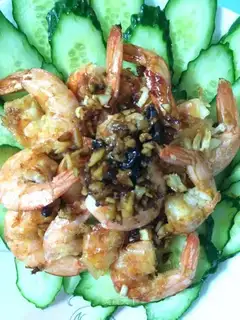 Fried garlic shrimp