The Lantern Festival has arrived, and supermarkets of all sizes, as well as roadside stalls, have all launched a colorful variety of tangyuan. "With stars and moon in the sky and ten thousand candles burning, there are tangyuan both in the human world and the heavens." Eating tangyuan on the fifteenth day of the first lunar month expresses people's wish for family reunion and a happy and beautiful life. Although making tangyuan can be a bit troublesome, you can also choose to make them yourself. Shaking tangyuan with family members makes the joy of reunion even stronger, and what you eat is also more reassuring, safe, and healthy.
Hawthorn-filled Tangyuan
Varieties and Ways of Eating Tangyuan
This food, "tangyuan," is said to have appeared in the late Song and early Yuan dynasties. Before the Northern Song Dynasty, tangyuan were solid and unfilled, boiled in water and served with rock sugar, jujubes, osmanthus, and longans. During the Southern Song Dynasty, "rutang yuanzi" with sugar filling in the center appeared, which were among the earliest filled tangyuan. Afterwards, tangyuan fillings were divided into sweet and salty types. Sweet fillings are generally made with white sugar, brown sugar, osmanthus, nuts, and sesame seeds; salty fillings are mostly meat fillings, either with meat alone or a combination of meat and vegetables. Tangyuan are mostly boiled in water, but they can also be fried. "Youzheng duizi" in "Lu's Miscellaneous Sayings" is actually a type of fried tangyuan. Today, the ways of eating tangyuan in various parts of our country are even more abundant, and the use of tangyuan fillings is also more colorful. Now, I will introduce several types of tangyuan that are both delicious and have health-preserving functions, along with their preparation and consumption methods for everyone to choose from.
Hawthorn Tangyuan
Use 250 grams of fresh hawthorn, 500 grams of glutinous rice flour, 50 grams each of wheat flour, walnuts, sesame seeds, and red silk threads, 10 grams of osmanthus syrup, 100 grams of white sugar, and appropriate amounts of sesame oil and refined vegetable oil. First, wash the hawthorn, cook it until soft, let it cool, then peel and pit it to make hawthorn paste. Mix the paste with white sugar and wheat flour, add crushed walnuts and other ingredients, then mix well with vegetable oil. Put the mixture into a wooden mold, press it flat, demold, and cut into 2 cm square pieces. Take a flat container, pour in glutinous rice flour, and spread it evenly. Use a ladle to scoop the filling, dip it in water, and place it in the glutinous rice flour. Roll it several times, then dip it in water again and roll, repeating this process many times until the tangyuan are formed. Cook and eat as usual. This type of tangyuan has the effects of stimulating appetite, aiding digestion, invigorating blood to resolve stasis, and lowering lipids and reducing weight. It is suitable for simple obesity, hyperlipidemia, fatty liver, arteriosclerosis, and hypertension.
Tangerine Tangyuan
Use 250 grams of seedless tangerines, 200 grams of small filled tangyuan, 30 grams of white sugar, and an appropriate amount of osmanthus sugar. First, wash the seedless tangerines, peel them, remove the veins, and separate into segments, then cut each segment in half and place them in a bowl. Heat a pot, add water and bring to a boil, add the tangyuan, and stir gently with a ladle. When the tangyuan are cooked and soft and float on the surface, add white sugar, tangerine segments, and osmanthus. Bring to a boil over high heat, skim off the foam, remove the pot from the heat, and pour into a soup bowl to serve as a dessert, the amount is optional. This type of tangyuan has the effect of regulating qi and strengthening the spleen. It is suitable for chronic bronchitis and chronic gastritis.
Orange Tangyuan
Use 250 grams of fresh oranges, 200 grams of glutinous rice flour, 150 grams of white sugar, and a small amount of jujube paste and osmanthus syrup. First, place the glutinous rice flour in a basin, add an appropriate amount of clear water, knead it well into a dough, then divide into small pieces, flatten each, and wrap with jujube paste to make tangyuan. Then, wash the oranges, peel them, and cut into small pieces. Heat a pot, add an appropriate amount of clear water and bring to a boil, add the tangyuan, and simmer over low heat until the tangyuan float on the water's surface. Then add white sugar and osmanthus syrup and bring to a boil. Remove from the heat, pour into a bowl, and sprinkle with orange pieces. This type of tangyuan has the effects of replenishing qi, strengthening the spleen, stimulating appetite, and aiding digestion. It is suitable for those with a weak spleen and stomach, poor appetite, abdominal bloating and discomfort, and thirst due to fluid damage. It can also have a tonic and strengthening effect for healthy people, making it a tonic and health-preserving food.
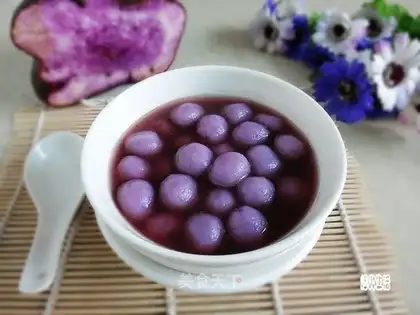
Purple Yam Tangyuan
Use 150 grams of yam (Chinese yam), 90 grams of white sugar, 500 grams of glutinous rice flour, and a pinch of pepper. First, wash the yam, chop it into small pieces, and place in a bowl. Then, put the bowl in a pot of water and steam until cooked. Remove, add white sugar and a pinch of pepper, and mix well to make the filling. Soak the glutinous rice in cold water for 3 hours, then grind into wet glutinous rice flour. Knead the flour with water into a dough, divide into small pieces, flatten, add yam filling, wrap into tangyuan, and cook in boiling water until done. This type of tangyuan has the effect of tonifying the spleen and benefiting the kidneys. It is effective for poor appetite due to spleen deficiency, kidney essence deficiency, enuresis, chronic enteritis, and diarrhea. If the white sugar is removed, it is effective for diabetes.
Bran and Meat Tangyuan
Use 100 grams of wheat bran, 250 grams of pork, 250 grams of glutinous rice flour, and appropriate amounts of scallions, ginger, salt, and MSG. First, wash the glutinous rice, soak in water for 1-2 days, then grind into a paste with a small mill. Place in a clean cloth bag, filter out the water, and dry to make glutinous rice flour. Then, stir-fry the wheat bran in a pan until yellow, let it cool, chop the pork into mince, and chop the scallions into small pieces and ginger into fine particles. Mix the wheat bran, pork mince, scallions, and ginger in a basin, add salt, MSG, and an appropriate amount of water, and mix well to make the meat filling. Then, add an appropriate amount of water to the dry glutinous rice flour and knead into a dough. Divide into small pieces, place the meat filling in the center, and roll into tangyuan. Finally, add water to a pot, bring to a boil over high heat, add the raw tangyuan, bring to a boil again, then reduce the heat and simmer for 8-10 minutes until the tangyuan float and are cooked through. Eat twice a day for breakfast and lunch. This type of tangyuan has the effect of stopping sweating. It is indicated for deficiency sweating, spontaneous sweating, and night sweats.
Ginseng Tangyuan
Use 30 grams of ginseng, 30 grams of chicken oil, 15 grams of rose honey, 15 grams of cherry honey, 150 grams of white sugar, 15 grams of flour, 500 grams of wet glutinous rice flour, and 30 grams of black sesame seeds. First, soften the ginseng with water, slice it, and bake until crispy in a pan over low heat, then grind into a fine powder. Stir-fry the flour in a pan over low heat until yellow. Toast the black sesame seeds until fragrant and crush. Then, use a rolling pin to press the rose honey and cherry honey into a paste on a table. Add white sugar, chicken oil, and ginseng powder and mix well. Add the stir-fried flour and knead until smooth to make the filling. Knead the glutinous rice flour with an appropriate amount of water into a smooth dough, roll into a long log, and divide into small pieces (about 12 grams each). Shape each piece into a small wine cup, fill with the filling, and make tangyuan. Finally, add water to a pot, bring to a boil, add the tangyuan, and simmer over low heat for 2-3 minutes until they float on the water's surface. This type of tangyuan has the effects of tonifying the middle jiao, replenishing qi, and calming the mind and strengthening the heart. It is indicated for treating spleen deficiency with diarrhea, palpitations and spontaneous sweating, and fatigue and listlessness.
In addition, you can also use some traditional Chinese medicines to cook tangyuan. For example, use 40 grams of Cistanche, 50 grams of Morinda officinalis, and 60 grams of yam. Decoct in water, remove the dregs, and use the medicinal liquid to cook the tangyuan. When cooked through, add salt, ginger, scallions, and MSG to season. This type of tangyuan contains protein, amino acids, various vitamins, starch, crude fiber, iron, calcium, phosphorus, resins, and alkaloids. Its characteristics are fresh and delicious, and it has the effect of nourishing the kidneys and strengthening yang.
 The purple mountain potion
 It's a long night