Cabbage is one of the best vegetables recommended by the World Health Organization and is hailed as a natural "stomach vegetable." Therefore, people with poor digestion, especially those suffering from stomach and duodenal ulcers, can eat more cabbage. So, how should cabbage be eaten? Don't worry, here are two cabbage recipes recommended for everyone to learn!
Cabbage for Stomach Care
Cabbage is neutral in nature and sweet in taste, non-toxic, and affects the stomach and kidney meridians.
The large amount of fiber in cabbage can enhance gastrointestinal function, promote intestinal peristalsis, and lower cholesterol levels. It is beneficial for hormone secretion and helps with breast development.
Cabbage is one of the best vegetables recommended by the World Health Organization and is also known as a natural "stomach vegetable." The Vitamin K1 and Vitamin U it contains not only help resist stomach ulcers, protect and repair gastric mucosal tissue, but also keep stomach cells active and vigorous, reducing the chance of disease. People with stomach and duodenal ulcers are often advised by doctors to eat more cabbage. Of course, you can also mix cabbage with honey daily, as this method helps promote ulcer healing.
Cabbage is very helpful for weight loss. Every 100 grams of cabbage contains only 25 calories, and its sugar content is also very low. Therefore, cabbage can stabilize blood sugar levels, and after eating this vegetable, you won't feel very hungry, thus achieving the goal of dietary weight loss.
Cabbage Recipes
After understanding the effects and benefits of cabbage, let's look at how to prepare it. In fact, cabbage is like any other vegetable; it can be stir-fried or served as a cold salad.
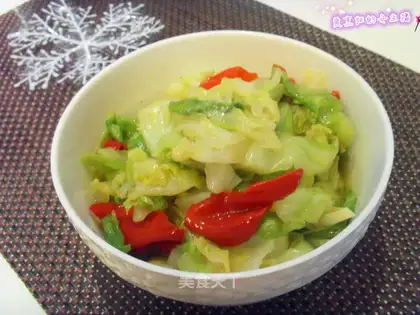
Stir-fried Cabbage
Stir-fried Cabbage
Ingredients: Cabbage leaves, red bell pepper, cooking oil, garlic, light soy sauce, salt.
Instructions:
1. Wash the cabbage leaves, drain the water, remove the stems, and tear into large pieces by hand.
2. Mince the garlic and slice the red bell pepper into rings.
3. Place a small amount of cooking oil in a wok, heat it up, then sauté the minced garlic and pepper rings over low heat until fragrant.
4. Add the cabbage pieces, stir-fry over high heat until the color changes, then add an appropriate amount of light soy sauce and a little salt, and continue to stir-fry.
5. Before serving, add MSG and sesame oil.
Cold Cabbage Salad
Ingredients: One head of cabbage, a small handful of vermicelli, scallions, ginger, Sichuan peppercorns, soy sauce, vinegar, red chili peppers, salt, oil.
Instructions:
1. Peel off the outer old leaves from one cabbage, wash it, and wash and drain the scallions and ginger.
2. Shred the cabbage thinly and cut the red chili peppers into sections.
3. Bring water to a boil in a pot, add a little salt and oil to the water. Once boiling, put the shredded cabbage into the boiling water, then immediately remove and rinse with cold water, and drain.
4. Put the vermicelli into the boiling water and cook for one minute, then remove and rinse with cold water, and drain.
5. Heat oil in a wok. Once hot, add the Sichuan peppercorns, scallions, and ginger to the wok. Fry until the scallions and ginger are golden brown, then remove the peppercorns, scallions, and ginger with a slotted spoon. Turn off the heat and put the chili sections into the hot oil.
6. Place the shredded cabbage and vermicelli in a basin, and pour the hot oil with chili sections over them.
7. Add an appropriate amount of premium soy sauce and vinegar, salt to taste, mix well, and serve on a plate.
Reminder: For those who want to cook with cabbage, note that when selecting, a high-quality purple cabbage will feel quite heavy in your hand, indicating it has plenty of moisture, a compact structure, and a better texture when eaten.
 Cracked kale