In the dim lamplight, the long night stretches on, I pluck a flower branch but cannot bear to look. My white hair taps the hairpin, ashamed of the festive ornament, Astragalus root simmers in porridge, offered for the spring plate. In the east, they cook the dog as the sun begins to rise, In the south, they fight for oxen to form a round. The old master has never lacked for joy, But who in the corner can have a hall full of celebration?” This is a poem written by the great Song dynasty poet Su Dongpo during the Lichun (Start of Spring) festival while ill, as he entertained friends. In the poem, Astragalus root (Huang Qi) is a well-known tonic and a fine food remedy. Let us now learn about the specific effects and uses of Astragalus.
Astragalus Lamb Soup
Specific Effects of Astragalus
Tonify the Middle and Qi
(1) For symptoms such as weak spleen and stomach, poor appetite, reduced food intake, loose stools, and limb fatigue, it is often used with Dang Shen (Codonopsis root), Bai Zhu (Atractylodes macrocephala), and Shan Yao (Chinese yam).
(2) For qi collapse with internal organ prolapse, such as rectal prolapse, uterine prolapse, or gastric ptosis, it is often used with Dang Shen (Codonopsis root), Sheng Ma (Cimicifuga rhizome), and Chai Hu (Bupleurum root), as in the formula Bu Zhong Yi Tang (Tonify the Middle Qi Decoction).
Secure the Exterior and Arrest Sweating
(1) For spontaneous sweating due to exterior deficiency, often caused by general debility and weak exterior. If the exterior qi is not secured and sweating occurs due to an external cold wind invasion, it is treated with Astragalus combined with Bai Zhu (Atractylodes macrocephala) and Fang Feng (Saposhnikovia root), which is effective with long-term use. The formula is Yu Ping Feng San (Jade Screen Powder); it can also be combined with Fu Xiao Mai (Triticum aestivum sprouts) and Ma Huang Gen (Ephedra root).
(2) For night sweats due to yin deficiency, it can be used with Yin-nourishing herbs such as Sheng Di Huang (Rehmannia root) and Mai Dong (Ophiopogon root).
Promote Urine Drainage and Reduce Edema
(1) For acute nephritic edema, used for deficient edema caused by insufficient yang qi, and is often combined with Fang Ji (Stephania tetrandra), Fu Ling (Poria cocos), and Bai Zhu (Atractylodes macrocephala), as in the formula Fang Ji Huang Qi Tang.
(2) For chronic nephritic edema in patients with spleen and kidney deficiency, it is often used with Dang Shen (Codonopsis root), Bai Zhu (Atractylodes macrocephala), and Fu Ling (Poria cocos).
Support Sores and Drain Pus
(1) For yang qi deficiency, used for sores that have not ruptured for a long time and have sunken inward, with the effect of promoting rupture and localizing the infection. For carbuncles that do not come to a head for a long time, it is often used with Chuan Shan Jia (Manis pentadactyla scales), Zao Jia Ci (Gleditsia spine), Dang Gui (Angelica sinensis), and Chuan Xiong (Ligusticum wallichii).
(2) For sores that have been unhealed for a long time after rupturing, used for promoting granulation and healing the wound, and is often combined with Yin Hua (Lonicera japonica), Zao Ci (Gleditsia spine), and Ding Ding (Viola yedoensis). If the pus is thin and clear, it is often used with Dang Shen (Codonopsis root) and Rou Gui (Cinnamon bark).
When is the best time to drink Astragalus root tea?
There is no specific time limit for drinking Astragalus root tea, but it is not recommended to drink it right before bedtime. It is excellent to drink a cup of Astragalus tea after breakfast in the morning to happily start a new day. Generally, 15-20g is sufficient. Before steeping, it is best to soak the Astragalus root for 15-20 minutes, and then either decoct it or steep it directly with hot water. If you are short on time, steeping with hot water is more suitable. When you have time, it is better to decoct it. Even on busy workdays, you can steep some Astragalus root as a tea to refresh yourself.
How to consume Astragalus root?
There is a proper way to prepare Astragalus root tea. It is best to use freshly boiled water to better extract the nutrients from the Astragalus. However, steeping can only extract about 40% of its medicinal properties. To maximize the benefits, the best method is to decoct it in a clean pot. The specific methods for taking Astragalus root are as follows:
1. Wash the Astragalus root, decoct it in a pot, and drink the liquid as a tea to improve physical constitution.
2. Prepare Astragalus root and Goji berries in a 2:1 ratio, decoct them in water, which is very suitable for patients with qi and blood deficiency.
3. Decoct Astragalus root to make a medicinal liquid, then use it to cook congee. The resulting Astragalus congee not only tastes good but also has great nourishing effects.
4. Add a small amount of Astragalus root when stewing meats, such as duck, chicken, or pork, to enhance the nourishing effects.
Contraindications for consuming Astragalus root
In terms of body constitution, Astragalus root is most suitable for people with qi deficiency and damp spleen. These individuals are often plump but weak, with soft muscles, especially in the abdomen. People who are very thin and solid should not take it. In terms of health conditions, do not take Astragalus root when you have a cold or during your menstrual period. In terms of seasons, ordinary people should avoid taking Astragalus root in the spring. Why shouldn't you drink Astragalus congee when you have a cold? Because Astragalus secures the exterior, it helps the body "close its doors" to prevent external pathogens from invading. However, when the body is already invaded by pathogens, it becomes "locking the door and keeping the bandit inside," trapping the illness in the body with no way to expel it. Similarly, spring is a season of growth and the body needs to release and expand, so taking Astragalus is not very suitable. Also, do not take it when you have a fever.
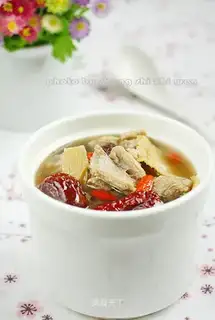 Yellow lamb soup