Chrysanthemum is one of the most well-known traditional Chinese medicines. TCM health experts also consider chrysanthemum tea the top tea for spring health preservation. Different varieties of chrysanthemums have different effects, and the "heat-clearing and detoxifying" properties of chrysanthemum tea are not suitable for everyone, with many contraindications.
In TCM, chrysanthemum is considered sweet and bitter in taste, slightly cold in nature, and has effects such as dispelling wind and clearing heat, clearing the liver and improving vision, and detoxifying and reducing inflammation. It is particularly suitable for spring health preservation.
Chrysanthemum, Hawthorn, and Green Tea
Chrysanthemum Tea: The Number One Tea for Spring Health Preservation
Chrysanthemum Tea: Soothes the Liver and Reduces Liver Fire
Spring corresponds to the liver in TCM. Improper care can easily lead to liver fire, manifesting as irritability and anger, and sometimes the following symptoms: dry mouth and throat, a bitter taste and bad breath, dry eyes, dizziness, headache, vexation and insomnia. Women may experience breast tenderness and irregular menstruation. Medicines that clear liver fire must have the characteristic of "descending" or "bringing down."
The Qing Dynasty pharmacology monograph "Ben Cao Zheng Yi" records: "All flowers are primarily for promoting and dredging, but chrysanthemum is unique in its ability to absorb and descend, capable of pacifying liver fire."
Chrysanthemum Tea: Moisturizes and Reduces Stomach Fire
The weather is dry in spring, and if water is not replenished in time, the body can develop stomach fire due to a lack of fluids. The Qing Dynasty pharmacology work "Ben Xin Bian" states: "The reason chrysanthemum can be used extensively is its ability to reduce the stomach fire of the Yangming meridian."
Stomach fire is essentially stomach heat, often caused by damp-heat, excessive alcohol consumption, or a diet rich in spicy and greasy foods. Drinking chrysanthemum tea can help clear this stomach fire.
Chrysanthemum and Rose Tea
Chrysanthemum Tea: An Adjunct for Treating Eye Diseases
The warm and humid spring weather is conducive to bacterial reproduction, easily triggering various eye diseases, with conjunctivitis being the most common. The Ming Dynasty pharmacology work "Yao Pin Hua Yi" states: "Chrysanthemum can treat acute red and swollen eyes, eye pain, and tearing."
"Acute red eyes" corresponds to epidemic keratoconjunctivitis in Western medicine. Modern pharmacological research also shows that chrysanthemum decoctions and aqueous extracts have inhibitory effects on various bacteria and viruses.
Although chrysanthemum is the most familiar traditional Chinese medicine to everyone and its many benefits are well-known, did you know that chrysanthemums should be consumed according to their variety? Different varieties of chrysanthemums have different effects when brewed into tea. See if you've been drinking the right one!
Different Varieties of Chrysanthemum, Different Tea Effects
For Sore Throat: Use Hang Chrysanthemum
Hang chrysanthemum flowers are larger and come in two types: Hangbai (white) and Hanghuang (yellow), with the former being slightly sweeter. Compared to Gongju, Hang chrysanthemum has a darker flower center, and its petals are more prone to falling apart after brewing. When you have a sore throat, drinking Hang chrysanthemum is the best choice.
For Vision: Use Gong Chrysanthemum
Gong chrysanthemum, also known as "Huangshan Gongju," has snow-white flowers with green stems. The tea liquor turns green if brewed for a long time. The cold nature of Gong chrysanthemum is milder, and it can clear the liver, improve vision, and nourish the liver and eyes.
Brewing Gong chrysanthemum with some goji berries is a great remedy for eye care for computer users.
To Reduce Fire: Use Chu Chrysanthemum
Chu chrysanthemum, also known as "white chrysanthemum" or "sweet chrysanthemum," has the most tightly packed petals among chrysanthemums. Chu chrysanthemum is the most effective for dispelling wind and clearing heat. If you experience symptoms of "summer heat cold" such as a dry throat and dizziness, drinking some Chu chrysanthemum can help relieve these symptoms.
For Anti-inflammation: Use Wild Chrysanthemum
Wild chrysanthemum flowers are smaller and more yellow, and their shape is not very aesthetically pleasing. Its bitter and cold nature is stronger. Wild chrysanthemum is the most effective for detoxifying, clearing heat, and reducing swelling, and is helpful for relieving sores, toothaches, and bad breath.
In general, avoid brewing wild chrysanthemum for tea, as it may damage the spleen and stomach's yang energy, causing adverse reactions such as stomach discomfort, bowel rumbling, and loose stools.
Chrysanthemum is truly a wonderful traditional Chinese medicine. However, after drinking chrysanthemum tea for so many years, few people know about the contraindications for its consumption. Be careful, as drinking it incorrectly can deplete your qi and harm your body. Be sure to remember this clearly this time.
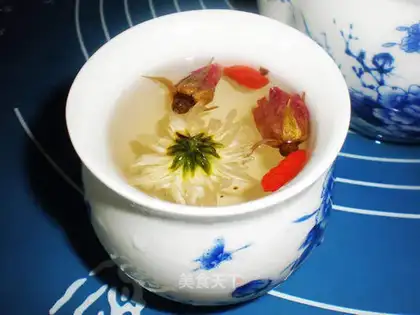 Chrysanthemum rose tea
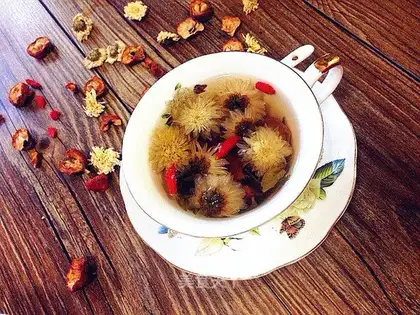 Green tea on the mountain