Will eating yams make you fat? Yam is not only an ingredient but also a traditional Chinese medicinal herb, offering many health benefits. So, will eating yams make you fat? What happens if you eat too many yams? Let's find out with the editor!
Will eating yams make you fat?
Eating more yams will not make you fat. Yam is mainly used to nourish the spleen and kidney yin, and it generally has little to do with weight gain.
Yam has the effects of nourishing and strengthening, aiding digestion, stopping sweating from deficiency, and stopping diarrhea. It is indicated for diarrhea due to spleen deficiency, cough due to lung deficiency, diabetes and thirst, frequent urination, spermatorrhea, leukorrhea in women, and chronic enteritis due to indigestion. Yam is most suitable to be taken with Ganoderma lucidum (Lingzhi) for the prevention and treatment of diabetes.
Yam should not be eaten in excess
Yam is very beneficial to human health and is suitable for people of all ages. Yam is not only extremely nutritious, but it also has many medicinal effects, and different people may experience different results from eating it. Traditional Chinese medicine believes that yam is sweet, neutral, and non-toxic. It has the effects of tonifying the spleen and benefiting the kidney, nourishing the lungs, stopping diarrhea, and stopping sweating. It is a great "food-medicine" for supplementation.
Yam is rich in nutrients. Every 100 grams contains 1.5 grams of protein, 14.4 grams of carbohydrates, 14 milligrams of calcium, 42 milligrams of phosphorus, 0.3 milligrams of iron, 0.02 milligrams of carotene, 0.08 milligrams of thiamine, 0.02 milligrams of riboflavin, 0.3 milligrams of niacin, and 4 milligrams of ascorbic acid. In addition, it contains other nutrients such as protein, amino acids, and polyphenol oxidase. It has the effect of inducing interferon and enhancing human immune function.
Will eating yams make you fat?
Although it is a healthy food, it should not be eaten in excess. It is better to eat three or four liang (about 150-200 grams) per person per day. Eating too much can easily lead to "internal heat" (上火). Yam has a high starch content, so people with a feeling of fullness in the chest and abdomen, dry stools, or constipation should eat less of it. Yam is a tonic herb, sweet and neutral but slightly warm. People with a "heat" constitution who are prone to "internal heat" should also be cautious when consuming it. Some people like to cook yam in hot pot, and if paired with spicy dipping sauce, it becomes even "hotter," so it's best to eat less.
Although yam has great tonic effects, it must be consumed in moderation. Generally, each person can eat three or four liang (about 150-200 grams) per day. Because yam has an astringent effect, eating too much can not only lead to "internal heat" but may also cause constipation. Yam can be boiled, cooked in a hot pot, stir-fried, or deep-fried. When peeling, be careful not to let it touch your skin to avoid causing itching.
How to cook Yam Porridge:
Red Date and Yam Porridge
Ingredients: 200g yam, 40g glutinous rice, 60g rice, 10 red dates, 800ml water.
Steps/Method
1. Prepare the yam, glutinous rice, rice, and red dates.
2. Soak the red dates in water in advance.
3. Wash the yam, peel it, and cut it into small pieces.
4. Wash the glutinous rice and rice.
5. Put cold water in the pot, add the washed glutinous rice, rice, and yam.
6. Put the soaked red dates into the pot.
7. Cover the pot, plug it in, and press the porridge button.
8. After 50 minutes, the porridge is cooked.
9. Serve in a bowl.
Little tip: Yam, commonly known as Chinese yam, is the tuber of a perennial climbing herb, *Dioscorea polystachya*, of the Dioscoreaceae family. Cultivated yams are called "family yams," while wild ones are called "wild yams." In Chinese medicine, it is also known as "Huai Shan" or "Huai Shan Yao." Yam is photophilic and has poor cold tolerance. It grows best in well-drained, loose, fertile loam. It is a perennial herb with climbing, often purple stems, cylindrical tubers, opposite, ovate or elliptical leaves, and cream-white, unisexual flowers. The tubers contain starch and protein and are edible.
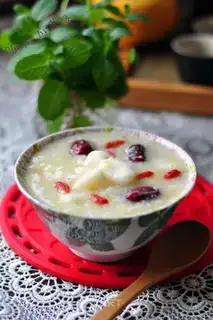 The porridge of the mountain