Oranges, also known as tangerines. Oranges are a delicious and popular fruit in autumn and winter, known for their vibrant colors and sweet and sour taste. While oranges are tasty, they are also rich in vitamin C, with one orange almost meeting the daily human requirement. Below, the editor will provide a detailed introduction to the effects and functions of oranges.
Detailed introduction to the effects and functions of oranges
Oranges are a treasure, as their pulp, peel, and seeds can all be used for medicinal purposes.
1. One of the effects and functions of oranges is that their dried outer peel is called "Chenpi" (dried tangerine peel). Because the medicinal effect is better when it is aged, it is named Chenpi.
2. The second effect and function of oranges is the white, net-like strands on the pulp, called "juéluò" (orange pith). It contains a certain amount of vitamin P and has effects such as promoting circulation, resolving phlegm, and relieving stagnation.
3. The third effect and function of oranges is that the orange seeds are bitter in taste and non-toxic. They have the effect of regulating qi and relieving pain and can be used to treat conditions like hernia and lower back pain.
4. The fourth effect and function of oranges is that the roots and leaves of the orange can also be used medicinally, possessing different functions such as soothing the liver, strengthening the spleen, and harmonizing the stomach.
5. The fifth effect and function of oranges is that the pulp is also an important raw material for light industry. It can be processed into canned goods, candied fruit, and fruit sugar, and can also be made into fruit juices and fruit wines. During processing, pectin, citric acid, and essential oils can be extracted.
6. The sixth effect and function of oranges is that orange peel can be used as raw material for extracting vitamins. Orange peels also have many clever uses in daily life, such as for beauty and skincare, cleaning porcelain with tea stains, deodorizing, and even as fertilizer. Knowing the effects and functions of oranges, one must also be aware of the precautions for eating them.
Oranges should not be eaten in excess. One should brush their teeth and rinse their mouth promptly after eating to avoid harming the oral cavity and teeth. People with poor gastrointestinal function may suffer from the problem of bezoars if they eat too many oranges. Oranges contain relatively high calories; if we consume too many at once, it can lead to "heatiness," which can trigger conditions like stomatitis and periodontitis. Excessive consumption of citrus fruits can cause "orange disease," with symptoms such as yellowing of the skin.
In life, many people like to pull off the white veins on the outside of the orange pulp completely when eating oranges. In fact, this way of eating is not scientific. The white, net-like veins on the outside of the orange pulp are usually called "juéluò" (orange pith). From both the perspectives of Traditional Chinese Medicine and modern nutrition, juéluò is very beneficial to human health. Traditional Chinese Medicine believes that juéluò has the effects of promoting circulation, resolving phlegm, and regulating qi and blood circulation. It is not only an excellent food therapy product for patients with chronic diseases such as chronic bronchitis and coronary heart disease, but also has a supporting therapeutic effect on chest pain and discomfort caused by prolonged coughing.
Recipes containing oranges tell you about the effects and functions of oranges
1. Hollow Noodle and Orange Salad
Ingredients: 4 hollow noodles, 1 orange, 2 small florets of broccoli, 2 large tablespoons of yogurt, some seaweed broth, and sugar.
Method:
(1) Cook the hollow noodles and broccoli, then chop them.
(2) Peel the thin skin from the orange segments.
(3) Add all the ingredients to the seaweed broth and cook together.
(4) Season with sugar and cook until the broth is reduced. Pour the yogurt on top and serve.
Orange Jam
2. Honey Kumquat Jam
Ingredients: Kumquats and honey
Method:
(1) Wash the kumquats, then dry them and let them air-dry for half an hour for the moisture to fully evaporate.
(2) Cut into thin slices and remove the seeds.
(3) Place them in a clean, dried glass bottle, adding honey as you fill it. Fill the bottle completely, seal the lid, and put it in the refrigerator.
(4) It can be eaten after a week.
(5) Scoop out a few tablespoons with a clean, dry spoon, pour into warm water, and enjoy the rich fruity aroma.
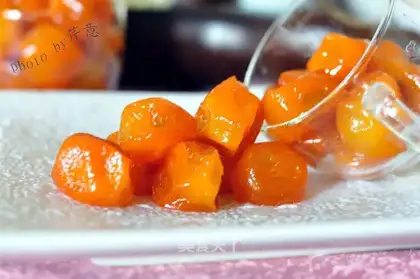
3. Candied Kumquats
Ingredients: 85 kg fresh kumquats, 45 kg Sichuan white sugar, 2 kg salt, and 2 kg lime.
Candied Kumquats
Method:
(1) Selecting the kumquats: Choose kumquats that are uniform in size, bright red in color, and 90% ripe as the base material.
(2) Scoring the segments: Use a scoring knife to make 9 to 10 cuts around the kumquat, being careful not to pierce the center.
(3) Squeezing the seeds: Gently squeeze each piece by hand to remove all the seeds, but do not crush the pulp to maintain its shape.
(4) Salting: Salt the base material with salt. Use 2 kg of salt for every 50 kg of kumquat base. Salt for 4 hours until the base is moderately soft, then it can be lime-soaked.
(5) Lime soaking: Soak the kumquat base in limewater for 12 hours. Use 2 kg of lime for every 50 kg of fresh kumquat base. When the limewater has penetrated the center of the base, it can be washed with water.
(6) Water washing: Wash with water for 24 hours, changing the water 4 to 5 times. When it has no off-flavor, it is ready.
(7) Blanching: Put the kumquat base into boiling water and cook for 2 to 3 minutes, then feed it with sugar.
(8) Sugar feeding: Squeeze the kumquat base dry and place it in a honey jar. Pour in cold sugar syrup (38° Baume). The amount of syrup should be enough to allow the base to move freely. The sugar feeding time is 12 hours.
(9) Final cooking: Put the sugar syrup (35° Baume) and the kumquat base into a pot together. Cook until it reaches 108°C, then ladle into the honey jar and let it rest for 48 hours.
(10) Finishing: Heat fresh sugar syrup (35° Baume) to 113°C, then pour the kumquat base into the pot and heat over medium heat. When the temperature rises to 116°C, pour it into a powder pan. When the temperature drops to 50-60°C, add powdered sugar, and it is the finished product.
 ♪ Orange and honey ♪
 Orange jam