There is a common saying in folk wisdom: "Eating bitter in summer is better than taking tonics." Bitter foods are known for their heat-clearing and summer-heat-relieving effects, making them excellent for cooling down and refreshing the mind. So, do you know what kinds of bitter foods there are? Do you know the benefits of eating bitter foods? And what dietary precautions should you be aware of when consuming these bitter foods?
Eggs Stir-fried with Bitter Melon
1. Bitter Melon
Bitter melon is usually harvested in July and August. It is a highly popular seasonal summer vegetable. Due to its unique bitter taste, which comes from components such as momordicoside and momordicin, it is one of the most commonly eaten bitter foods. Components extracted from bitter melon, such as bitter melon polysaccharide, momordicin, and flavonoids, have been proven in vitro and in animal experiments to have effects like lowering blood sugar, lowering blood lipids, antiviral, and antitumor properties. For this reason, bitter melon is often regarded as a "magical" vegetable with various health benefits. But the reality is not so magical.
Please remember: The effects of an extract cannot be equated with the specific benefits of eating the whole food.
Eating bitter melon cannot cure diabetes
For instance, the results of clinical trials are mixed. Some support bitter melon's ability to lower blood sugar, while others have found no significant difference between bitter melon and a placebo. Therefore, while bitter melon has certain nutritional value as a vegetable, daily consumption cannot treat high blood sugar or diabetes. Diabetic patients still need to follow their doctor's advice for treatment.
Be careful of bitter melon seed poisoning
Bitter melon seeds contain some components that may cause discomfort or poisoning. When eating bitter melon, the seeds must be thoroughly removed. In animal experiments, bitter melon has shown strong anti-fertility effects, including causing abnormal sperm function in mice and early and mid-term miscarriage in pregnant mice. However, this anti-fertility effect has not yet been proven in humans.
2. Lotus Plumule (Lotus Seed Heart)
Lotus plumule is the dried, young green leaf and radicle of the lotus seed. Its main functional components are alkaloids and flavonoids, which are also the primary source of its bitterness. The alkaloids in lotus plumule have also been proven to have effects such as lowering blood pressure, lowering blood lipids, and anti-arrhythmia, and are often used in medicines.
Lotus plumule is toxic
It should be noted that lotus plumule has low toxicity and is not a common food. In 2008, the former Ministry of Health (now the National Health and Family Planning Commission) stated in a response letter that lotus plumule contains various bioactive substances and lacks a history of use as a standalone food ingredient and evidence of its food safety in China.
Therefore, lotus plumule is rarely eaten directly and is more often used as a medicinal herb. The active ingredients in lotus plumule are difficult to activate simply by steeping it in boiling water for daily consumption, so it is acceptable to drink it as a daily beverage, but significant health effects are unlikely. From a safety perspective, regular direct consumption is not recommended.
3. Kuding Tea
Kuding tea is made from processed tender leaves. When brewed, it has a taste that is bitter at first and then sweet. Its main bitter substances include alkaloids, bitter glycosides, and flavonoids.
Kuding tea is a health food, and its extract can be used in medicine
The concentrated extract of kuding tea has effects such as lowering blood pressure, lowering blood lipids, and alleviating dizziness, headaches, and chest tightness caused by cardiovascular diseases. It is more commonly used in pharmaceutical research. Kuding tea itself is permitted for use in health foods. Whether the active ingredients in the kuding tea we brew daily can be effective is currently uncertain. If you can accept its unique taste, kuding tea can be a good daily beverage, but it is absolutely not recommended to rely on it to treat diseases.
How to eat these bitter foods
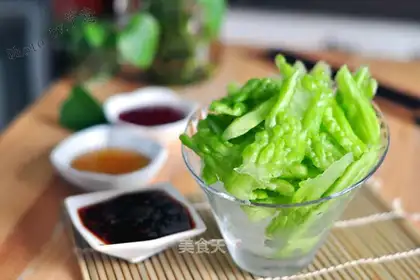
Chilled Bitter Melon
1. Refreshing Bitter Melon
Ingredients:
250g bitter melon, 30g goji berries, 10g honey, 5g rock sugar, 10g concentrated orange juice
Instructions
1. Peel the bitter melon, remove the seeds, wash it, and cut it lengthwise into thin slices.
2. Wash the goji berries and soak them in warm water until they soften.
3. Dissolve the rock sugar in Sprite and cold water.
4. Mix the bitter melon slices and goji berries with the rock sugar water, honey, and orange juice. Chill in the refrigerator before serving.
Tip
Goji berries are generally not recommended to be eaten with large amounts of "warming" tonics like longan, red ginseng, or jujubes.
2. Bitter Melon Milk Drink
Ingredients:
Bitter melon, ice milk, honey.
Instructions
1. Soak the bitter melon in light salt water, scrub the skin clean, cut it in half, and use a small spoon to scrape out the pulp and white membrane.
2. Cut the bitter melon into small pieces.
3. Place the bitter melon pieces in a blender, add a little pure water, and blend into bitter melon juice.
4. Pour the filtered bitter melon juice into a glass, filling it about one-fifth full. Then pour in ice milk, add a spoonful of honey, and mix well before drinking.
In conclusion: The above is an introduction to the dietary taboos regarding bitter foods. Through the information provided, I believe everyone now knows what bitter foods are and their benefits. Of course, the article also reminds everyone that not all bitter things can be eaten, and it's important to be aware of the relevant dietary taboos to know what is safe to eat and what is not.
 Ice cream
 Eggs and guacamole