Introduction: Before eating fish, steps such as scaling and gutting are essential. Fan Zhihong, an associate professor at the College of Food Science and Nutritional Engineering at China Agricultural University, told the Life Times reporter that this process seems simple, but it hides a lot of knowledge, and some people may throw away many treasures from the fish.
Fish Scales
Fish scales are the fish's exoskeleton, rich in nutrients such as collagen, calcium, phosphorus, and lecithin, and also contain chitosan, a dietary fiber. Because collagen converts into soluble gelatin at temperatures of 70°C to 90°C, a common way to eat it is to make fish scale jelly. The specific method is: Scrape off the fish scales and wash them. Put them in a pot full of water, add a little vinegar to keep the water temperature at 70°C to 90°C, just before it boils, and simmer slowly over low heat. Wait for the fish scales to slowly melt and the soup to become viscous, then turn off the heat. Let it cool, then place it in the refrigerator to set into a jelly. When eating, just mix the fish scale jelly with seasonings.
Fish Scale Jelly
Fish Maw
The fish maw is rich in collagen and omega-3 unsaturated fatty acids, which may be beneficial for blood lipid control. A common method is: Wash the fish maw with clean water, and stew it with the fish in a clear soup or braised in soy sauce.
Fish Bones
Fish bones, which are commonly known as fish bones, are rich in trace elements such as calcium. After softening treatment, their nutrients are more easily absorbed by the body. Very small fish with bones should be chewed vigorously. After entering the stomach, the stomach acid will soften the fish bones, promoting the dissolution of nutrients such as calcium and phosphorus. For larger fish bones, you should suck the marrow, which is the white line in the fish's spine. In addition, fish bones can also be stewed into soup with vinegar, simmered over low heat (2-4 hours). It should be noted that if you boil soup with plain water, the fish bones are difficult to soften. Adding more vinegar and stewing can use the effect of acetic acid to promote the softening of fish bones.
Salmon Bone Soup
Fish Intestines
Fish intestines are low in fat and their protein content is no less than that of fish meat. However, only the intestines of larger fish are edible, and the dirt inside must be removed before eating. Because the food eaten by fish must be digested by the intestines, it is an organ in the fish's body that is relatively heavily polluted. If you are not sure about the farming environment of the fish, it is not recommended to eat it.
Fish Liver
The fish liver is a place in the fish's body where many nutrients are stored, such as micronutrients like vitamin A, vitamin D, and iron. However, its cholesterol and purine content are also very high, making it unsuitable for patients with gout. The fish liver is connected to the fish gallbladder. When cleaning the fish liver, do not break the gallbladder. The liver has the function of detoxification and is especially easy to accumulate toxins. Before eating, you should be sure that the fish has not been polluted by the environment.
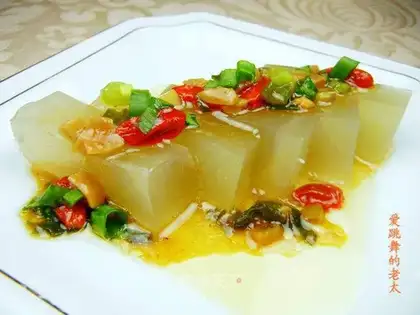 fish scale jelly
 Squid liver
 Celery mixed with black wood