Introduction: Today, whole grain porridge is receiving more and more attention and recognition, and consequently, confusion among people is also increasing. In this issue, we summarize the four most common questions and answer them one by one.
What should I do if I feel bloated after starting to drink whole grain porridge? Many people feel bloated when they first start drinking whole grains, which may be because they are accustomed to a diet of refined, white, and soft foods, and their gut microbes are not yet used to a high amount of dietary fiber. For those who have never had whole grains or tubers before, if they do not have diabetes, they can gradually replace part of the porridge ingredients with whole grains, still keeping more than half of it as white rice. Once they are accustomed to it, they can slowly reduce the amount of rice. For those who feel bloated after eating corn or sweet potatoes, they can first add a small amount of them to rice to be steamed, or cook them together with white rice porridge. Eat the white rice or porridge first, and then eat a small amount of sweet potato or corn. Then, gradually increase the proportion of whole grains and tubers, and the gut will gradually adapt.
Pumpkin and Lotus Seed Porridge
Can people with poor digestion drink whole grain porridge? People who are weak or have poor digestion are prone to issues like stomach blockage and bloating. It is advisable to use little or no soybeans, black beans, mung beans, and other such ingredients because they are indeed quite difficult to digest and can easily cause gas. Other miscellaneous beans should not account for more than 1/3 of the porridge ingredients, and they should be cooked until soft. If there is severe bloating, diarrhea, or loose stools, it is not advisable to use whole wheat grains, barley, oats, etc. Instead, it is better to use more easily digestible ingredients that are very gentle on the intestines, such as brown rice, millet, foxtail millet, Chinese yam, and sticky sorghum. It is best to soak them for more than 8 hours before cooking, and use an electric pressure cooker for cooking. This way, the whole grains and beans will be softer and easier to digest after cooking.
What kind of whole grain porridge should people with chronic diseases drink? For diabetics and patients with hyperlipidemia, to strictly control the postprandial blood sugar response, more than half of the ingredients must be miscellaneous beans, including adzuki beans, mung beans, kidney beans, peas, fava beans, etc. Whole grains such as oat kernels, barley kernels, wheat kernels, and buckwheat kernels, as well as starchy seeds like lotus seeds, lily bulbs, and fox nuts, are also porridge ingredients with a low glycemic response. Do not add ingredients with a high glycemic response like glutinous rice or millet, use less sweet ingredients like jujubes and raisins, and certainly do not add sugar. For those who are losing weight or have the "three highs" (high blood pressure, high blood sugar, and high cholesterol), the whole grain and bean porridge needs to have a slightly chewy texture to achieve a lower glycemic response and higher satiety. The beans can be soaked for a shorter time, and the whole grains can be unsoaked, within an acceptable range, so that the porridge's texture is not too soft.
Five-Grain Porridge
At what age can children drink whole grain porridge? Babies can start drinking soft millet porridge at 6 months old, which is very easy to digest and has been a nutritious complementary food for infants since ancient times. After 1 year old, they can start to try other whole grains, tubers, and beans, beginning with whole grain pastes. As their teeth grow in, they can drink whole grain and bean porridge at 2 years old. Before the age of 3, a child's swallowing function is not yet fully developed, so do not add ingredients like peanuts to their porridge that could easily choke the trachea. Also, the porridge should be cooked a bit softer.
Brown Sugar Whole Grain Porridge
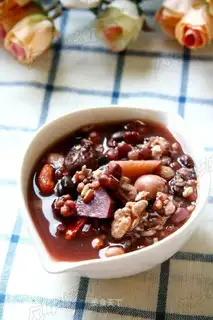 Five grains of porridge
 Red sugar congee
 Black pepper beef pizza