stir-fried fungus with red pepper
By CadenMraz

Let's have another home-cooked dish, one for clearing the lung... stir-fried fungus with red pepper... I hope everyone likes it...
Recipe Recommendations
- dried fungus 50g
- red pepper 100g
- shallots 10g
- Jiang 5g
- garlic 10g
- salt appropriate amount
- pepper appropriate amount
- chicken essence appropriate amount
- fish sauce appropriate amount
- slightly spicy
- fried
- ten minutes
- ordinary
Steps for stir-fried fungus with red pepper
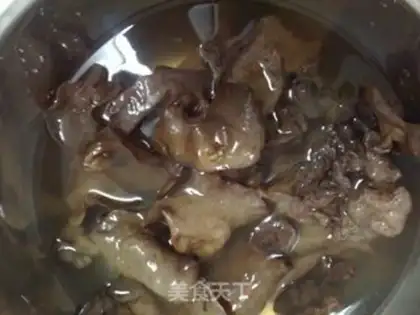
1
Soak dried fungus in water, remove the roots and shred.
2
Remove the red pepper, divide it into two, cut it into corners, cut the green onion into chopped green onion, shredded ginger, and sliced garlic
3
Heat the oil in the pan, add a little garlic slices and shredded ginger and saute until fragrant, add shredded fungus, and stir fry
4
Stir fry for about 3 minutes, then add the remaining ginger and garlic, and stir fry again.
5
Pour in the red peppers, stir fry well, add a little salt, cover the pot with the lid and simmer over high heat for about 2 minutes (so that the frying will not be too dry and will have a little more moisture). Add salt, fish sauce, add chopped green onion, stir fry for a while, and serve on a plate.stir-fried fungus with red pepper Make Tips
Black wood ear is also known as cloud ear, mulberry ear, pine ear, and Chinese black fungus. It has a soft texture, a tender mouthfeel, a delicious taste, and a unique flavor, making it a famous edible fungus rich in nutrients. It can be used in both vegetarian and meat dishes; not only does it add great luster to cuisine, but it also nourishes the blood, beautifies the complexion, prevents disease, and prolongs life. Taxonomically, black wood ear belongs to the class Basidiomycetes, the order Auriculariales, and the family Auriculariaceae. There are 8 varieties in China. The mushroom is shaped like an ear and grows parasitically on dead wood, containing carbohydrates, proteins, fats, amino acids, vitamins, and minerals. Fresh black wood ear appears as gelatinous flakes, is translucent, disc-shaped, and grows laterally on trees. The ear shape is irregular with a diameter of 3 to 12 centimeters. It is elastic; the ventral side is smooth and concave, the edges are slightly curled upward, the dorsal side is convex and covered with very fine down, and it is dark brown or tan. After drying, it shrinks into a leathery state, becoming hard and brittle, and the dorsal side turns dark gray or grayish white; upon entering water, it expands, can return to its original shape, becoming soft and translucent with a smooth, slimy mucus on the surface. Modern nutritionists highly praise black wood ear as the "meat among vegetables," and its nutritional value is comparable to that of animal-based foods. Teflon corresponding URL: http://www.teflon-club.com/club/kaopu_detail.php?reid=1139