Soy sauce, butterfish
By VicentaLakin
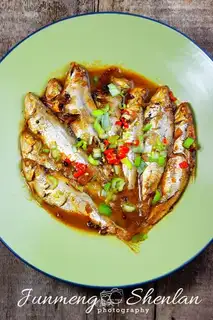
“The sprouts, the twitches, the fragrances, the fragrances, the gnashings, the freshness.” The phrase simply describes a small species of fish produced in the waters of the Sea of Wei Hong, called the yellowfish, which is known by the local population as the “crackerfish”, which usually live at depths of more than a dozen metres, and which migrate to shallow areas of three or four metres each year during the season when the fragrance sprouts take hold. Every spring, fishing boats travel through the sea and fish women are scavenging on shore, looking at the size of the docks of the city, the sea's blue sea, the seagulls and the seagulls. And what's most attractive here is the kind of small fish that eats, the yellowfish. The fish is small, on average a dozen centimetres long, and, in the words of local fishermen, “the big button fish will not be long enough” (the local meaning is the distance between the two fingers after the thumb and the index finger have been spread). It is also known in civil society as knitting, oil buttons, yellow pointers, Wang Jie, tits, bare noses and roasted fish. It's flat, it's a little bumpy. Short head, flat, small eyes. The upper of the chest fin is free, but one fin is extended to a filament and the end reaches the anus. There's a small thorn in front of the back fin (the thorn-like prism). The kisses and the centre of the head are yellow, gray or green on the back, silver on the side and orange on the end. The back fins, the chest fins and the tail fins are yellow and the hips are light yellow. Yellow platinum is a warm, small, medium- and low-lying, offshore fish, often formed into large herds of bait, shrimp-eating and apox, with a life cycle of four years. Near-coastal migratory fish species are often found in estuary areas. The period of March-April and September-October of the Yellow Tompo Sea. Yellow is one of China's most important food fish. The meat is fine, tastes good, has high nutritional value, is protein-rich, fat-rich and contains large amounts of minerals such as calcium, phosphorus and iron. Its medicinal value is also extremely high. It is odour, flat, warm, stomach, kidney, which has the effect of repairing and retortation, dehumidizing water, retrieving vanity, eating warm stomachs and retrenchment. The nets used to fish yellow gills are called jarnets. Each web is 40-50 metres long and is rectangular. Fishermen carry it by boat to a sea one or two nautical miles away, holding one end of the net with a long stick, falling on the bottom of the net and leaving the other without it. So the whole net is like a mouthful of croaks, and the tides are pouring around in the ocean, and the fish shrimps are ready for delivery. Once the yellowfish enter the net, the net is smaller and smaller from the outside, with only a few centimetres thick at the end of the net, and the yellowfish can easily get in and out. Different fish have different habits, and they move in different places in the sea. Yellowfish prefer to travel in water about two metres from the surface of the sea, and fishermen have to control their nets with foam-made floats. In fact, fishers were first used to control nets. When a net drops in the sea, it fills the altar with more water; when a net rises, it pours out some of the water, which is called an jar. In the 1980s, the number of yellow gillfish in the sea was so high that it could be described as a disaster, with an average net approaching a kilo a day. At that time, the fish was cheap, selling two triangles per pound, but in large quantities, and in April of each year, everyone was able to make little money by fishing it. Since then, the number of fishing vessels has increased, and the number of yellow mackerel is decreasing. "Selling--punch fish." Once upon a time, when evening came, the sound of the traffickers calling for yellow gills came from villages large and small by sea. Villagers heard they went out to buy one or two pounds of peanut oil, fryed with peanut oil, and fed with tungsten or tungsten are the most common. Living by the sea, eating all the fish, making me feel the freshest, the smelliest, the yellowfish, which has a lot of stings, but which is especially oily, which usually can only be fried, fried or eaten, or fertilized after drying. Because the fish is stingy and easily hurt their throats, there is also a local custom of not turning back, let alone bowing, or getting stabbed. The seawater is relatively salty and can reach about 30 per cent; the seawater is pure, always clear blue, and the yellow larvae is naturally good.” A characteristic of yellow gills is that they die on shore, and therefore they are extremely difficult to farm, and they are not yet cultivated。
Recipe Recommendations
- Yellow carp 10 articles
- salt appropriate amount
- soy sauce appropriate amount
- sugar appropriate amount
- cooking wine appropriate amount
- oyster sauce appropriate amount
- onion appropriate amount
- Jiang appropriate amount
- garlic appropriate amount
- pepper appropriate amount
- octagonal appropriate amount
- Little red pepper appropriate amount
- salty and fresh
- burn
- ten minutes
- senior
Steps for Soy sauce, butterfish
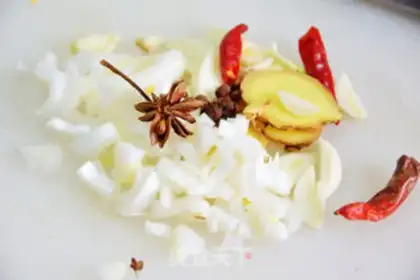
1
Onions, ginger, garlic, peppers, horns, red peppers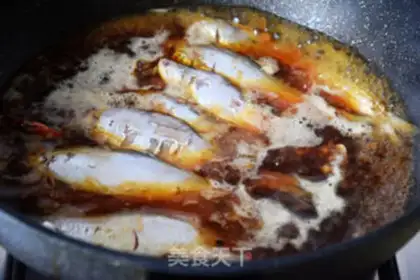
2
When the pot is refuelled and hot, the spices boil, when the sauce is boiled, and when the water is released, the purified fish are fed into the pot, adding salt, sugar, wine, apricot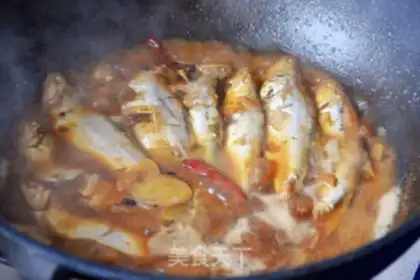
3
(a) The turn of the pot into a small flaming ring for about 10 minutes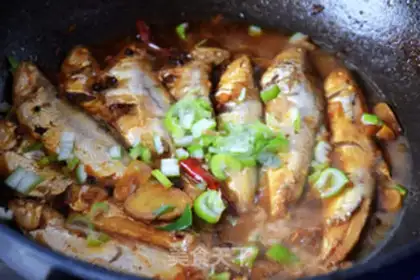
4
Then the fire will gather the juice and pour it into the onion。Soy sauce, butterfish Make Tips
One, yellowfish are stingy and be careful to eat; two, yellowfish have a variety of practices and can be fried, steamed, etc。