Hokkaido toast
By VicentaLakin
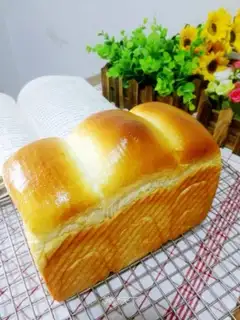
Today I can't help but do 100% of the Chinese Hokkaido toast. It's really delicious. It smells like milk, it's so delicate, it's so soft, it's so flexible, it hits it. What puzzles me is that when you're out of the oven, it's a little dimpled, for whatever reason
Recipe Recommendations
- high-gluten flour 250 grams
- fine sugar 8 grams
- sugar-tolerant yeast 1.5 grams
- pure milk 80 grams
- light cream 70 grams
- egg white 20 grams
- unsalted butter 5 grams
- salt 3 grams
- milk powder 15 grams
- whole egg liquid a little
- milk fragrance
- roast
- several hours
- senior
Steps for Hokkaido toast
1
Put all Chinese materials into the bread drums and start the "Customs and Faces" program (my bakery is 8500 platonics and the "Customs and Faces" program is by default 13 minutes) in groups, which need not be smooth to the surface。2
Cover it with a baking sheet and put some beads on it3
And a wet towel4
And then you put on the hood of the baker and let the noodle ferment5
We're not at a very high temperature right now, and this noodle is very slow to ferment because it contains a lot of light cream. I woke up at more than 9:00 this morning before I went to bed last night (when I didn't go to work until I woke up naturally, ha ha) and it just happened to be twice as big, with my hands on it, and it felt like the face was drifting, turning over, and there were clear holes at the bottom。6
Tore the Chinese into a bread bucket and put them in the main lard material (but not butter first). Note: Sugar and salt are placed at both ends of the bread can, and yeast are spread over the noodles。7
The iMix program (20 minutes) was initiated, after which the left hand covered the olive oil, squeezed the noodles, cut the small noodles with a pair of scissors in the right hand (without scratching the noodles with the hand or cutting them off with a knife, because both methods have a pull force against the noodles, which is not conducive to the back of the noodles, squeezing them slowly towards the surroundings, at which point the noodles did not reach their full stage, were not able to tear out the thin membranes and were easily broken。8
Add softened butter and start iMix again9
When the procedure is completed, a small piece of noodles is removed and their hands are slowly opened up, which can easily become a very thin and difficult sheet of film。10
Split the noodles into three equals, roll round, shrouded with a shampoo of 15-20 minutes11
When a face is flattened, the cane is pressed on the face, and the face goes up and down, the face becomes an elliptical face, and the bubble of the edge of the air is punctured with toothpicks12
Up and down in the middle13
We'll do all three of them, and then we'll turn 90 degrees to put it down, and we'll put it down in 15-20 minutes14
And then you're gonna put your face up and grow, and you're gonna have to cut through the edges with your toothpicks, and you're gonna have to clean the air15
Squeeze down, roll up and down16
Put in the mold17
Put the three noodles in the mold18
Put it in the bottom of the oven with a bowl of open water (to produce steam to maintain humidity) and fermentation19
The pre-heat oven with an eight-point end of the mould, removed, 180 degrees above (with a thermometer in the oven, showing 210 degrees), a smooth egg fluid on the surface of the face, placed in the lower of the pre-heated oven, 180 degrees and 30 minutes in the upper fire, (upholstered tin paper)20
Out of the oven, the bread is poured out and placed on the grilled web to cool up to the temperature of the hand, so that the mouth is clad in a bag. It's totally cold to enjoy。21
Take a look. Good toast can be radish. It's delicate。Hokkaido toast Make Tips
1. Bread making is important and cannot be fermented too quickly, so it is generally natural. Each oven is different, so temperature and time only provide reference. The temperature and timing of the bakery must be based on the situation in the oven