Rice sprouts started trying to make bread in August this year. Since then, they have been out of control. They have to make bread at least twice a week, otherwise I feel uncomfortable. Especially after knowing that my mother-in-law likes the bread I make, I can make bread to the point where I can sleep endlessly. A while ago, I suddenly became hotheaded and participated in the Gourmet's year-end competition. For this reason, I temporarily stopped making bread.
In the few days when I didn't make bread, I read many posts and books, but I didn't read "BBA" seriously-I preferred the few pages of descriptive words written by the author in the front. They were eloquent, simple and warm, and they didn't look boring... Uh, it seemed to have gone astray...
When I didn't make bread for a few days, I always wondered what kind of bread I should make next time. When I was thinking about making bread, I couldn't concentrate on how to make the theme competition, and then I wanted to make bread more, and the theme competition lost inspiration... I was a little annoyed, and my husband said,"Why are you torturing yourself like this? Aren't you going to the gourmand just for fun?" One sentence woke up the person in my dream, and I suddenly realized... What I want to do should be what I like! So, I decided to continue making the bread I like! Then, my whole egg toast and pure milk whole wheat toast were born, hehe...
Actually, I just want to talk about some of my experiences in making bread over the past few months. Let's get to the main topic now!
The most important thing in making bread is kneading and fermentation. The biggest improvement for me now is mainly kneading dough-using the bread machine, I can basically knead a beautiful film! This is what makes me so happy at the moment. Maybe I haven't done very well, but it's really different than before.
Maybe everything is like this. Although there is the experience of predecessors, if you don't operate it with your own hands and experience some failures, you will never be able to truly understand the valuable experience left by your predecessors, nor will you be able to truly learn anything. For example, when kneading dough, I hoped that I could take shortcuts at first, but later I found that making bread is really a practical job and cannot be sloppy at all! After reading many posts, I learned a lot of basic knowledge from the posts of Sina's "Xiaodan"(http://blog.sina.com.cn/ce32fc). It was mainly the problem of kneading dough with the bread machine. His explanation was very detailed. Following his method, I gradually had the feeling-every time I used the bread machine to knead dough, I used the "dough dough" program to knead dough twice for a total of 40 minutes--The first kneading time for 20 minutes, the bread machine entered the fermentation process. At this time, the "dough" program was selected again, butter was added, and stirring for 20 minutes. Then take it out and beat it 100-150 times, with the kneading action in the middle. It takes about 5 minutes in total. When you fall 100 times, you can check the pulling condition of the membrane. If not, continue to beat until you can pull out a beautiful membrane. Generally, you can beat it about 150 times. If you do all of this, the dough still cannot pull out of the film, and it will easily break when you pull it. It is likely that there is not enough water. The issue of kneading the dough and adding water is also important. What I want to talk about next is the problem of adding water:
Occasionally in a post (I can't remember who the author is), the blogger mainly talked about the issues to be paid attention to at the beginning of kneading dough with a bread machine. For example, from the time the ingredients go down to the dough, you should stay by the bread machine., mainly pay attention to whether the water consumption for the dough is appropriate. Because different flour water absorption is different, and different weather, different batches of flour will affect the water absorption of flour, this I deeply understand! One day's water consumption may be low the next. Therefore, when kneading flour with a bread machine, first add 2/3 of the amount of water in the recipe. When the bread machine kneads the raw materials into a ball, if the rotation of the bread machine's stirring knife is difficult, pinch the dough with your hand. If the dough is hard, it means that the dough is relatively dry. Add water. The method of adding water is to add water to the dough instead of pouring it directly into the bread bucket. Moreover, do not add all the remaining 1/3 of the amount of water at once. It is better to add half the amount. If the same thing happens again, add another half of the water. If all the remaining 1/3 of the water is added and this happens, then additional water will be needed. Generally, 10-20 grams are added at a time. It is better for novices to add it slowly. If you add less, you can add more. If you add more, you will be in trouble! If the mixing knife rotates freely and the dough is wrapped around the mixing knife rather than being thrown around, it's basically fine. Then pinch the dough with your hands. It's wet and soft, but it won't stick to your hands.
My current experience in dough fermentation is that "you can't grab it fast"! I used the "fermentation" function of the oven to ferment before, but later measured it with a thermometer. When my oven started the fermentation function, the temperature inside was about 50 degrees! The optimal temperature for dough fermentation should be around 28-30 degrees. In this way, the temperature during the "dough spreading" process of the bread machine is the most suitable, but after the dough is finally shaped, it is not suitable for fermentation in the bread machine. According to the gourmand's "stir-fried spoon" method, use a steamer to ferment-that is, inject water into the steamer, heat it to 50 degrees, then close it, place the container containing the dough on the steaming rack, cover the lid, and this fermentation The effect is very good, that is, the water easily gets cold in winter, and it needs to be heated again in the middle, which is troublesome. There is also the method provided by "Xiao Dan": use a foam box to ferment-that is, put a bowl of warm water at each end of the foam box, then put the dough in, and seal the foam box. The gourmet beauty "Wu Siyuan Ren" tried it, and the effect is good. I haven't found a foam box yet, so I can only make full use of my bread maker! So this time I didn't use the oven but used a toaster to make toast the whole time. Let's take a look at my making process and finished product effect!
Whole-wheat black sesame toast
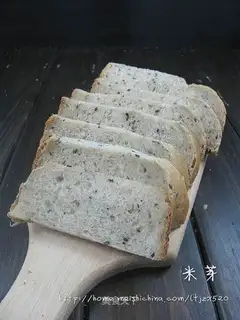
Recipe Recommendations
- the sponge appropriate amount
- whole wheat flour 130 grams
- high-gluten flour 95 grams
- water 50 grams
- main dough appropriate amount
- salt 1/2 teaspoon
- honey 25 grams
- black sesame 2 tablespoons
Steps for Whole-wheat black sesame toast
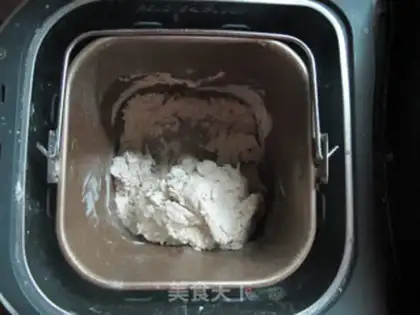
1
Mix the Chinese ingredients, press the "Menu" button, select the "5""Sweet Bread" program, and then press the "Start/Stop" button to start kneading the dough. This is not what it looks like long ago.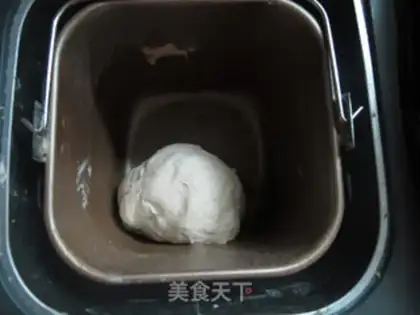
2
After kneading for ten minutes, the bread machine stopped stirring, pressed and held the "Start/Stop" button, closed the "Sweet Bread" program, and started basic fermentation.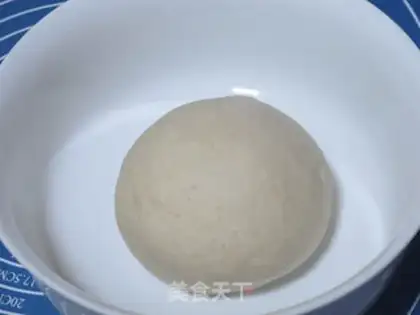
3
Round the dough, and then put it into the bread machine for basic fermentation. This is to make the dough smoother and better, but... I forgot to pat the dough when it is ready...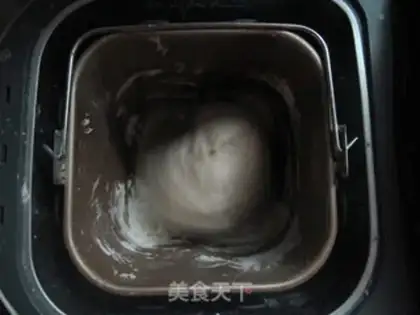
4
After basic fermentation, tear the Chinese dough into small pieces and mix it with the main dough material, press the "Menu" button to select "8" to start the "dough dough spreading" program.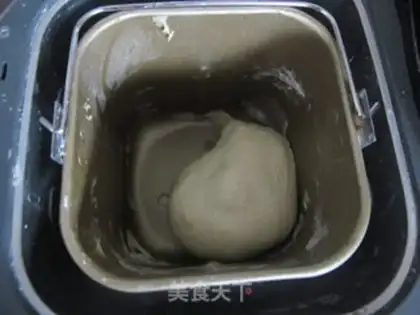
5
The kneading time of the "dough" program is 20 minutes. After 20 minutes of kneading, the bread machine stops kneading. At this time, the "Start/Stop" button is still pressed and held. When the program is reset to "1", add butter., press the "Menu" button again, select "8", and start the "dough" program again.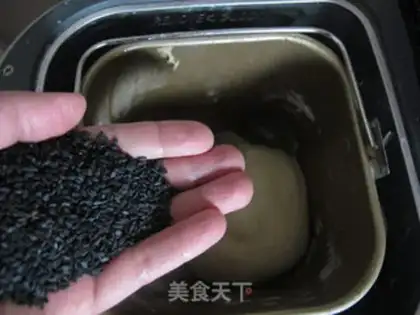
6
Knead the dough for the second time for about 15 minutes, and add black sesame seeds.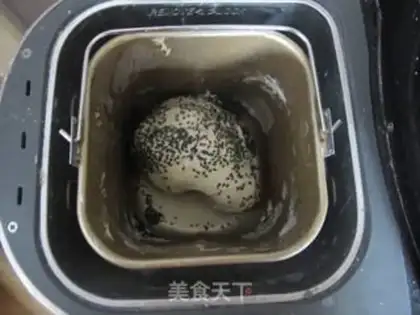
7
After kneading the dough for 40 minutes, take out the dough, taking care not to turn off the "dough spreading" program, but to cover it and keep it warm inside. Because after kneading the dough by hand, the dough must be put back into the bread maker to ferment.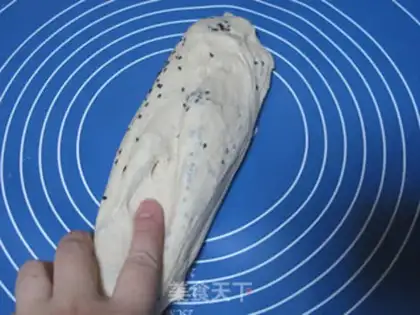
8
Place the dough on the kitchen counter, place it on a silicone pad, and throw the dough out with your hand as the center. As shown in the picture, the dough will stretch when it is thrown out.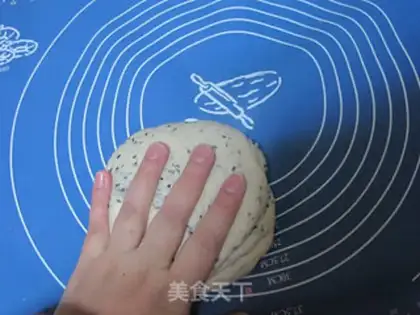
9
After shaking it two or three times, the dough will become very long and be stacked. Shake it again and beat it again and again 100-150 times.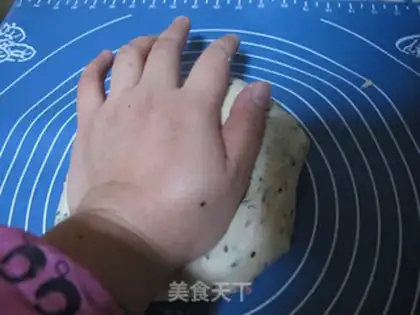
10
During the wrestling process, you must also cooperate with the kneading action.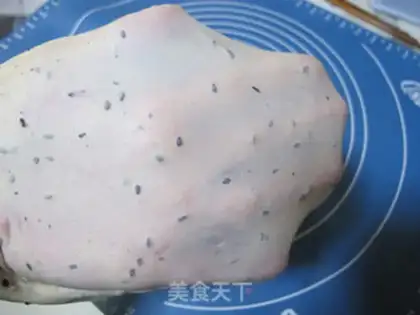
11
Until you can pull out a large, thin, strong membrane.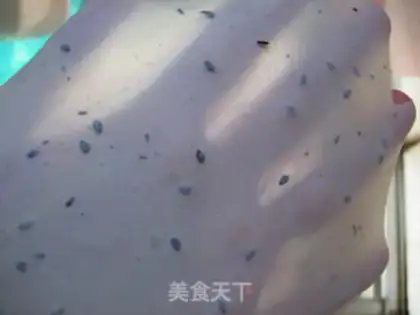
12
This is the effect of light.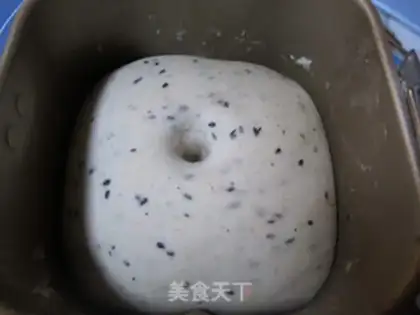
13
Round the kneaded dough, place it in a bread maker, and ferment it for a second time.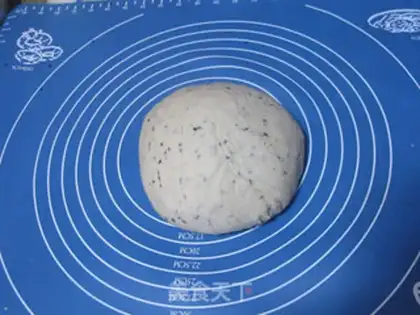
14
After the second fermentation, take out the dough, place it on the chopping board, exhaust it, round it again, relax for 20-30 minutes. It is advisable to roll it out with a rolling pin without difficulty and easy to retract.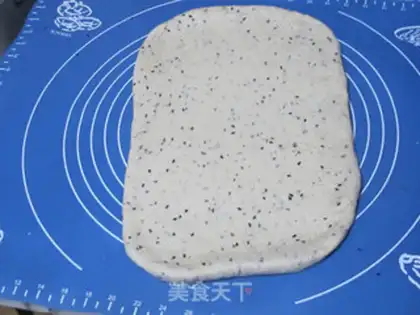
15
Roll out the relaxed dough into large pieces. It doesn't need to be very thin. Using my silicone pad as a reference (there are scales on it), the length is about 30 cm and the width is about 20 cm. Form the dough into a square.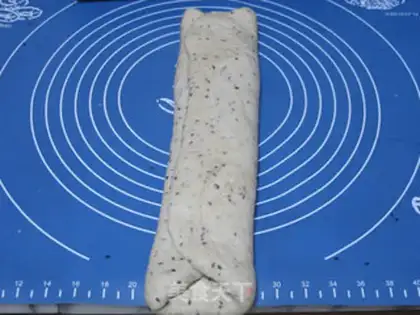
16
Then move it lengthwise and fold each side 1/3 to the middle.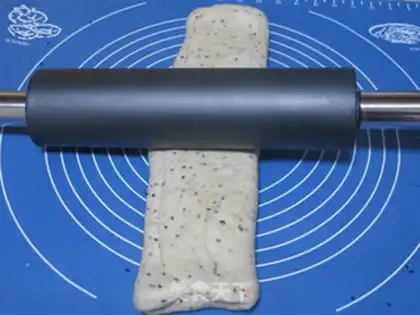
17
Roll open slightly with a rolling pin.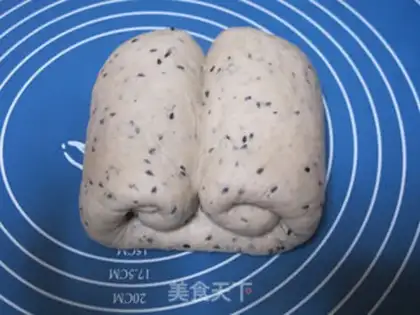
18
Roll each end 1-1.5 times to the middle to finish the shape of the toast. Because I am using the toaster to bake toast today, I adjust the dough to fit the bread bucket.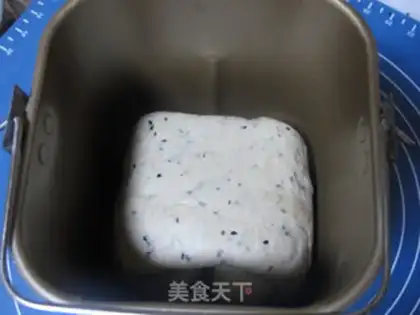
19
Put the shaped dough into the bread bucket. Not to mention, it's really suitable!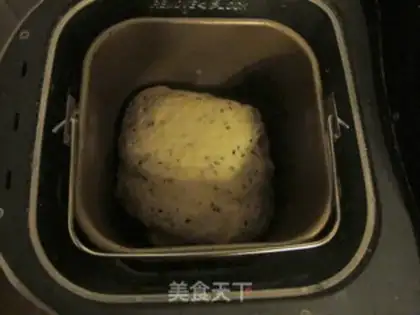
20
Finally, the fermentation reaches twice the size (it is already dark at this time, the lighting in the dining room is not very good, so I am lazy and didn't turn on the camera lights), and the fermentation time for the "dough dough" will be enough! Activate the "Bake" function and wait for the finished product to come out, haha! By the way, while I was shaping the dough, I used the "dough" program of the toaster to knead the dough for making the buns, so when I was done shaping it, I took out the dough for making the buns directly, put it in the refrigerator, and then put it in the toast dough and fermented it directly! Haha…