In Sichuan and Chongqing, most people make bean paste (directly called "Douban") to prepare home-cooked dishes. The raw materials of home-made watercress are basically the same as those used in Pi County watercress. The latter is mainly industrial mass production with special formulas, complex processes and higher production requirements; while the former has relatively simple processes and no restrictions on the production environment and venue, making it suitable for family production.
The ingredients used in the bean paste I make myself are fresh and sufficient, healthy and hygienic, and do not contain any pigments or additives. The finished product tastes more fragrant than the one I buy. When frying, the pan will not be cooked (the bottom of the pot will be pasted). The dishes made are red in color and bright and fragrant. When buying Pi County watercress from outside, you have to open your eyes and choose products from well-known large factories, otherwise you will accidentally buy something that is not authentic. I still have lingering fears about the bean paste and chili paste I bought from abroad. Back then, many unscrupulous factories used "Sudan red" to reduce costs and improve color. Some would add flour and other raw materials to reduce the amount of chili peppers. The color of the bean paste darkened and completely lost the red luster of the red pepper itself.
Douban is made every year or two. As long as the prepared Douban is stored properly, it will become more and more fragrant, and there will be no problem leaving it for a few years. I am used to eating my own bean paste, and no matter how troublesome it is, I want to make it myself. I don't waste much time thinking about it. Compared with the long time that it used to take time and effort, it only takes a few hours to make it once, but it can be eaten for a year or two or even three years. Moreover, the production process is also an enjoyable process.
I often think of all the processes I used to help my mother make home-made watercress at home when I was a child: cutting bean (broad bean) petals->peeling the shell of bean bean->WO watercress (fermented Aspergillus flavus)->beating sea peppers (peppers)->making watercress paste jar. This series of tasks is usually completed in the summer. I thought I was small at that time, sitting on a small bench with a long bench high in front of me. The basin on my left hand contained whole beans. A small basket was placed under my feet. I grabbed a handful of beans with my left hand. Holding a small machete in my right hand, using my thumb and index finger to fix the beans under the cutting blade, and then "pop" it on the bench. The beans were cracked into two intact from the middle. With a loose finger, the beans fell into the basket under my feet, and it took only a short amount of effort to knock one or two kilograms. Then soak the bean beans with clear water, peel off the bean shells, drain the water, and when it is half-dry in the sun, pick fresh tree leaves or pumpkin leaves, take a large dustpan made of bamboo, and evenly spread the leaves on the dustpan, then evenly spread the bean beans, then cover with two layers of tree leaves or pumpkin leaves, and place them in a cool place to grow mold (Aspergillus flavus). Wait until the watercress grows green and black mold hairs (not the mouldy mold), the mouldy watercress will be ready. Moldy bean beans do not need to be washed. They can be soaked directly to make bean paste, or they can be dried and used again. If stored properly, they can be preserved for several years. Now, there is no longer this fun, because you can buy Wow-ready Wow-bean beans in the market and use them directly after soaking them soft, saving the very troublesome process of cutting Wow-bean beans. When I returned to my hometown this year, I actually saw that when I was a child, I was sitting on the stool where I was cutting mustache beans. It was still the same, the same color, and still as strong. My father said that he had this stool when he was a child. It seems that this stool will be fine for 100 years.
Sichuan Home-cooked Douban
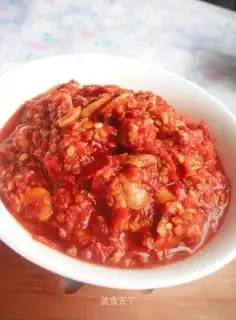
Recipe Recommendations
- red pepper 30 pounds
- salt 3.5 jin
- green pepper 50 grams
- medium spice
- other
- several days
- senior
Steps for Sichuan Home-cooked Douban
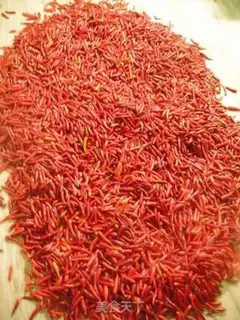
1
Buy fresh chilli with few seeds.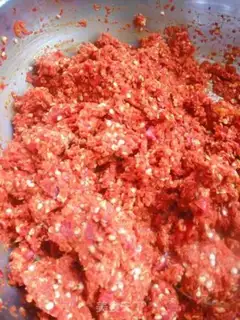
2
After the red peppers are removed, washed, and drained of the surface moisture, take a large water-free container, chop the peppers with a water-free and oil-free knife and cutting board or break them with a clean food processor (Don't beat them too much, just make them rough).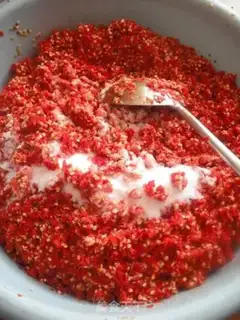
3
Add about 3 kilograms of salt, stir well, and place into a jar. The salt should be salty enough so that the watercress does not easily sour. 30 kilograms can hold 2 - 3 jars. Due to different uses, one of the jars can be put with some pepper to enhance the fragrance. I like the aroma of green pepper.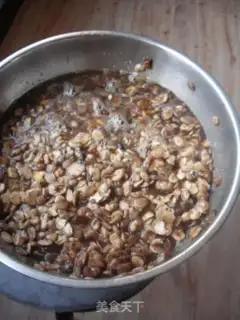
4
Soak the moldy bean curd in beer for two to three days (keep observing and keep the beer just submerged the bean curd. If there is not enough beer, add it in time), and add about half a pound of salt to mix well. You can soak the watercress in advance, or you can cook the peppers first, and you can add them when the watercress is ready.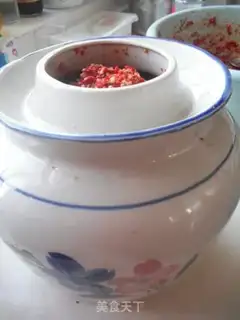
5
Pour the soaked moldy watercress and beer into the pepper jar, mix well, then sprinkle with a layer of salt, seal the mouth of the jar with plastic wrap, cover the jar, and seal the rim of the jar with water.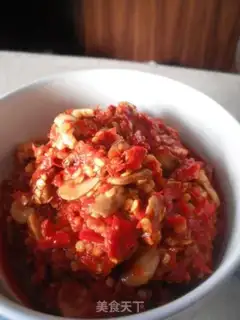
6
After fermentation for a period of time, the peppers no longer have the fresh and spicy taste and begin to become mellow, so they can be used. During the first few months of fermentation, remember to take time to stir the watercress and observe the fermentation situation. If you find that there is white, you can eliminate it by pouring in a suitable amount of high-quality white wine.Sichuan Home-cooked Douban Make Tips
1. You can put some pepper in the watercress jar to make the taste more fragrant. I usually like to put two jars in, one in and the other not. I like to put green pepper best to make it more fragrant. 2. You can pour appropriate amount of raw vegetable oil or vegetable oil into the watercress jar and seal it. Air cannot easily enter and watercress cannot easily turn white. 3. The mouth of the jar needs to be covered with a layer of plastic wrap and the rim of the jar should also be wrapped, so that the water along the jar will not be sucked into the jar, affecting the quality of the watercress. 4. Regularly replenish water along the altar edge to keep the altar edge clean.