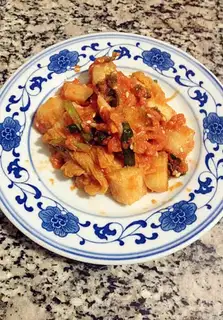
Korean spicy cabbage
By VicentaLakin
Recipe Recommendations
- baby vegetable four
- Apple
- pear a
- fresh ginger a large piece
- garlic a
- onion half a
- glutinous rice flour appropriate amount
- carrots half a
- leek a
- white radish a
- Korean hot sauce two tablespoons
- fish sauce appropriate amount
- white sesame appropriate amount
- chili powder appropriate amount
- coarse salt appropriate amount
- refined salt appropriate amount
- white sugar appropriate amount
- slightly spicy
- pickled
- ten minutes
- ordinary
Steps for Korean spicy cabbage
1
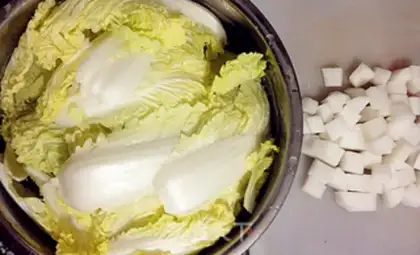
Wash and pick baby vegetables into slices (you can choose Chinese cabbage, I'm afraid I'll choose baby vegetables if I buy bad ones. In fact, it's just as delicious) Because the leaves are small, you don't need to cut them, and then soak them in water (to be cleaner). I also cut half a white radish ~ the white radish was cut into 1.5 cm square pieces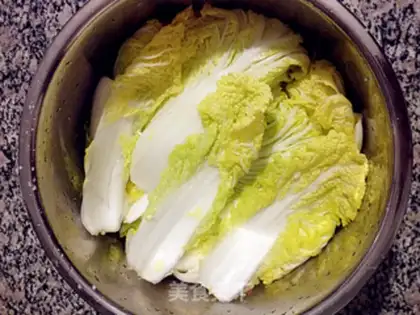
2
Prepare a bag of coarse salt, slightly drain the soaked cabbage, find a container that can hold all the cabbage and radishes, sprinkle with a thin layer of salt first, then put a layer of cabbage, and then sprinkle with a thin layer of salt, but Sprinkle evenly, then add cabbage, and so on until the cabbage and radishes are finished. (If you don't have it, refined salt can also be ~ but it's better to use coarse salt, because the cabbage needs to be drained next, and the coarse salt is specially used for this ~) Then put a plastic wrap on the cabbage, press heavy objects on the plastic wrap, and keep it for at least five hours.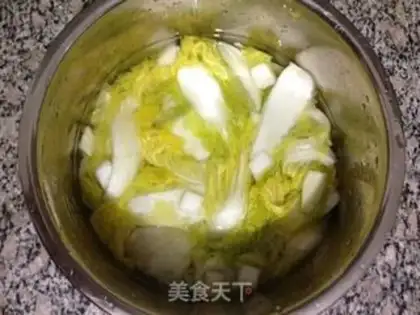
3
This is cabbage that has been marinated all afternoon. It is very soft, because there is so much cabbage soup. At this time, the cabbage is very salty, so you should pour the marinated cabbage and radish to remove the water, rinse it with water several times, and then fill it in the container. Fill it with clear water to drown the cabbage, which is also to remove the salty taste. After this step is done, soak the cabbage and radish in water, and then prepare the marinade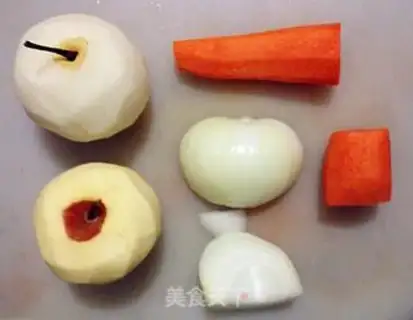
4
Prepare fruits and vegetables, cut them into pieces and place them in the cooking machine to juice (note that juice ~). Don't omit fruits, which will help fermentation and give the finished product a fragrance, which is a sweetness that cannot be replaced by white sugar ~ Carrots are for color ~ Shallots enhance flavor ~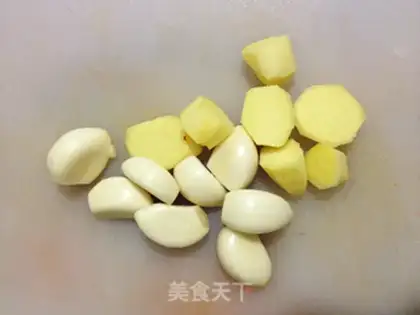
5
Peel the ginger and garlic and cut into pieces, and continue to put them into the cooking machine to juice. You don't have to distinguish them from fruit and vegetable juices, just squeeze the juice together ~ I just want to take pictures ~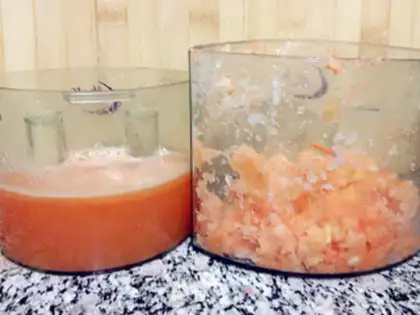
6
Place the squeezed sauce and fruit and vegetable residue separately, and remove the glutinous rice flour.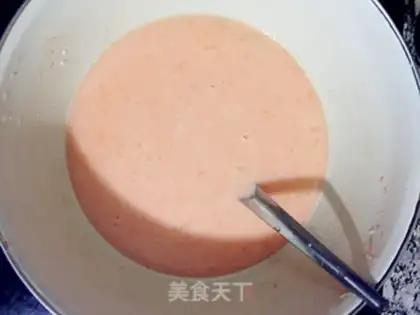
7
Here comes the personal secret weapon ~~ It is definitely the exclusive one I developed personally ~ Mix the glutinous rice flour and fruit and vegetable juice in a ratio of 1:10 ~ Pay attention to the fruit and vegetable juice ~ If your juice output is not large, you have to add some water. If enough, use all the fruit and vegetable juice ~
8
Place on heat, turn on low heat and stir constantly to avoid sticking to the pan. When heated until the glutinous rice is stuck to the cannon and becomes very thick, cease fire ~ as shown in the picture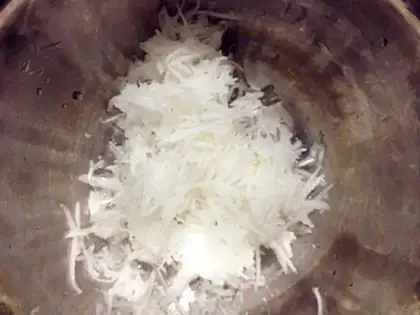
9
Set aside the glutinous rice paste to cool. Peel half of the white radish and rub it into thin threads ~ Generally, I will attach it to the radish pieces for pickled spicy cabbage. The reason is that the sauce of spicy cabbage requires shredded white radish ~ After wiping, add appropriate amount of salt to flood out the water. After draining the water, drain away the water.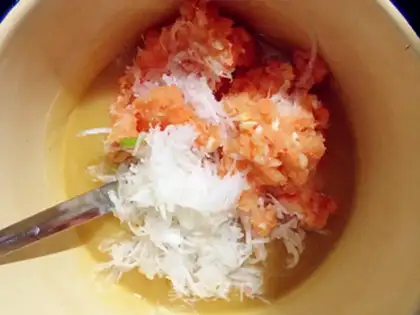
10
After cooling the glutinous rice paste, add the squeezed fruit and vegetable residue and the pickled shredded white radish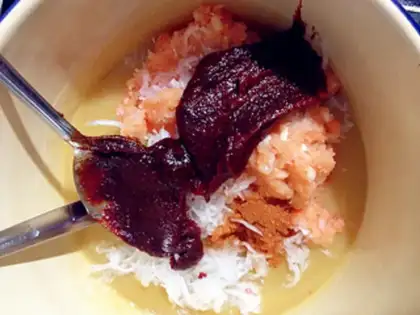
11
Add Korean chili paste (the household I use, it tastes good, I don't worry about adding more chili paste ~ you can put more) and fine chili powder (chili noodles). If you look at the picture, you will find that I add very little chili noodles, because this chili noodles are very spicy ~ You add the right amount according to the spicy degree of your chili powder. It is recommended to add less first, and finally add it after it is not enough flavor.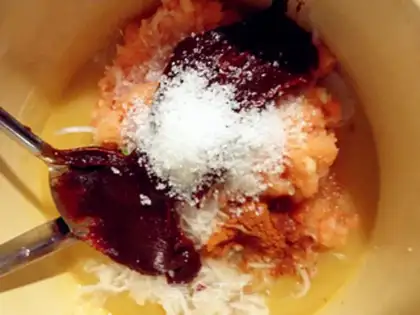
12
Add sugar and fish sauce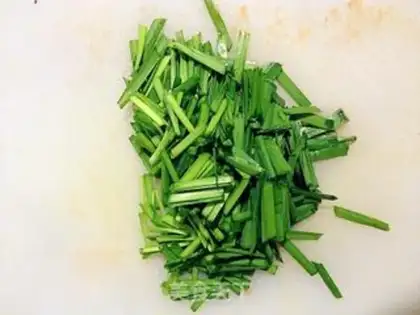
13
Remove the roots of the leeks, wash them, and cut them into sections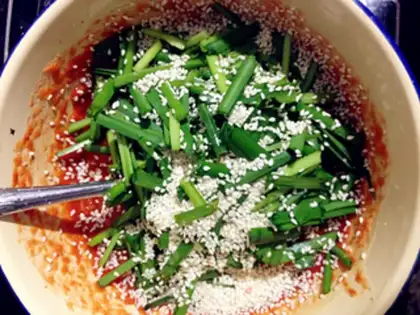
14
Add leeks and white sesame seeds and a small amount of salt, and never mind a small amount of salt. At this time, you should try your cabbage. If the cabbage is just a little salty, add less; if it is very salty, don't add any at all. Then soak the cabbage in more water ~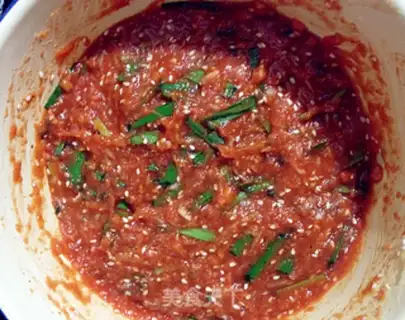
15
Stir all the ingredients evenly and taste the taste. The taste should be very good at this time ~ If it is not sweet or spicy enough, add the chili noodles or white sugar. If the garlic and ginger are not taste enough, chop them into mashes and add them ~ But remember not to taste too much of the garlic and ginger. Too prominent ~ the whole sauce should be a new taste of multiple materials ~ the main taste is sweet and spicy ~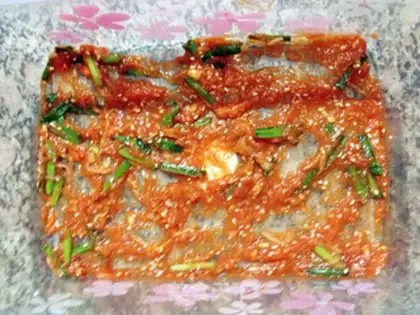
16
First apply a layer of sauce to the bottom of the large crisper box where you want to keep spicy cabbage (ensure that the crisper box is disinfected in advance without oil or water)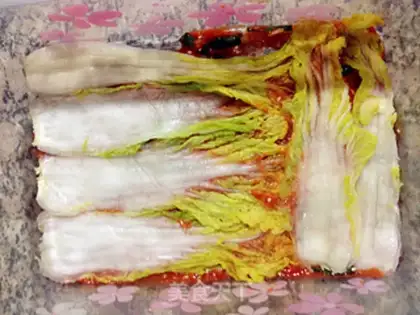
17
Grab the soaked cabbage and spread it evenly on the hot sauce to ensure that each piece is stained with the hot sauce (when holding the water, it is like twisting a towel, but be careful not to twist it)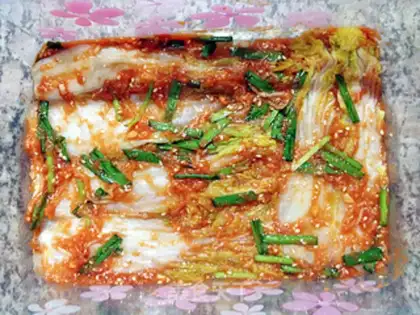
18
Spread a layer of hot sauce evenly on the cabbage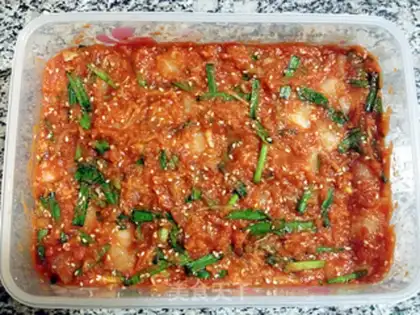
19
By analogy, lay all the cabbage. Put the white radish pieces first or put them last. It's entirely up to you. The requirement is also to dry the water ~ apply thick hot sauce on the top ~ This will help fermentation ~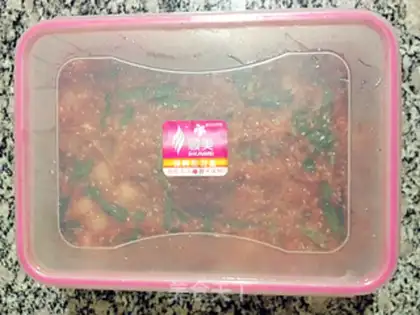
20
Cover and ferment indoors. If it's winter, keep it in a warm place. Leave it indoors for one to two days in summer. Winter is three to four days. Place it until you open the box and have a slight sour taste. Gently press the cabbage with the tip of your chopsticks and you can feel that there is a certain space under the cabbage. When pressed, it does not feel solid but virtual, which means that the preliminary fermentation has been completed ~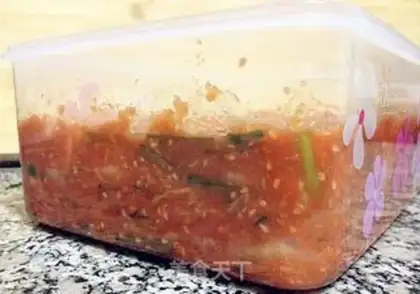
21
After the preliminary fermentation is completed, put it in the refrigerator, that is, refrigerated ~~ I don't like the very sour ones, I just like the taste when they have just been fermented, so I usually eat them on the fifth or sixth days ~ The more sour they are, the more prominent it will be ~ What flavor you like is up to you ~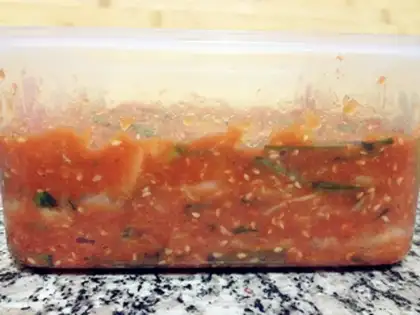
22
Side view of the crisper box, the sauce must be enough to taste the pickled slices ~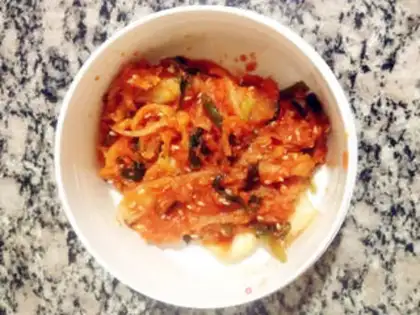
23
Finished product ~ Cut it into pieces and eat it if there are guests ~ Eat it in one piece if there are no guests ~ Or eat it with your hands like Koreans ~ Cool! This is how good taste is born ~ I can't stop talking ~ With it, you can make ever-changing kimchi food ~Korean spicy cabbage Make Tips
1. Although the ingredients are a bit complex, the taste is definitely good ~~~ So you should try your best to prepare them ~ Fish sauce is a condiment often used in coastal countries. It is sold in major supermarkets. If you don't have it, use shrimp skin instead ~ Both can be put in some ~ I don't have shrimp skin at home, so I didn't put it
2. One of the key steps is to use fruit and vegetable juice instead of water to boil the glutinous rice paste
3. The second key step is to grasp the water from radish pieces and cabbage, and the glutinous rice paste should be thicker. The shredded white radish should be marinated to remove the water. Because if their moisture is not cleaned, a large amount of soup will emerge during the fermentation process, the taste of the sauce will become lighter and the vegetables will be too soft and soft, which will destroy the hard-working kimchi ~
4. The more fermentation, the more acidic it is, the more acidic it is, so if you put it in the room for slight fermentation, you must move it to the cold room to delay its fermentation speed ~ so that you can not finish it in a while and become too sour.
5. The tone of this dish is sweet and spicy flavor, which is actually a prominent feature of Korean cuisine. Therefore, you must grasp the amount of salt. I have already said before putting the chili noodles carefully.
6. Although it is irresistible to eat alone, you can also make kimchi fried rice, Korean hot sauce soup, spicy fried rice cake and many other Korean dishes. On busy days, cooking a bowl of porridge or rice will definitely make you enjoy it with it ~~ It's so delicious and definitely worth a try ~
30,000 words of praise are omitted here. I hope you will learn it ~ This is definitely an exotic delicacy that makes everyone exclaim, admire, and follow suit ~
2. One of the key steps is to use fruit and vegetable juice instead of water to boil the glutinous rice paste
3. The second key step is to grasp the water from radish pieces and cabbage, and the glutinous rice paste should be thicker. The shredded white radish should be marinated to remove the water. Because if their moisture is not cleaned, a large amount of soup will emerge during the fermentation process, the taste of the sauce will become lighter and the vegetables will be too soft and soft, which will destroy the hard-working kimchi ~
4. The more fermentation, the more acidic it is, the more acidic it is, so if you put it in the room for slight fermentation, you must move it to the cold room to delay its fermentation speed ~ so that you can not finish it in a while and become too sour.
5. The tone of this dish is sweet and spicy flavor, which is actually a prominent feature of Korean cuisine. Therefore, you must grasp the amount of salt. I have already said before putting the chili noodles carefully.
6. Although it is irresistible to eat alone, you can also make kimchi fried rice, Korean hot sauce soup, spicy fried rice cake and many other Korean dishes. On busy days, cooking a bowl of porridge or rice will definitely make you enjoy it with it ~~ It's so delicious and definitely worth a try ~
30,000 words of praise are omitted here. I hope you will learn it ~ This is definitely an exotic delicacy that makes everyone exclaim, admire, and follow suit ~