Anatomy and application of perch
By VicentaLakin
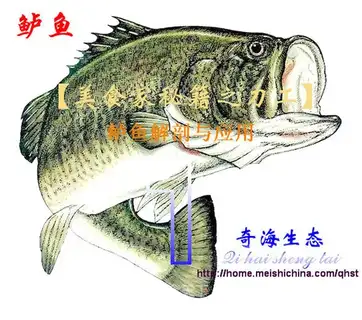
Recipe Recommendations
- Freshwater perch appropriate amount
Steps for Anatomy and application of perch
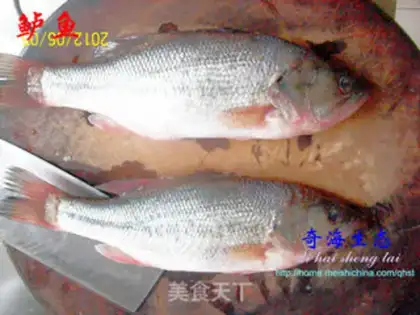
1
Perch slaughter: There are no special requirements for perch slaughter today. Therefore, ordinary vegetable farms can simply let them slaughter when purchasing them.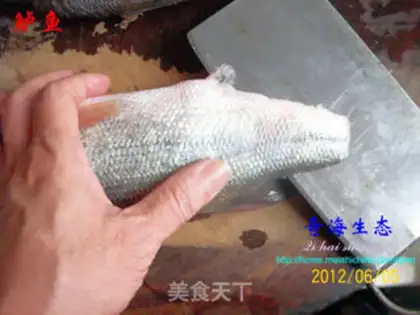
2
The first knife A. Slice the upper part of the perch: 1. Dry the perch body and the chopping board with water to avoid slipping between the fish body and the chopping board. You can place a dry cloth on the chopping board for the first time. 2. Place the bass flat on the chopping board, with the back of the bass facing inward. The purpose is to make it easier for the base of the knife to exert force after inserting the knife and avoid scratching the skin due to the force of the blade. 3. Insert the knife, hold your hand on the fish head and its upper body, add the knife to the fish tail and tail bone, and use it to retract the knife and shave it along the tail bone. After inserting the knife, the knife head is forward, and the tip of the knife follows the lower part of the fish body. Shave the fish tail fin line into the abdominal cavity of the perch.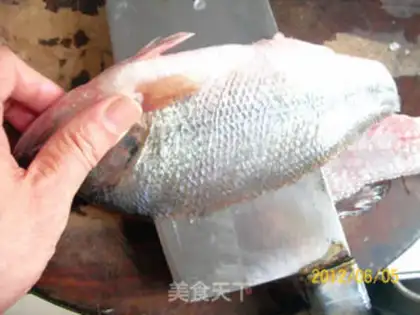
3
Then, use the base of the knife to shave it along the dorsal fin line of the upper half of the fish. Then use the knife to shave it close to the bass vertebrae and cut off the fish ribs with force to separate half of the fish from the fish bones.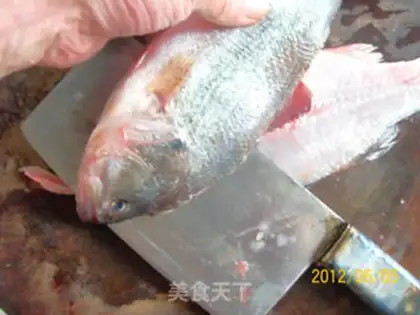
4
Finally, use a knife to cut open the fish head or avoid it, completing the separation of the bones and flesh of the upper half of the fish. Note: The method of shaving the fish head and the fish at the same time is suitable for small family cooking steamed perch, chopped perch, roasted perch with green onions, etc.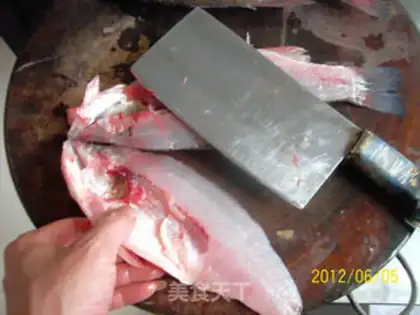
5
The knife technique requires that the cut marks of the fish meat be smooth and smooth, and the remaining meat quality of the fish vertebrae should be less.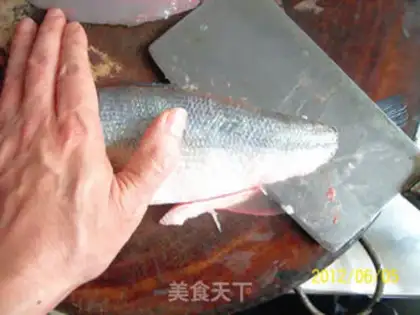
6
B. Operation method for the lower half of the bass;1. Place the vertebrae of the bass flat on the chopping board (the knife should not slip at this time), first use the base of the knife to stick to the fish tail and tail bone, and use it to retract the knife and scrape it along the tail bone. After inserting the knife, the base of the knife is forward, and the tip of the knife is shaved into the abdominal cavity of the bass along the fish tail fin line at the lower part of the fish body.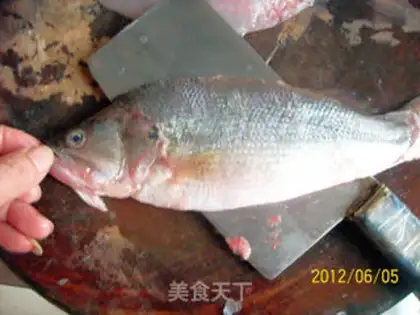
7
Then, use the front of the knife to shave it along the dorsal fin line of the upper half of the fish, and then use the knife to shave it close to the bass vertebrae and forcefully cut off the fish ribs to separate half of the fish from the fish bones.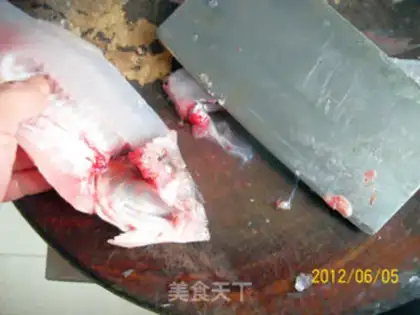
8
Finally, use a knife to cut or avoid the fish vertebrae from the fish's cervical vertebrae, completing the bone and flesh separation step of the perch.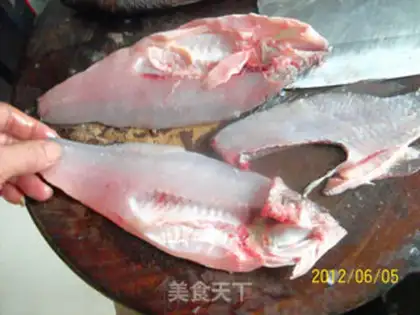
9
Illustration of the perch vertebrae after segmentation.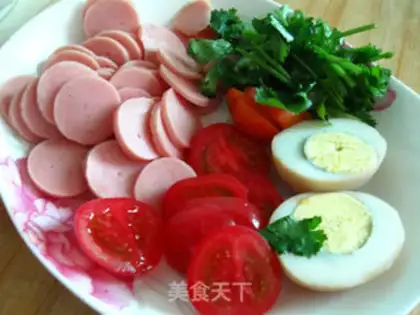
10
Split bass vertebrae.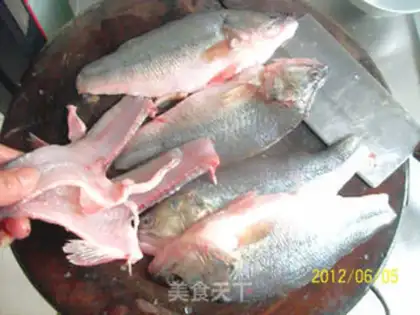
11
The second knife of chopping bones and slicing meat A. The use of perch vertebrae: We know that fish protein is hydrolyzed protein, which can cook nutritious fresh soup as white as milk. The perch vertebrae contain very rich nutrients and are the best ingredients for making soup.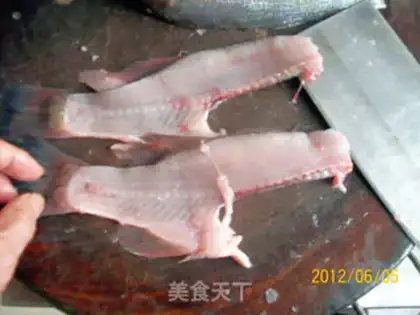
12
Vertical chop method: Place the bass vertebrae flat on the chopping board.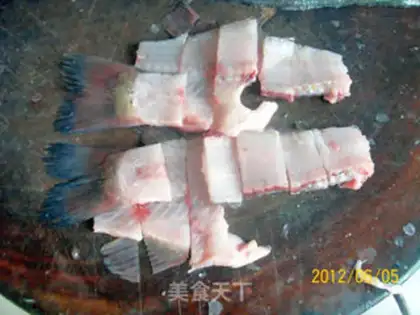
13
Perch vertebra cutting: Point the blade at the fish bone and hide the blade vertically. When the blade touches an object, a trace of hidden force is needed to guide the blade to cut the fish bone smoothly.14
Split the fish head: Use the base of the knife to aim at the top of the gills of the perch and cut off the fish head.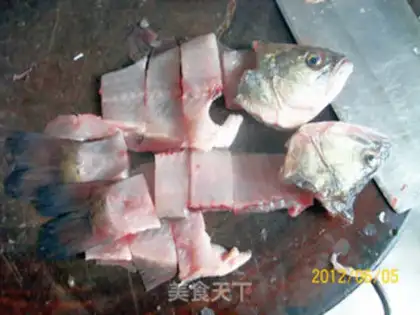
15
Application of ingredients for perch head and bones: The dishes I creatively cook with fish bones: "Perch Price Tofu Soup","Perch Bone Juice Fresh Milk Soup","Garlic Flavor Radish Fish Bone Soup","Scallion Cold Skin Fish Scrambled Soup","Sheep Sauce Fish Bones Easy to Fresh Sky" and other soups are the most economical and nutritious fresh soups for children, the elderly, pregnant women, postoperative rehabilitation and bodybuilding and beauty. (The above dishes are uploaded after editing)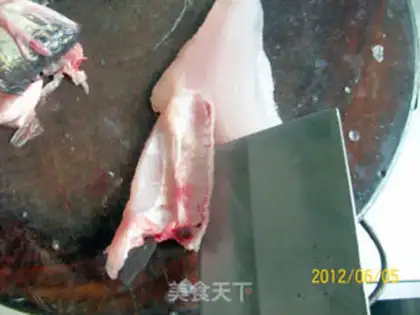
16
B. Dividing the bass belly block: 1. Use the tip of the knife to follow the line of the bass rib break mark, tilt slightly towards the rib surface, and use a drawing cutter to divide the bass belly block. (Note: The knife should be moved steadily and accurately without hesitation, and the cutting surface should be smooth and smooth. If you use this, pay attention to the use of your left hand to place your hand in front of the blade's landing opening to avoid scratching your fingers.)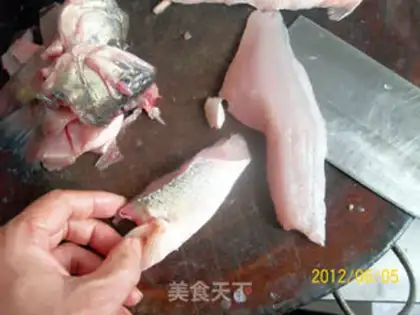
17
Cutting the perch belly block deviates the blade, increasing the perch tenderloin.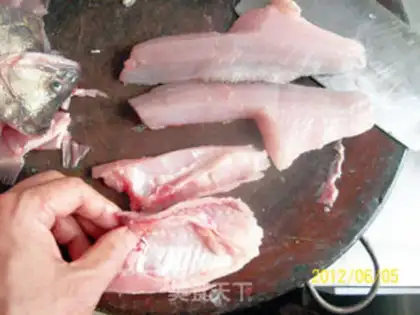
18
Cutting of bass belly stalls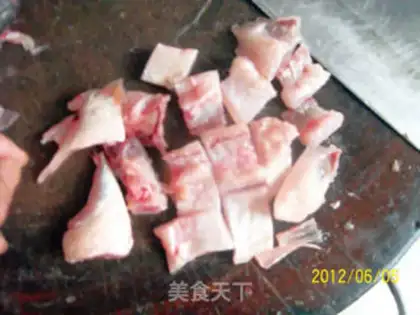
19
Using a vertical chopping knife technique, chop the bass ribs and cut them into inch pieces. Application value of fish maw stall meat quality: Fish maw stall is the most frequent part of perch's life that expands and contracts and stores fat energy. Its meat is fat, tough, tender and smooth, and is very nutritious. It is a good ingredient for braised, steamed and stir-fried dishes.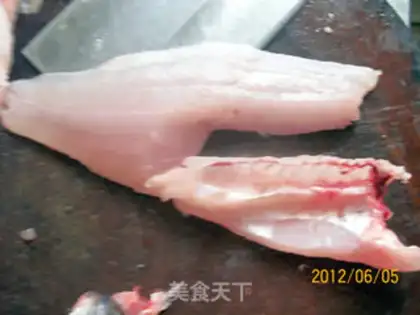
20
C. Segmentation and application of perch meat: According to the meat characteristics of perch, it is divided into two parts, that is, the most vivid part of the perch tail and the thick tenderloin part of the perch meat are processed separately.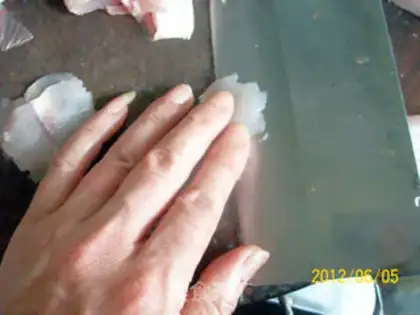
21
Knife method and application of "running water" and "paddling" meat quality at the tail of perch: Place the skin of the perch meat face down flat on the chopping board, use an oblique knife method to push the blade into the fish along the fish fiber until the fish skin is cut. Cutting requires uniform thickness, smooth meat, and its thickness depends on the needs of the dish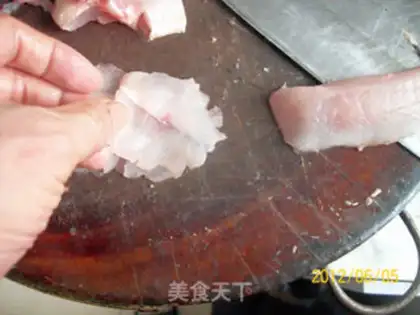
22
For small fish or ingredients with thin meat quality, a continuous knife method can be used, that is, the fish skin is not cut when the first knife is lowered to the fish skin, so that the fish slices under the slices remain connected to the fish skin, and the fish slices are cut when the second knife is lowered., then, the fish slices are unfolded to require uniform thickness and skin.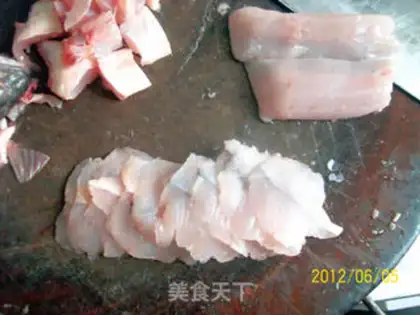
23
Food processing and application: The cut fish slices must be unfolded and placed on the chopping board for subsequent processing. The application value of fish tail meat quality: The fish tail is a part of the perch that keeps exercising throughout its life. Due to its carnivorous nature, the meat quality is precise and delicate, and rarely suffers from parasites. It is the most vivid part of the perch fish body. It is a good ingredient for cooking fish and sashimi.
24
D. Knife method and application of perch tenderloin meat: Chrysanthemum fish knife method: 1. Place the perch skin face down flat on the chopping board, use a straight knife method to insert the knife horizontally along the perch tenderloin meat strips to the fish skin, and cut them into strips of 5mm thick connected to the fish skin.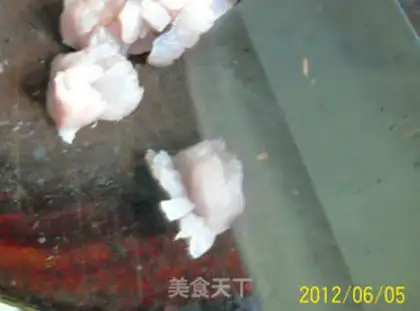
25
Then, use an oblique knife method to insert the bass tenderloin lengthwise along the stripes of the perch tenderloin to the fish skin, and cut the perch tenderloin into 5mm square skinned fish willows.
26
According to the needs of different dishes, it can be divided into three consecutive knives, four consecutive knives, etc., that is, the vertical and horizontal knives connect the skin, the third knife breaks the skin, and the vertical and horizontal knives connect the skin, the fourth knife breaks the skin, the 16 flowers, etc.
27
There is always more than enough to eat one fish and four things, and the world is full of delicious food! After dissecting the perch through the above-mentioned knife technique, the ingredients for perch head vertebrae, perch belly blocks, perch fillets and perch chrysanthemum fish were processed according to the edible value of each part of the perch, realizing the need for one fish to eat more, multiple dishes, multi-taste and multi-flavor family members... Achieve a healthy new life with no fish left in meals and more food in daily life.
28
Three examples of eating perch: (Each perch is about 11 yuan) 1."The value of perch in tofu soup";2."Steamed perch with onions, ginger, chopped peppers";3."Roasted perch with chives and mushrooms".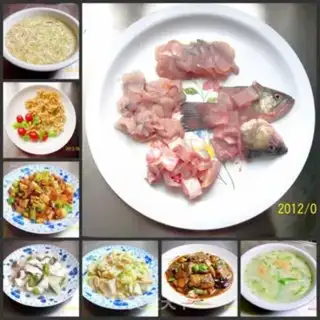
29
Case 1 of five eating perch: (Each perch is about 12 yuan) 1."Tofu Xishi Fish Milk Soup";2."Sweet and Sour Jingui Hangju Fish";3."Diced perch with Scallion Companion Sauce";4."Boiled Yam Sliced Fish Fillet";5."Braised Fish Maw with Fresh Shells and Mushrooms".Anatomy and application of perch Make Tips
bass
[Chinese scientific name]: Perch (Luyu);
[Alternative name]: Sea perch, sea perch board, flower village, sea perch fish, four-rib fish, etc., commonly known as sea perch and shark.
[Latin scientific name]: Lateolabraxjaponicus;
[English name]: Japaneseaperch;
The meat of the perch is white, tender, fragrant, and has no fishy smell. The meat is in the shape of garlic cloves, so it is best to steam, braise or stew. Perch is distributed in the western Pacific, coastal waters of China and freshwater waters leading to the sea, and is found in the Yellow Sea and Bohai Sea. It is one of the common economic fish and a species used to develop marine aquaculture.
[Understanding of Medicinal Materials];
From "Diet Therapy Materia Medica".
1. "Jiayou Materia Medica": Perch is pleasant to eat more, and it is especially good. It is also very fragrant and beautiful when it is dried violently. Although there is a small poison, it will not get sick.
2. "Compendium": Black is called Lu. This fish is called black chapter, hence the name. Song's name is the four-gill fish. Perch originated from Wuzhong, and the Songjiang River was particularly prosperous. It rises in April and May. It is only a few inches long. It is slightly like a fish fish and white in color, with black spots, a huge mouth, fine scales, and four gills. Li Shizhen believes that the perch is the four-gill fish of Songjiang (Trachidermus fasciatus Heckel), but according to the description, it looks slightly like a mandarin fish with white color, black spots, and a huge mouth and thin bill.
[Habitat Distribution]
Ecological environment: Fish in the middle and lower layers of coastal shallow seas often inhabit salty and fresh water in the estuary, or can also live in fresh water. In spring and summer, young fish have the habit of tracing the river in groups, and return to the sea in winter; the staple food is fish and shrimp. Eggs are laid in the estuary in late autumn and early winter; the eggs are floating, 1.35 - 1.44mm in diameter, and have oil balls.
Resource distribution: They are distributed along the coast of our country.
[Chemical Composition]
Eat 100g, containing 78g of water, 17.5 g of protein, 3.1 g of fat, 0.4 g of carbohydrates, 1g of ash; 56mg of calcium, 131mg of phosphorus, 1.2 mg of iron, 0.23 mg of riboflavine, and 1.7 mg of nicotinic acid. Taiwanese produce contains 76.10% moisture, 19.39% crude protein, 1.16% crude fat, and 1.16% ash. Regarding vitamins, there are also the following figures: 100g of vitamin A contains 180ug, B1130μg, B2110μg, and 2.4mg of nicotine.
[Sex and taste] Sweet taste; flat nature;
[Chinese scientific name]: Perch (Luyu);
[Alternative name]: Sea perch, sea perch board, flower village, sea perch fish, four-rib fish, etc., commonly known as sea perch and shark.
[Latin scientific name]: Lateolabraxjaponicus;
[English name]: Japaneseaperch;
The meat of the perch is white, tender, fragrant, and has no fishy smell. The meat is in the shape of garlic cloves, so it is best to steam, braise or stew. Perch is distributed in the western Pacific, coastal waters of China and freshwater waters leading to the sea, and is found in the Yellow Sea and Bohai Sea. It is one of the common economic fish and a species used to develop marine aquaculture.
[Understanding of Medicinal Materials];
From "Diet Therapy Materia Medica".
1. "Jiayou Materia Medica": Perch is pleasant to eat more, and it is especially good. It is also very fragrant and beautiful when it is dried violently. Although there is a small poison, it will not get sick.
2. "Compendium": Black is called Lu. This fish is called black chapter, hence the name. Song's name is the four-gill fish. Perch originated from Wuzhong, and the Songjiang River was particularly prosperous. It rises in April and May. It is only a few inches long. It is slightly like a fish fish and white in color, with black spots, a huge mouth, fine scales, and four gills. Li Shizhen believes that the perch is the four-gill fish of Songjiang (Trachidermus fasciatus Heckel), but according to the description, it looks slightly like a mandarin fish with white color, black spots, and a huge mouth and thin bill.
[Habitat Distribution]
Ecological environment: Fish in the middle and lower layers of coastal shallow seas often inhabit salty and fresh water in the estuary, or can also live in fresh water. In spring and summer, young fish have the habit of tracing the river in groups, and return to the sea in winter; the staple food is fish and shrimp. Eggs are laid in the estuary in late autumn and early winter; the eggs are floating, 1.35 - 1.44mm in diameter, and have oil balls.
Resource distribution: They are distributed along the coast of our country.
[Chemical Composition]
Eat 100g, containing 78g of water, 17.5 g of protein, 3.1 g of fat, 0.4 g of carbohydrates, 1g of ash; 56mg of calcium, 131mg of phosphorus, 1.2 mg of iron, 0.23 mg of riboflavine, and 1.7 mg of nicotinic acid. Taiwanese produce contains 76.10% moisture, 19.39% crude protein, 1.16% crude fat, and 1.16% ash. Regarding vitamins, there are also the following figures: 100g of vitamin A contains 180ug, B1130μg, B2110μg, and 2.4mg of nicotine.
[Sex and taste] Sweet taste; flat nature;