Japanese curry
By VicentaLakin
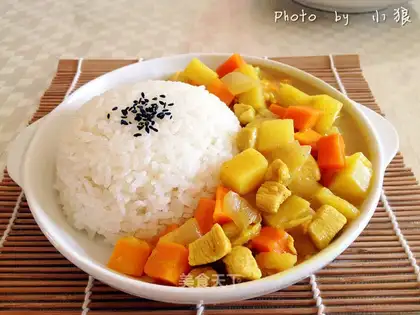
The curry thing has become an indispensable force in my search for food. When I was in school, I used to buy online curry from one to five flavors, making my own vegetable curry, egg curry, fish curry, curry and curry. I was wondering. Maybe there's no food like curry that's so rich in taste buds, with a little bit of sweetness at the same time, and a little excitement that can't be ignored. Make a curry full of love for those who love you and those who love you
Recipe Recommendations
- chicken breast 150 grams
- boiled rice a bowl
- potatoes of 2
- carrots 1 piece
- onion one
- garlic appropriate amount
- Jiang appropriate amount
- curry 4 small pieces
Steps for Japanese curry
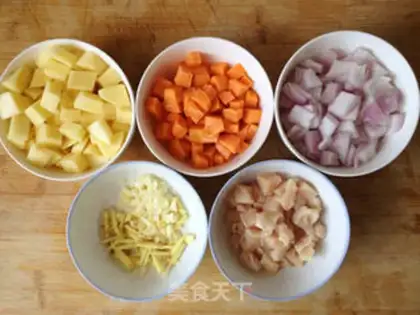
1
Preparing raw materials, potatoes, carrots, onions and chickens, respectively, for cuttin, garlic and ginger。
2
The fire heats up the pot, and the oil burns garlic and ginger。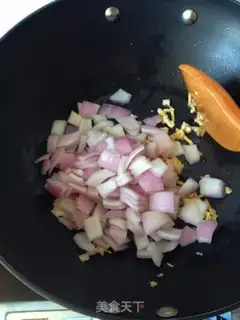
3
Put the onions in the pot. The little fire makes the sweet taste
4
Put the chicken in the pot and it'll be tanned。
5
Put potatoes and carrots in the pot for a second。
6
Add a proper amount of open water, it's about as good as no food. The fire boiled and turned to the fire for 10 minutes。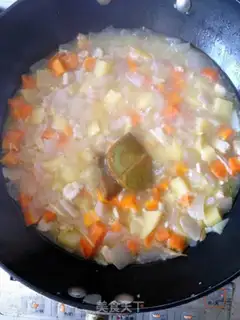
7
Turn off the fire, add curry, until all curry melts completely, and then the fire continues for five minutes。
8
You'll get a pot of hot soup。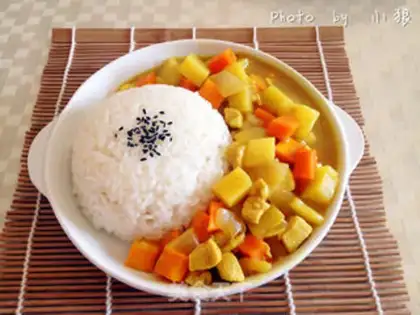
9
Put rice in the bowl and put curry on the plate。Japanese curry Make Tips
Besides India and its neighboring countries, Japan is also a nation with a great love for curry. The various curry powders and curry blocks sold on supermarket shelves today are mostly packaged with a Japanese flair, to the point where one might almost mistake Japan for the birthplace of curry. In fact, although Japan and India are both in Asia, the curry eaten in Japan was only introduced from Europe during the Meiji Restoration period. It seems that anything that reaches Japan transforms into something more refined, delicate, and mild, ingeniously integrating with its native culture. Curry also underwent new developments after its arrival in Japan.
Japanese curry is generally not very spicy and has a strong, sweet flavor due to the addition of concentrated fruit puree. Although Japanese curry is also known as "European-style curry," it was actually invented by the Japanese. It is called European-style curry because it uses roux—a thickening agent common in French cuisine for making soups—and the spices used also tend to be of a South Indian style. While European-style curry is richer and more mellow, its spice flavor is significantly less pronounced compared to similar Indian dishes. Besides being served with rice, curry can also be used as a soup base for noodle dishes like ramen and udon, which is a significant difference from curry in other regions. The Sapporo region in Hokkaido is known for its soup curry.
In the hands of the Japanese, curry powders and curry blocks that could be mass-produced were developed. While they may not have the endless variety and personal touch of homemade Indian curry, their convenience and time-saving nature are their greatest strengths. There is no need to go to a restaurant, learn cooking skills, or buy ingredients; one only needs to heat the curry slightly and pour it over rice to enjoy. As a result, curry has become a delicious dish that ordinary people can savor anytime.