In home cooking, garlic is an indispensable ingredient. A dish can be greatly enhanced by adding minced garlic, sliced garlic, or whole garlic cloves. What are the nutritional advantages of different ways of preparing garlic?
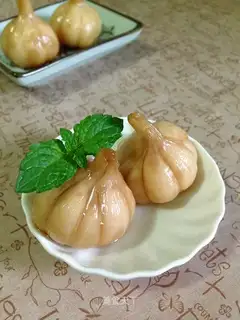
Pickled Garlic in Sweet and Sour Sauce
Sprouting doubles the nutrition. When it comes to sprouting, most people think "it's inedible". However, as long as the garlic cloves themselves are not moldy or discolored, sprouted garlic is edible. Research has found that the antioxidant effect of sprouted garlic is higher than that of fresh garlic. Peeling a sprouted garlic clove, you will see a green sprout has grown in the center. Once this green sprout emerges from the clove, it becomes garlic greens, a type of leafy vegetable. If you place garlic greens in a plate of water, it not only adds a touch of greenery to your kitchen but can also be used as a seasoning in place of scallions. If you plant the garlic greens in soil and let them continue to grow, the leaves will become what is known as green garlic. Those who are not accustomed to eating garlic cloves can eat garlic greens directly. The vitamin content of garlic greens exceeds that of garlic cloves, and they also possess certain antibacterial properties.
Fermented black garlic has a better texture. After being fermented to make black garlic, the water content of garlic is reduced by about 50%, while its sugar and amino acid content increases significantly, and the amount of B vitamins also rises. The garlic turns from white to black because of the "Maillard reaction" that occurs after a long period of fermentation and incubation. At this point, allicin has degraded, and components like polyfructose are broken down to produce fructose, enhancing the sweetness. Therefore, black garlic has a soft, sweet texture without the pungent spicy taste, making it edible for people with sensitive stomachs. There's also no need to worry about bad breath, which makes it very popular among young people. However, one should not take claims like "black garlic lowers high blood pressure, blood sugar, and lipids" or "black garlic boosts immunity" too seriously. It is difficult to achieve these effects if the daily amount of black garlic consumed is not large.
Pickling aids digestion. In Northern China, there is a tradition of pickling garlic, with Laba garlic and sweet and sour garlic being popular methods. These methods retain all the mineral components of garlic and largely eliminate the spicy pungent taste, although their antibacterial effect is reduced compared to raw garlic. Professor Zhao Guanghua from the College of Food Science and Nutritional Engineering at China Agricultural University found that the extract of sweet and sour garlic contains antioxidant activity and has a certain inhibitory effect on cancer cells. When making sweet and sour garlic at home, it is best to use brewed vinegar; adding a little sugar will make the taste even better. Laba garlic turns green after pickling, which is harmless to the human body and has certain antioxidant effects. Both of these preparation methods have the effect of cutting through grease and aiding digestion, making them very suitable to eat with meat.
Eating it raw is the most health-preserving. As is well known, garlic can kill bacteria and viruses, and it also has an appetizing and digestive-aiding effect. Intact garlic contains alliin and allinase. When garlic is crushed, these two components interact to produce allicin, the main source of garlic's unique pungent flavor. In addition, garlic is rich in the trace element selenium, and moderate selenium intake has an auxiliary anti-cancer effect. Crushing and eating raw garlic can effectively preserve allicin to kill bacteria and viruses. However, garlic itself is spicy, and the daily intake of raw garlic should not exceed 2-3 cloves. It is contraindicated for people with stomach ulcers, diarrhea, or those who are taking medication.
Roasted Garlic with Rosemary
Stewing removes off-flavors. When making soups or stewing meat, especially pork belly or intestines, many people are accustomed to adding a few cloves of garlic. This helps to remove the strong odors of the ingredients. First, sauté the garlic until fragrant, then stir-fry it with other ingredients before adding water to stew. After stewing, the off-flavors of the ingredients are gone, and the allicin in the garlic has decomposed, so the texture is not spicy and may even be sweet. This is because the spicy allicin has converted into sweet sulfur-containing substances, enhancing the umami and sweetness of the broth. At this point, garlic is used as a seasoning, so there is no need to worry about vitamin loss from long stewing.
Grilling removes the spiciness. Cumin garlic and charcoal-grilled garlic are crispy on the outside and tender on the inside, with a fragrant, soft, and chewy texture. The garlic grilled in this way has almost no spiciness and does not cause bad breath, making it very popular among young people. However, after high-temperature grilling, the allicin in garlic is completely gone, losing its antibacterial effect, but its mineral components are retained. When grilling, be sure to grill the garlic with its skin on, and the flame should not be too strong, otherwise it is easy to burn the garlic, producing carcinogens.
Stir-frying with hot oil releases a rich aroma. Allicin is very "afraid of heat"; once it encounters high-temperature processing, its antibacterial effect is greatly diminished. Therefore, you cannot expect the minced garlic in a stir-fried dish to help kill harmful bacteria. However, garlic releases a rich aroma when sautéed in oil, especially bringing a mouth-watering appeal to vegetable dishes. Compared to scallions, sautéing garlic to release its aroma requires a higher oil temperature. The best flavor is usually achieved when the surface of the garlic pieces turns yellow. This is because the main reason for the aroma is the "Maillard reaction," accompanied by the process of the color deepening and yellowing. However, if the oil temperature is too high, the minced garlic can burn and char, producing toxic substances and affecting the quality of the dish.
 Rosemary makes garlic
 Sugar and garlic