In recent days, temperatures have continued to drop across the country, and cold weather is also being experienced abroad. Faced with the sudden cold, how can we protect our health?
How to keep warm in winter
1. Don't set the heating temperature too high. John Scour, a vascular surgery expert at University College London Hospital in the UK, said that if the air conditioning or heating temperature is too high, the temperature difference between indoors and outdoors will be too large. When going out, small blood vessels can suddenly constrict, making people feel colder. Therefore, the indoor temperature should be set at 18°C to 20°C.
2. Reduce caffeine intake. Eddie Chalona, a vascular surgery expert at Lewisham General Hospital in the UK, said that caffeine has the effect of dilating blood vessels, which prevents blood vessels from naturally constricting in the cold, leading to heat loss in the body and making people feel colder. Caffeine-free hot drinks like ginger tea have a better warming effect and are more suitable for winter.
3. Don't put your hands in your pockets. Tim Hatchett, an expert from the British Chiropractic Association, said that in winter, don't walk with your hands in your pockets. Instead, wear gloves and swing your arms. This can exercise the arm muscles, improve blood flow in the arms and hands, generate body heat, and help keep you warm.
4. Drink more soy milk. Dr. Sarah Sink, a nutritionist from the British Dietetic Association, said that compared to consuming carbohydrates or fats, consuming protein can significantly raise body temperature. It is recommended to drink a cup of soy milk for breakfast, and you can also eat some nuts and yogurt appropriately.
5. Make sure your hat covers your ears. Dr. Andrew Camilleri, an ENT surgeon at South Manchester University Hospital in the UK, said that the head accounts for 30% of body heat loss. It is best to choose a hat that can cover the ears, because although the ears are thin, they have a large surface area and are more prone to heat loss.
6. Wiggle your toes before getting out of bed. Sami Margo, a British physiotherapist, suggests wiggling your toes up and down 20 times before getting out of bed, then circling your ankles to move them, 10 times in each direction, and then tightening and relaxing your thighs 10 times. This can get your body moving, so you won't feel too cold when you get out of bed.
Several "Warming Meals" Recommended by Experts to Fight the Cold
Yam, Carrot, and Lamb Soup
North Tofu: Won't Make You Fat and Can Resist the Cold
Suitable for: People who are losing weight or picky eaters.
North tofu is rich in vitamin B2, which can reduce the rapid loss of body heat during daily work and activities. It not only helps maintain energy but also improves your ability to withstand the cold, and it won't make you gain weight.
Yam Can Nourish the Body Comprehensively
Suitable for: People who are physically weak and have poor resistance.
In the cold winter, eating more root and stem vegetables can help supplement various vitamins and carbohydrates. Yam, a common winter vegetable, contains high-quality protein and starch. These two nutrients can be quickly broken down into heat in the human body, thereby increasing energy for the body and playing a role in cold resistance. It is especially suitable for the elderly and children who are physically weak and have poor resistance.
Lament Warms the Meridians to Expel Cold
Suitable for: Middle-aged and elderly people with a cold spleen and stomach.
In traditional Chinese medicine, Aconite is considered a good medicine for warming meridians, expelling cold, and promoting blood circulation. It is especially suitable for middle-aged and elderly people who are afraid of cold due to a cold spleen and stomach and weakened liver and kidney function. Lamb is also a warming food that can help yang, strengthen the stomach, and promote blood and fluid production. If the middle-aged and elderly people in your family also have symptoms such as coldness in the waist and knees and frequent urination, they can drink more Aconite and Lamb Soup.
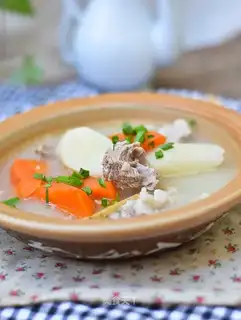 Carrot broth