Eggs, commonly known as chicken eggs or white fruit, are the most commonly consumed type of egg. Because of their comprehensive and rich nutritional content, they are hailed as the "ideal nutritional warehouse for humanity." Nutritionists call it the "complete protein model." But did you know? Eating eggs the wrong way can turn this nutritious food into a poison!
Eggs become poisonous when eaten this way
1. Fried eggs, tea eggs
Many people like to eat fried eggs, especially those with golden-brown edges. At this point, you should be careful, because the scorched edges cause the high-molecular-weight proteins in the egg white to break down into low-molecular-weight amino acids. These amino acids can often form carcinogenic chemicals at high temperatures. Additionally, tea eggs should be eaten sparingly. First, the nutrients in tea eggs are destroyed by repeated boiling. Second, in this process, the acidic substances in the tea combine with the iron in the eggs, irritating the stomach and affecting digestive function.
2. With sugar, with soy milk
Many people like to cook eggs with sugar. In fact, cooking eggs and sugar together at high temperatures produces a substance called glycosyllysine, which destroys the beneficial amino acids in the eggs. It's worth noting that glycosyllysine has a blood-clotting effect and can be harmful to the body after consumption. Therefore, sugar should be added after the egg dish has cooled down.
Also, many people like to eat an egg with a bread and a cup of soy milk for breakfast. In fact, the trypsin in soybeans combines with the ovomucoid in the egg white, leading to a loss of nutrients and reducing the nutritional value of both.
3. Eating raw
Some people believe that cooking food destroys its nutritional value. That's why many people like to eat raw vegetables and raw seafood. Similarly, some believe that eating raw eggs provides more nutritional value than cooked ones.
However, this is not the case. Eating raw eggs can easily introduce bacteria (like E. coli) into your system, causing gastrointestinal discomfort, diarrhea, and in severe cases, even death. Furthermore, the egg white contains avidin, which needs to be destroyed by high heat. Otherwise, it will hinder the absorption of biotin in food, leading to symptoms like loss of appetite, general weakness, muscle pain, skin inflammation, and eyebrow loss.
4. Overnight
It is actually okay to eat a fully cooked egg the next day after reheating. However, you should not eat a partially cooked egg overnight! If an egg is not fully cooked, it can easily breed bacteria if stored improperly, causing issues like stomach upset and gas.
At the same time, some believe that the longer you boil an egg, the better, which is also wrong. Boiling an egg for too long causes the ferrous ions in the yolk to combine with the sulfur ions in the white to form insoluble ferrous sulfide, which is difficult to absorb. If a fried egg is overcooked, the edges will burn, and the high-molecular-weight proteins in the egg white will break down into low-molecular-weight amino acids. These amino acids can form chemicals harmful to human health at high temperatures.
Boiled eggs are the most nutritious
Among all foods, the ways to eat eggs are almost the most diverse. According to various research and experimental data, experts have listed a "Top 3 Ways to Eat Eggs" for us. In the end, regardless of the list, "boiled egg in its shell" always ranks first.
"Heart-Healthy Ranking": First place: Boiled egg in its shell. With no oil added, low cooking temperature, and the yolk's cholesterol not exposed to oxygen (once oxidized, cholesterol becomes one of the most serious threats to cardiovascular health), this is the most heart-healthy way to eat eggs. Second place: Poached egg. Third place: Egg drop soup and steamed egg. Fourth place: Fried egg. Fifth place: Scrambled egg (a thin omelet made with a small amount of oil over low heat, so the cholesterol in the yolk is not heavily oxidized). Sixth place: Stir-fried egg. The egg is beaten before frying, so the cholesterol in the yolk has more contact with air and is more oxidized. Eggs also absorb oil, requiring a larger amount.
"Best Protein Digestibility Ranking": First place: Boiled egg in its shell. Studies show that the protein digestibility of a boiled egg is as high as 99.7%, almost fully absorbed and utilized by the body. Second place: Fried egg and scrambled egg. The protein digestibility for these two methods is 98%. Third place: Stir-fried egg. Protein digestibility is 97%. Fourth place: Steamed egg. Protein digestibility is 92.5%. Fifth place: Raw egg. Protein digestibility is only 30%–50%.
"Vitamin Retention Ranking": First place: Boiled egg in its shell. Low heating temperature preserves nutrients comprehensively. Second place: Steamed egg. Low heating temperature results in little loss of water-soluble vitamins like riboflavin and lutein. Third place: Poached egg. Low heating temperature with slight loss of water-soluble vitamins. Fourth place: Fried egg. High heating temperature causes loss of both fat-soluble vitamins (A, D, E, K) and water-soluble vitamins. Fifth place: Scrambled egg. High heating temperature causes loss of all vitamins. Sixth place: Stir-fried egg. High heating temperature causes significant loss of vitamins.
How to boil an egg
4 expert tips for boiling eggs
1. Don't use boiling water. First, boiling water will cause the egg to roll around violently in the pot, easily cracking the shell and even exposing the white. Second, the proteins in the egg coagulate and denature at a much lower temperature, typically 60°C–87°C, while boiling water is 100°C. If you boil with boiling water, the white may become as tough as rubber. Therefore, when boiling an egg, you should have the lid off and let the water simmer gently, not boil.
2. Boil for a short time, then cool. A fully cooked egg with a firm yolk takes about 10 minutes, but if you want a soft-boiled egg with a tender yolk, about 6 minutes is enough. If you boil the egg for too long, it will develop an unpleasant sulfur smell. Also, after taking the egg out of the pot, cool it immediately in cold water; otherwise, the residual heat will continue to cook it and make it tougher.
3. Slightly older eggs are easier to peel. We all think fresher is better, but for boiled eggs, it's not necessary to use the freshest eggs. In fact, slightly older eggs are easier to peel. If you store an egg in the fridge for a few days, its pH value will slightly rise, and the adhesion between the white and the inner shell membrane will loosen a bit.
4. A green ring around the yolk is harmless. If you boil an egg for too long, you might notice a green ring around the yolk. This is a reaction between sulfides in the yolk and iron, and it is not harmful. You can avoid it simply by not boiling the egg for too long.
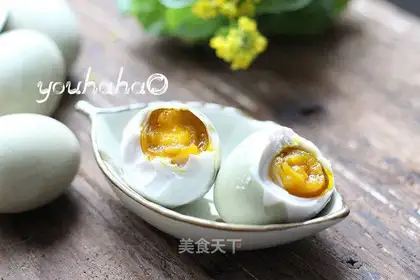 Homemade duck eggs