Besides being a common vegetable, eggplant contains numerous elements that not only provide the human body with daily essential nutrients, but more importantly, play a role in preventing and treating diseases. Therefore, eggplant is also a traditional Chinese medicine. So, what are the effects of eggplant? How is it best to eat eggplant?
Eggplant can resist aging and detoxify
1. Anti-aging
Eggplant contains vitamin E, which has the functions of preventing bleeding and anti-aging. Regular consumption of eggplant can prevent the increase of cholesterol levels in the blood and has a positive significance for delaying human aging. Wash it, gently rub it with your hands, rinse with clean water, and let it dry in a cool, ventilated place.
2. Clearing heat and detoxifying
It is used for toxic sores, skin ulcers, canker sores, hemorrhoids with bleeding, hematochezia, epistaxis, etc. Traditional Chinese medicine believes that eggplant is a food with a cold nature. Therefore, eating it in the summer helps to clear heat and relieve summer heat, and is especially suitable for people who are prone to heat rash and sores. People with indigestion and a tendency to diarrhea should not eat too much of it, as Li Shizhen said in the "Compendium of Materia Medica": "Eggplant is cold and promotes bowel movement; excessive consumption will inevitably lead to abdominal pain and diarrhea." The "Dian Nan Ben Cao" records that eggplant can invigorate blood, reduce swelling, and relax the bowels. Therefore, people with constipation, hemorrhoidal bleeding, and damp-heat jaundice can also benefit from eating more eggplant. You can choose purple eggplant and cook it with rice into a porridge. The "Compendium of Materia Medica" introduces that drying the eggplant with its stem, grinding it into a fine powder, and taking it with wine can treat intestinal wind bleeding. The "Dian Nan Ben Cao" suggests that it is more appropriate to take it with rice water, because intestinal wind bleeding and hemorrhoidal bleeding are not suitable for wine. The dried eggplant with its stem, ground into a fine powder, is also often used externally.
3. Treating chilblains
Take two or three eggplant seedlings (with roots) from the field in winter, decoct them in water. After the water boils, simmer for another 20 minutes. Use this water to soak and wash the chilblains, and also scrub the affected area with the eggplant seedlings. It can be cured in two to three applications.
4. Lowering blood pressure
Eggplant has a good effect of lowering high blood lipids and high blood pressure. The specific method is as follows: choose dark, long-shaped eggplant, cut it into sections or shreds, and mix it with sesame sauce and soy sauce. Take it at dinner to effectively lower and self-heal.
What are the ways to cook eggplant?
Braised Eggplant
1. Sauteed Eggplant
Minced garlic, sliced eggplant; separate the egg white from the egg and beat it; pour the egg white over the eggplant slices, then add starch; add starch while stirring until the slices are evenly coated. Take a small bowl and mix vinegar, salt, sugar, and dark soy sauce to make a sauce, roughly in the ratio for Fish-Flavored Pork Shreds, which can be adjusted according to your own taste. Prepare a bowl of starch water; heat oil in a wok; fry the prepared eggplant slices until the skin turns yellow, then set aside; leave some oil in the wok, sauté the scallions and garlic; return the fried eggplant to the wok, stir-fry, then add the sauce; simmer over low heat to reduce the sauce, and thicken with starch water before serving.
2. Fish-Flavored Eggplant
Wash the eggplant and cut it into suitable-sized pieces; heat a wok without oil, and stir-fry the eggplant over medium heat until it wilts and softens, then remove it; season with salt, sugar, cooking wine, light soy sauce, vinegar, starch water, and pepper to make a sauce; heat oil in the wok, sauté ginger and garlic until fragrant; add chopped chili and stir-fry until fragrant, then add the prepared sauce and bring to a boil; add the eggplant, stir to coat evenly, and add chopped scallions and chicken essence.
3. Braised Eggplant
Wash the eggplant, cut it into irregular chunks, and sprinkle evenly with salt to marinate for 10-20 minutes; wash the green peppers and tomatoes and cut them into pieces; mince several cloves of garlic, some sliced, some minced; squeeze the marinated eggplant firmly to remove excess water, which will help it absorb less oil; heat a flat-bottomed pan with a moderate amount of oil, then add the garlic slices to bloom; when the aroma of garlic is released, add the squeezed eggplant and stir-fry over medium heat until the color changes and it softens; add green peppers and tomatoes, add a spoonful of sugar and an appropriate amount of salt for seasoning, stir-fry over high heat; you can add a little hot water during the process to cook the tomatoes until they soften and release red juice; sprinkle the minced garlic before serving.
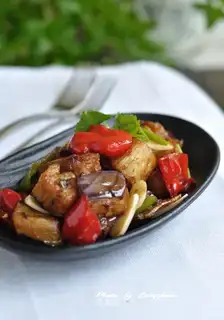 Red eggplant