Compared to the greasy dishes of winter, the spring dining table is a lush green oasis. For food lovers, the most direct way to embrace the spring season is to sit at the table and heartily eat a handful of spring's "greens"! The tender, dewy spring vegetables represent the very taste of spring. In this issue, let's go find the seasonal vegetables of spring and eat "greens" together!
1: Malantou (Kalimeris indica)
Malantou with Tofu Skins
During this season, you can find malantou in fields and by the roadside. It is a typical grassroots spring vegetable.
Today, many Cantonese people enjoy eating malantou. "Sky No. 1" in Zhujiang New Town air-fresh malantou from Jiangnan, receiving a new batch every two or three days. It is wrapped in paper and stored in a refrigerator. High-quality malantou is dark green with intact leaves and no rotten ones. Chef Wen Bin suggests pairing malantou with tofu as a cold appetizer. First, blanch the malantou, chop it, and season with oil and salt. Then, cut the tofu into finger-sized pieces, steam it, and lightly season with oil and salt.
2: Seedlings
In spring, all things germinate, and various seedlings sprout, making it the perfect time to eat spring seedlings. Corn has also just sprouted, producing about 10-centimeter-tall corn seedlings. Chef Wen uses organic corn seedlings, which are not heat-processed. After washing, they are tossed with olive oil and served with Hokkaido scallops. Corn seedlings are not available everywhere, but bean sprouts are relatively easier to find. In Asian Games Town, "Yifang Fish House" uses peas to grow bean sprouts. The kitchen staff first simmers a superior broth with pork bones and chicken, adds quail eggs to cook, and then pours it over the blanched bean sprouts.
3: Toon Sprouts
Toon Sprouts with Scrambled Eggs
When spring arrives, it's time to eat toon. Now, foodies who love toon have developed a habit: when the season arrives, they rush to their favorite restaurants for the uniquely flavored toon sprouts. Toon sprouts can be found in many places in China, and Chef Wen chooses Yunnan toon. He says that at this time, Yunnan toon sprouts are tender without any fibrous residue and have a prominent aroma.
Toon can be prepared in various ways: stir-fried, cold-dressed, deep-fried, dried, or pickled. The most common way is to stir-fry toon sprouts with eggs.
For hardcore fans of toon sprouts, Chef Wen suggests trying them cold-dressed, as a little sesame oil best brings out their original flavor.
This spring, breaking from tradition, Chef Wen cooks the toon sprouts, then mashes them into a paste with a little salt to make a sauce. He then pan-sears a wild Philippine grouper, and the toon sauce becomes the "companion" to the fish fillet.
4: Chaoshan Baby Kale
Kale is not a rare species in Guangdong; you can buy it at any vegetable market stall. But just as people have different builds, kale comes in both small and large varieties. If the kale in Guangzhou is a burly giant, then the kale in Shantou is a petite beauty. The latter is about half the size of the former but is exceptionally sweet and crisp. Shengshan Shantoudi Specialty Food Shop in Zoumawgang, Sanyuanli, uses this small kale. This vegetable is mostly produced in Xinxi, Shantou, where there are many poultry farms, and duck and goose manure are used for fertilizer. The irrigation water comes from the river, so the kale grown this way is naturally very sweet. Locals stir-fry baby kale either with salt or use broad bean paste to enhance its flavor.
5: Spring Vegetable (Choi Cai)
Spring Vegetable with Pork
Its name already carries a distinct seasonal character—it is the "vegetable of spring." This is a name that is especially dear to the people of Shantou. It could be said that no one born and raised in Shantou has not eaten spring vegetable. Regardless of wealth or status, everyone loves to eat spring vegetable.
Although spring vegetables can now be eaten all year round, their best flavor is still during these three months of spring. This vegetable has a unique aroma amidst its slight bitterness and is a master at absorbing oil. In Shantou households, spring vegetable is often cooked in a clay pot with pork ribs. Shengshan Shantoudi Specialty Food Shop does the same. The owner, Mr. Xie, says that besides pork ribs, one can also add shrimp and dried scallops to the pot.
6: Crown Daisy
Ginger Juice Crown Daisy
Crown daisies, which prefer cool weather, cannot tolerate the scorching summer heat and are mostly planted in the cool spring season. Farmers usually sow them from late January to late February. They grow very quickly, like a baby in swaddling clothes, changing dramatically in just over ten days.
Mr. Xie says it takes about a month and a half for the crown daisies to be ready for harvest. The restaurant he runs serves Shantong crown daisies, and what he values is their rich and fragrant aroma, which is different from ordinary crown daisies. The cost is also much higher, fetching 10 yuan per jin at wholesale. The preparation is simple: either use it for hot pot, or stir-fry it after sautéing some garlic.
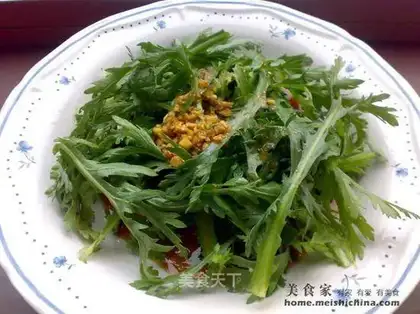 Chrysanthemum with ginger sauce
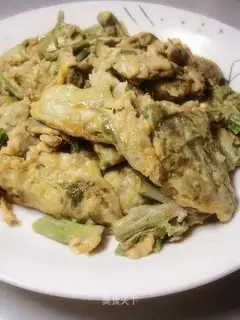 Chinese toon sprout slippery egg
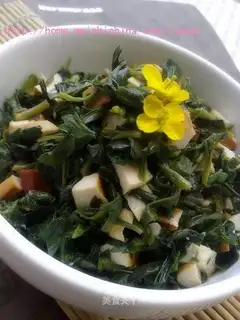 Malan head mixed with fragrant dried
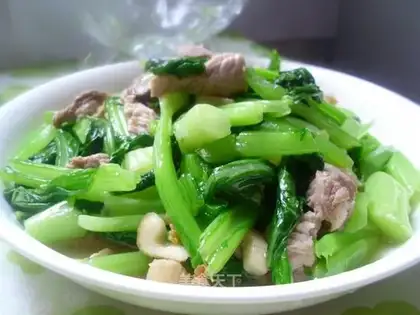 stir-fried pork with spring vegetables