The primary function of food is to nourish Qi and blood. When a person's Qi and blood are abundant, they naturally appear younger. Regularly consuming anti-aging foods can help prolong life, prevent illness, strengthen the body, and maintain a youthful state.
1. Eating Chinese Cabbages Often Can Prevent Illness and Prolong Life
Chinese cabbage, also known as heading cabbage, yellow bud cabbage, or jiaocai, was called "Song" in ancient times. It is a plant of the Brassicaceae family. It is said that Chinese cabbage was unnamed until the Han Dynasty, when it was named "Song" because it could endure frost and snow, similar to the pine tree.
Chinese cabbage originated in China and is a major winter vegetable in northern regions. It has high nutritional value, especially for its rich content of vitamin C and the trace element selenium. These can combat the damage caused by "free radicals" to cells, thus slowing down the human aging process.
Chinese cabbage is sweet and neutral in nature. It has the effects of smoothing the intestines, relieving chest distress, detoxifying and sobering up, aiding digestion and promoting qi circulation, harmonizing the middle jiao, and promoting urination. It is applicable for treating colds, fever and thirst, bronchitis, cough, indigestion, constipation, urination difficulties, chilblains, ulcer bleeding, alcohol toxicity, sores, and other ailments.
Chinese cabbage can be stir-fried, braised, or stewed, and can also be used as a filling for dumplings or in cold salads. It can also be made into sour cabbage, pickled vegetables, soy-preserved vegetables, or fermented vegetables.
Crystal Jade Cabbage
2. Eating More Spinach Makes You Younger
Spinach, also known as boqiu, boqiucai, bosisai, chigencai, or yingwucai, is a plant of the Chenopodiaceae family. Spinach originated in southwest Asia and was introduced to China during the Tang Dynasty, with a cultivation history of over 1,000 years.
The homeland of spinach is Persia. Over 2,000 years ago, Persians cultivated it as a vegetable, so it still has the alias "Persian grass." In the 21st year of the Zhenguan era of the Tang Dynasty, the King of Nepal sent spinach as a gift to Chang'an (modern-day Xi'an) via a special envoy. From then on, spinach became established in China.
Spinach is sweet and cool in nature. It benefits the five organs, detoxifies alcohol, moistens dryness and lubricates the intestines, nourishes blood and stops bleeding, clears heat and relieves restlessness, promotes fluid production to quench thirst, and nourishes the liver and improves vision. Additionally, spinach is rich in vitamin E. Vitamin E is an antioxidant that can stop the oxidation process in the body, contributing to longevity. Therefore, eating more spinach has an immeasurable effect in delaying aging. A recent experiment by the U.S. Department of Agriculture showed that eating about 30 grams of fresh spinach daily has a better anti-aging effect than drinking three glasses of red wine.
Spinach, Egg, and Vermicelli Salad
3. The Truly Worthy Longevity Vegetable—Portulaca
Portulaca, also known as changmingcai (long-life vegetable), wuxingcao (five-element grass), anlecai (peaceful vegetable), suanmicao (sour rice vegetable), or changshoucai (longevity vegetable), is the entire herb of the plant Portulaca oleracea. Portulaca is a wild vegetable recorded in ancient texts as beneficial to humanity, and it is commonly called "longevity vegetable" or "long-life vegetable" by the people.
Why is it called Portulaca? There is a beautiful legend behind it: Once, there was a wealthy merchant family with three sons. The two older sons were married, and the youngest, though still a child, had a child bride. The child bride was only eleven or twelve years old, thin and weak, yet all the hard and laborious work of the household fell on her shoulders. Not only did she have to eat leftovers and wear worn-out clothes, but she was also beaten and scolded by her mother-in-law for the slightest mistake.
One year, dysentery broke out in the village, and many people died within half a month. Unfortunately, the child bride also contracted it, suffering from diarrhea and rushing to the outhouse all day long. When her mother-in-law found out, she became very frightened, fearing she would be infected, and wanted to drive the girl out of the house. But then she thought that driving her out would be bad for the family's reputation, so instead, she sent her to live in a shed in the vegetable garden.
After moving to the shed, no one brought her food. She was so hungry she couldn't stand it, but dared not steal from the garden. She could only pick some wild weeds from the edge of the field, cook them in a pot in the shed, and eat them. After three days of this, unexpectedly, her dysentery stopped, and she regained her strength. Two days later, she was completely cured.
This news quickly spread throughout the village. Villagers began to dig up and eat this wild vegetable, and it proved to be effective. But no one knew its name. Seeing that its leaves resembled a horse's teeth, they called it "ma chi xian" (horse-tooth vegetable). From then on, people knew that Portulaca was a good medicine for treating diarrhea.
Portulaca is cold in nature and sweet and sour in taste. It has the effects of clearing heat and detoxifying, cooling the blood to stop dysentery, and stopping bleeding. It is suitable for heat-toxic sores, eczema, dermatitis, erysipelas, snake and insect bites, relieving itching and reducing swelling, and excessive bleeding. It is a key medicine for preventing and treating dysentery, and good results can often be achieved by simply decocting it alone. Modern medicine tells us that Portulaca contains strong antioxidants that can maintain the normal physiological function of the skin, delay skin aging, eliminate pigment spots, prevent facial acne, and make the skin moist, delicate, and smooth. It is suitable for people with dry skin.
Pickled Portulaca
4. For Anti-Aging, "Lotus Root" Leads the Way
Lotus root, also known as lien, is the underground stem of the perennial aquatic plant Nelumbo nucifera from the Nymphaeaceae family. Lotus root originated in India and was later introduced to China. During the Northern and Southern Dynasties, the cultivation of lotus root was already quite common, and it has a cultivation history of over 3,000 years.
Lotus root is slightly sweet and crisp, very refreshing, and can be eaten raw or cooked. It is not only highly nutritious but also has significant medicinal value, making it an excellent food and nourishing treasure for the old, young, women, and the weak or sick. As early as the Xianfeng era of the Qing Dynasty, lotus root was designated as a tribute food for the imperial court.
Raw lotus root is cold in nature. It has the functions of clearing heat and moistening the lungs, cooling the blood and moving blood stasis, clearing vexation and heat, and stopping vomiting and thirst. It is suitable for conditions such as vexation and thirst, alcohol intoxication, hemoptysis, and hematemesis; cooked lotus root changes from cool to warm in nature and can strengthen the spleen and whet the appetite, stop diarrhea, and secure essence. Elderly people who often eat lotus root can regulate the middle jiao and whet the appetite, nourish blood and replenish marrow, and calm the mind and strengthen the brain. Regular consumption can make the body feel light, be resistant to cold, not feel hungry, and prolong life.
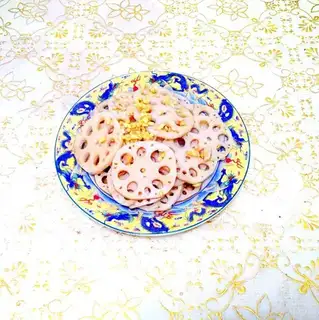
Lotus Root with Ginger Sauce
5. Cowpea is a Worthy Anti-Aging Treasure
Cowpea, commonly known as jiaodou, jiangdou, or daidou, is the young pod and seed of the plant Vigna unguiculata from the Fabaceae family. Cowpeas are divided into long cowpeas and rice cowpeas. Long cowpeas are generally eaten as a vegetable, which can be stir-fried or blanched and then served in a cold salad. Rice cowpeas are generally cooked as a grain or used to make bean paste fillings. Li Shizhen called it "this bean can be a vegetable, a fruit, or a grain; it is the best for all purposes and a superior bean among beans."
Cowpeas originated in Africa and were introduced to China during the Han Dynasty. It is said that Arabs often use cowpeas as a symbol of love. When a young man proposes to a girl, he always brings a bundle of cowpeas; when a bride goes to her new home's family, her dowry also always includes cowpeas.
Cowpea is neutral in nature and sweet in taste. It has the effects of regulating the middle and replenishing qi, tonifying the kidneys and strengthening the stomach. It is especially suitable for indigestion, bloating caused by weak spleen and stomach, and kidney deficiency with seminal emission, as well as some gynecological functional diseases, providing auxiliary therapeutic effects. Many elderly people have poor heart and kidney function, often suffering from leg swelling, foot swelling, and frequent urination at night. Cowpeas, which are low in sodium, are very suitable for them.
Sautéed Cowpeas with Douban Sauce
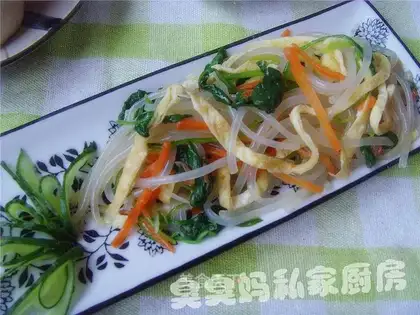 Spinach and egg mixed with vermicelli
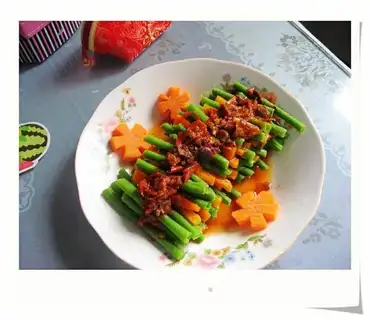 Cowpea in water-bean
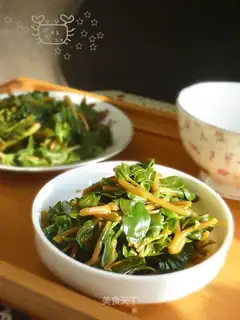 Pyramids
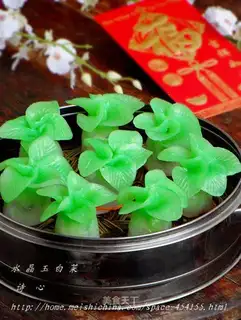 Crystal mackerel
 Gingertails