The world's ingredients all display different colors—red, orange, yellow, green, cyan, blue, purple—a vibrant spectrum. Among them, black is not an easy favorite. It lacks brilliant colors and regular shapes, yet some ingredients are thoroughly and beautifully black.
When bored, I looked up the definition of "black." It means the color of coal or ink, opposite of "white"; refers to night; dark, dim, lacking light; secret; not公开 (often illegal); evil, vicious; a symbol of reaction; a verb, or an adjective used as a verb, referring to a person using internet knowledge to attack others or websites; criticism of someone one dislikes. Looking closely, it seems none of the explanations are bathed in sunshine or positive. In this world, too many things are seen in black and white, with black always at a disadvantage. It seems it can only turn the tables when it comes to food.
So-called black ingredients mainly refer to grains, oils, fruits, vegetables, and fungi that contain melanin or have "black" in their names. Foods from animals or plants containing natural melanin, whether animal or plant, appear jet-black, deep purple, or dark brown due to the melanin. Some varieties have black skin; some are black through and through, inside and out; while some artificially produced black foods are mainly meant to stimulate people's appetite.
"Nourishing the kidneys" is the top priority for health in autumn and winter. The five elements—Wood, Fire, Earth, Metal, Water—correspond to five colors: green, red, yellow, white, and black. At the same time, these five elements correspond to the liver, heart, spleen, lungs, and kidneys in Traditional Chinese Medicine theory. Thus, there is a saying: Water corresponds to black, black corresponds to the kidneys, the kidneys govern water, and the theory that black foods can nourish the kidneys is completed through the five-element theory in TCM. Moreover, in the "Compendium of Materia Medica," black foods are also called "Immortal Food," "Imperial Food," and "Longevity Food," containing special nutrients that greatly help in activating blood vessels and providing antioxidants.
He Shou Wu Black Bean Soup with Pig's Tail
Many people don't believe the seemingly magical theories of TCM, but there is no doubt that black foods have excellent nourishing effects on the kidneys, a fact also proven by modern medicine. According to modern medical research, black foods are not only rich in nutrition but also have health-preserving, life-prolonging, kidney-nourishing, body-strengthening, hair-darkening, and beauty-enhancing effects, with the rich melanin they contain being the active ingredient.
In his collection of culinary novels, Japanese writer Ryu Murakami says, "A delicious soup is terrifying..." Following this logic, black foods are also terrifying. Who would be interested in something pitch-black, right? But indeed, it is a good thing. Black foods always create unique delicacies. From cold dishes to hot dishes, from staples to soups, the unassuming appearance of black foods brings an element of surprise to diners. Their rich texture and mouth-watering appeal, coupled with countless health benefits, make it no wonder black foods have become regulars on the dining table.
Among black foods, the one that embodies blackness the most is probably the black truffle. Its nobility, its mystery, and its depth. Nobility refers to its price, mystery to its rarity, and depth to its aroma. In Europe, the black truffle is known alongside caviar and foie gras as the "Three Kings of Gastronomy." The growing conditions for black truffles are extremely苛刻. A truffle might grow under one tree, while another seemingly identical tree right next to it will not, and to this day, people still don't understand why. Therefore, the annual global yield of black truffles is very scarce, making its price comparable to gold. It's called the "black diamond" or "black pearl" of the dining table.
In France, there is a group of people known as "truffle hunters." Every year from December to March, they follow their own treasure maps to search for black truffles. This is a fun yet arduous process. People love black truffles mostly for its rare and unique aroma. It's a distinct olfactory experience; a light whiff brings the scent of a forest floor and rich mushrooms. People's sense of smell varies, and each might describe it differently, but everyone is captivated by the aroma of the black truffle. Even just sprinkling a few fragments into a dish is enough to make it the star of the show, making even the simplest dish more intriguing and memorable.
1. Black Currant
Commonly known as blackcurrant, its scientific name is *Ribes nigrum* (picture shows processed blackcurrants). The ripe fruit is a small black berry, rich in vitamin C and anthocyanins. It can be eaten or processed into juices, jams, canned goods, and other beverages. It can help prevent gout, anemia, edema, arthritis, rheumatism, oral and throat diseases, and coughs. It is also very beneficial for cardiovascular health, high blood pressure, and high blood lipids.
2. Black Sesame Oil
Generally refers to oil pressed from sesame seeds. In many regions, it's the name for Sichuan pepper oil. In the south, it can also refer to oil pressed from sesame seeds. If it's sesame oil, pregnant women can eat it. If it's pepper oil, pregnant women should avoid it. It has the effects of nourishing the liver and kidneys, benefiting essence and blood, and moistening the intestines.
3. Purple Rice
Purple rice is a variety of rice belonging to the glutinous rice category. It is cultivated in small quantities only in Hunan, Sichuan, Guizhou, and China, making it a relatively precious rice variety. It comes in two types: purple japonica and purple glutinous. Purple rice grains are uniform in size, purple-black in color, and have a sweet, non-cloying taste. Purple rice is a type of rice, so named because the milled grains are slender and purple. There are two types: one with a purple bran and white, non-glutinous interior, and another that is glutinous and purple through and through.
4. He Shou Wu (Fo-ti)
Also known as many-flower knotweed, purple vine, or night-crossing vine, it is a perennial climbing vine of the Polygonaceae family. Its tuberous root is thick, long-elliptical, and dark brown (picture shows processed He Shou Wu). In China, its main producing areas are southern Shaanxi, southern Gansu, East China, Central China, South China, Sichuan, Yunnan, and Guizhou. The tuberous root is used in medicine to calm the mind, nourish blood, activate collaterals, detoxify, and reduce swelling. He Shou Wu can replenish essence and blood, strengthen bones and muscles, and nourish the liver and kidneys. It is a common and valuable traditional Chinese medicine.
Scapula Soup with Processed Rehmannia Root
5. Processed Rehmannia Root (Shu Di Huang)
Also known as prepared rehmannia root or fu di, it is made through processing and preparation. It is usually repeatedly steamed and sun-dried with auxiliary materials like wine, amomi fruit, and dried tangerine peel until it is black, oily, and moist, with a soft and sticky texture. It is used sliced or charred. It is a fine traditional Chinese medicine with the effect of nourishing blood and yin. It can be used for conditions like blood deficiency with sallow complexion, dizziness, palpitations and insomnia, irregular menstruation, and uterine bleeding. It can also be used for night sweats, spermatorrhea, and diabetes caused by insufficient kidney yin. It is one of the main ingredients in Liuwei Dihuang Wan, a non-prescription medicine for deficiency syndromes.
6. Chuanxiong (Lovage Root)
It is an irregularly shaped, knotted, fist-sized mass with a yellowish-brown, dark surface. It is rough, wrinkled, with many parallel, raised ridges. It is firm and not easily broken. The cross-section is yellowish-white or grayish-yellow, with a wavy ring of the cambium layer. It has a strong, fragrant aroma, a bitter taste, a slightly numbing sensation on the tongue, and a slight sweet aftertaste. Its pungent and warm nature dispels wind, unblocks collaterals, and relieves pain. It can also treat rheumatic arthralgia.
7. Silkie Chicken
Also known as black-boned chicken or Wushan chicken, it originates from Wushan in Taihe County, Jiangxi Province, China. Not only are its beak, eyes, and feet black, but its skin, muscles, bones, and most internal organs are also black. In terms of nutritional value, the Silkie chicken is far superior to ordinary chicken, and its texture is very tender. As for its medicinal and dietary effects, it is incomparable to ordinary chicken, earning it the title of "precious and rare medicinal and dietary poultry."
How do our friends in Taiwan eat "black"?
Mutton Hot Pot
A classic hot pot that has been popular in Taiwan since the late 1970s, commonly seen as a winter nourishment meal. Locally raised Taiwanese black mutton ensures the delicious flavor, gradually building the reputation of Gangshan mutton. To this day, Gangshan mutton has become one of the famous delicacies nationwide.
Si Wu Chicken Soup
A nourishing soup deeply loved by Taiwanese women, it has the remarkable effect of regulating menstruation and nourishing blood. It can regulate the body and relieve menstrual discomfort, suitable for all seasons. With consistent consumption, qi and blood will be effectively regulated, and problems困扰 women like menstrual issues, rough skin, and cold hands and feet will be effectively resolved.
Sesame Oil Chicken
Different from the Sichuan-style sesame oil chicken, the Taiwanese version has its own unique flavor. Made with chicken legs as the main ingredient and cooked with sesame oil, the dish has a reddish luster, the chicken is tender and delicious, and it is nutritious. It has a nourishing and body-tonifying effect that greatly stimulates the appetite.
Healthy Purple Rice and Taro
Purple rice has the effects of nourishing blood and qi, and warming the spleen and stomach. It has a certain therapeutic effect on stomach cold pain, thirst, and frequent urination at night. Furthermore, glutinous purple rice grains are large, full, and sticky. Purple rice is fragrant, glossy, soft, and delicious. Coupled with selected Taiwanese taro, which is soft and sweet, it is very suitable for women who like a light dessert after a meal but are worried about consuming too many calories.
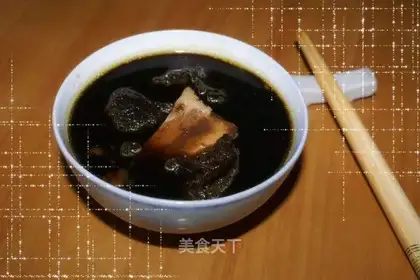 Raw rehmannia root fan bone soup
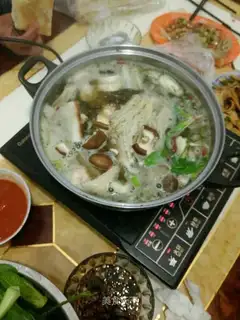 Chicken soup mushroom hotpot
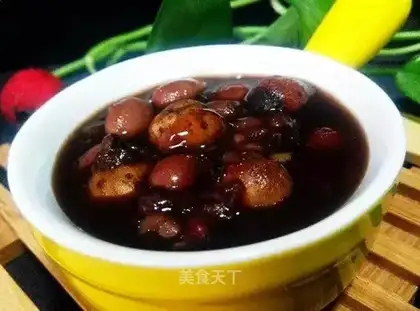 Porridge