How to make braised pork belly delicious and healthy. I believe many people love braised pork belly. Especially middle-aged and elderly people and gentlemen. But many people dare not eat too much braised pork belly, worrying that eating too much of it will harm their health. Today, I'm here to tell everyone that you can eat braised pork belly with confidence. As long as you follow my method, the braised pork belly will definitely not be harmful to your body, and it can even help you live longer!
Shanghai-style Braised Pork Belly
Cut the evenly fatty and lean pork belly into small pieces of 4cm x 2cm. Rinse with hot water to remove blood water, place in a stainless steel pot, add enough water at once (do not add cold water in the middle), and stew over low heat with a constant temperature of 100°C~103°C. Between 0.0 and 5.0 hours, take a sample every 0.5 hours to test its fatty acid content and composition (saturated fatty acids, monounsaturated fatty acids, and polyunsaturated fatty acids), as well as other indicators such as cholesterol.
To help everyone better understand the experimental results, I will first introduce some knowledge about cholesterol and fatty acids. Cholesterol has "good" and "bad" types. The "bad" cholesterol can easily damage the inner lining of blood vessels, while the "good" cholesterol can remove the former from the vessel walls. Depending on their composition, fatty acids can be divided into saturated fatty acids (such as palmitic acid) and unsaturated fatty acids. The latter can be further divided into monounsaturated fatty acids (such as oleic acid) and polyunsaturated fatty acids (such as linoleic acid). Research has shown that saturated fatty acids increase the risk of diseases such as coronary heart disease and atherosclerosis. Unsaturated fatty acids have multiple health benefits for the human body. For example, monounsaturated fatty acids help lower "bad" cholesterol in the blood and increase "good" cholesterol, which is beneficial for controlling blood lipids. Polyunsaturated fatty acids can lower total blood cholesterol.
Research has found: As the cooking time extends, the saturated fatty acids in the pork continuously degrade, and their content shows a downward trend, reaching a minimum at 2.5 hours, with a decrease of as much as 40% to 51%. The cholesterol content decreases by 51%. However, unsaturated fatty acids continuously increase as the cooking time lengthens. The increase is highest at 2.5 hours; for example, linoleic acid increases by nearly 21%, and the increase in monounsaturated fatty acids is greater than that of polyunsaturated fatty acids.
From the experiment, it can be concluded that the best cooking conditions for braised pork belly are: stewing over low heat, with a cooking time of 2.5 hours. Additionally, during the stewing process, you can add an appropriate amount of vegetables rich in dietary fiber, such as kelp or carrots. This way, you can enjoy the delicious food while also being very beneficial to your health.
Braised pork belly with alternating layers of fat and lean meat, sweet, fragrant, soft, and melts in your mouth is one of the simplest dishes on people's dining tables. Braised pork belly made in different regions with different methods has different flavors. How to make braised pork belly the most delicious? Come and take a look with me. The most classic braised pork belly recipe will save your appetite.
1. Suzhou-style Braised Pork Belly
Ingredients: Pork belly, oil, salt, sugar, dark soy sauce, one star anise, two cloves, a little cinnamon, green onions, ginger slices.
Method: Cut the pork belly into three pieces, bring to a boil over high heat, then wash; cut into mahjong-tile-sized pieces; heat oil in a wok, add rock sugar and cook until completely melted and the color is slightly yellow; add the pork belly and stir-fry until both sides change color, then add the spices, green onions, and ginger to stir-fry; add water and bring to a boil over high heat; after boiling, pour into a pre-prepared clay pot and simmer over low heat for 1 hour; add salt and soy sauce halfway through; after the meat is soft and tender, pour back into the wok to reduce the sauce.
2. Mao-style Braised Pork Belly
Ingredients: 850g of skin-on pork belly, 60g of cooking wine, salt, MSG, some spices, 50g of sugar, 20g of red yeast rice powder.
Mao-style Braised Pork Belly
Method: Heat an appropriate amount of oil in a wok until it boils, then pour it out and add star anise, cinnamon, dried chili peppers, Sichuan peppercorns, garlic, and chili to the remaining oil; blanch the pork belly with ginger slices and cooking wine, skim off the foam, then cut into pieces and set aside; put a small amount of oil back into the wok, add a large amount of sugar, and cook until it turns a light red color, then pour it into a prepared bowl; continue using the same wok (do not wash), add the prepared pork belly, and pour in a small amount of the previously made sesame oil.
Stir-fry over medium heat for 1 minute, add half of the prepared brown sugar syrup; add a small amount of boiling water, simmer until nearly dry and the sauce is thick; add the remaining brown sugar syrup, sesame oil, and stir to coat every piece of meat; simmer over low heat for a while; when the sauce becomes thick again, add a little water, red yeast rice powder, and a small amount of Sichuan peppercorn, and stir to coat every piece of meat again; simmer over low heat for a while. When the red color becomes apparent, add boiling water again and cook until the soup turns red, then add a small amount of salt (since there is less sugar, the salt is also relatively less), and a little MSG. When the sauce is thick, remove from the heat.
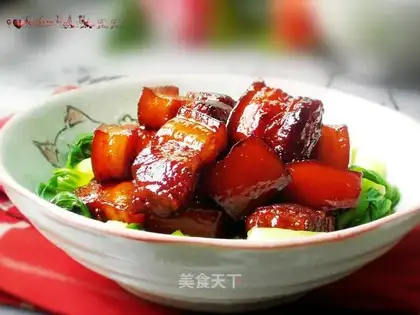 Mao red meat
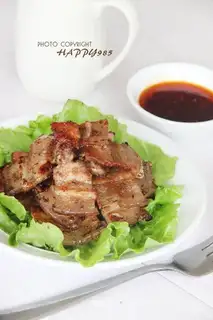 Frozen meat