Introduction: China's stinky tofu, France's moldy cheese, Japan's natto, Thailand's durian—these "notoriously" signature foods from various countries are loved by aficionados for being "smelly but delicious" while detested by others. Except for the "quintessence" stinky tofu, the others are all imported foods. When it comes to nutrition, these pungent delicacies each have their own unique strengths!
Moldy Cheese: The "Gold" Among Dairy Products
Food Lovers: When I first saw French blue cheese, I was shocked. Can this moldy cheese with green mold on it be eaten? It smelled like fermented tofu. I mustered up the courage to take a bite; it was a bit salty with a strong pungent and sour taste. But after eating it with bread a few times, I found its "stink" to be simply wonderful.
Nutrition Review: Blue cheese is one of the world's top ten famous cheeses with a history of over 2,000 years. The "green mold" on it is actually a product of green mold fermentation. This mold is a beneficial probiotic for the body. During fermentation, it creates the blue marble-like patterns in the cheese and gives it a very unique and strong flavor.
Cheese can be called the "gold" among dairy products; each pound of cheese is concentrated from about 10 pounds of milk. "All that is concentrated is essence." It is rich in protein, fat, and minerals such as calcium, phosphorus, and magnesium, as well as vitamins. Its calcium content is 7 to 8 times that of milk, making it the dairy product with the highest and most easily absorbed calcium content.
Most cheeses have a special milky and fermented taste that some people may find hard to accept at first. However, some cheeses are sweet and fragrant, so you can choose according to your own preferences.
A friendly reminder: Cheese generally has a high fat content. However, most cheese products now label their fat content as high-fat, full-fat, medium-fat, partially skimmed, or skimmed, so you can choose according to your own and your family's health condition.
Stinky Tofu: Stimulates Appetite and Aids Digestion
Food Lovers: Steamed cornbread paired with stinky tofu is a perfect match; it's stinky yet fragrant. A bite leaves a lasting aftertaste. Then there's the deep-fried stinky tofu, crispy on the outside and tender on the inside, drizzled with some red chili oil and served with cilantro—the flavor is simply divine.
Nutrition Review: Stinky tofu and fermented stinky tofu were once considered unhealthy foods, but in fact, they also have their unique nutritional value.
Fermented stinky tofu is made from tofu as a raw material and fermented. In the process of fermentation, some microbial enzymes break down proteins into small amino acids, which not only makes the nutrients easier for the human body to absorb but also produces plant-based lactic acid bacteria, increasing the content of rich Vitamin B2, B12, and enhancing the activity of soy isoflavones.
Eating an appropriate amount of fermented stinky tofu and stinky tofu can stimulate appetite, regulate intestinal flora, and aid digestion.
A friendly reminder: Fermented stinky tofu has a relatively high salt content, so it should not be eaten in excess. Stinky tofu is generally deep-fried, which is not very healthy, so it's best to eat it in moderation.
Chopped Chili Stinky Tofu
Natto: Prevents Blood Clots and Lowers Blood Pressure
Food Lovers: When I first came to Japan as a student, I saw many Japanese people couldn't have a meal without a certain sticky, slightly spoiled-smelling, dark yellow bean dish. The taste was not very good when I tried it. Later, I learned it was called natto, which is very nutritious. After eating it many times, although I still can't say I love its taste, I can accept it.
Nutrition Review: Natto is a microecological and health food made from soybeans fermented with pure bacterial strains. During fermentation, various physiologically active substances are formed, such as nattokinase, natto isoflavones, saponins, and vitamin K2.
During natto fermentation, a special stinky smell and a large amount of mucin are produced, which can be pulled into very long sticky threads. The rich nattokinase it contains is one of the important active components in natto, with the effects of dissolving blood clots and lowering blood pressure.
People who don't like the smell of natto can mix it with rice or use it as a seasoning mixed with vegetables and fruits.
A friendly reminder: The most important active component in natto, nattokinase, is not heat-resistant. Its active ingredients will disappear after heating, so it's best to eat natto cold.
Cucumber and Almond Salad with Natto
Durian: The King of Fruits in Terms of Nutrition
Food Lovers: Some people say durian has a very strange, even stinky feet smell, but it is the favorite of many people. Especially when chilled in the refrigerator and then eaten spoonful by spoonful, it feels like eating ice cream—sweet, fragrant, smooth, and truly irresistible deliciousness.
Nutrition Review: There is a saying in folk culture, "One durian is equivalent to three chickens," which is of course an exaggeration. However, durian is indeed a high-energy fruit that is very nutritious. Durian flesh contains 11% starch, 13% sugar, 3% protein, as well as fat, vitamin C, and various trace elements such as calcium, iron, and phosphorus, earning it the title "King of Fruits."
In "Durian Country" Thailand and in southern China, some people even use durian to nourish the weak. However, precisely because durian is a "high-sugar, high-fat, high-calorie" fruit, eating too much of it can be difficult for the body to digest and absorb, easily causing bloating and "internal heat" (inflammation).
A friendly reminder: When eating durian, be sure to eat it in moderation. One or two segments at a time is enough.
Durian Mousse Cake
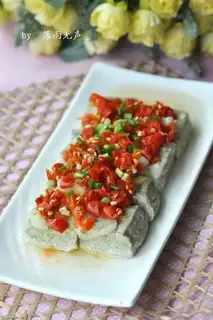 Stinky tofu with chopped pepper
 The durian mousse cake
 A fragrance