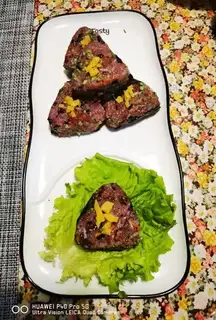
It's been a long time since I've been out of the house, and this morning I've bought blood rice for delivery, so I'm going to clean it up with fresh water and then I'm going to eat blood rice for dinner. Don't look at simple meals. They're too much. They can be put in anything they like. They're full of a variety of food, colorful colours, accompaniment, nutrients. Little knowledge: Blood rice is an important species in black rice, which is called haemophiles because of its acoustic properties. It's an old, well-established, red, expensive rice species. Due to the abundance of haemophilium, which is rich in vitamin E, protein and iron, as well as redin, and which is well nourished, it is known as “rehabilitated & quot; & quot; long-lived & quot. 1. High cellulose content in the outer layer of intestine-preservative haemoglobin, which promotes intestinal creeping, accelerates excretion of faeces, acts as an intestine decomposition and reduces cholesterol absorption, and is helpful in preventing artery sclerosis and intestine cancer. In the old language, "the porridge of rice is a good food for the warmth of the stomach" , which warms the stomach and helps to regenerate it. 3. Blood-inflicted, red-blooded rice. According to Chinese medicine, the blood of the heart, that is to say, its efficacy and the filling of the blood. The use of haemophilium can assist in the treatment of menstrual dysentery with the effect of condensation. 4. The haematological haematosis is beneficial in terms of haematological, renal and other effects, and women eat it to make it look better, as well as studies showing the presence of vasectomy antioxidants in the blood clot casing. 5. The levels of manganese in skeletal blood are significantly higher than in rice, and the mean levels of manganese in blood are 2.65 times those in rice and 1.44 times those of purple manganese rice. The lack of manganese, which is an essential auxiliary factor in the creation of cartilage, can cause a material synthesis disorder called sulphate mosaics, thus hindering the growth of the cartilage, leading to changes in the structure and composition of the cartilage, and eventually to deformation of the bones. Lack of manganese can also cause new calcification and osteoporosis by affecting calcium calcium。