Watercress has the effects of clearing dryness and moistening lungs, resolving phlegm and relieving cough, and diuretic. Healthy vegetables that benefit the brain and keep fit. The climate is cold and dry in winter and spring, and the defense function of the upper respiratory mucosa of the human body is relatively weakened. It is easily attacked by bacteria and viruses. Symptoms such as dry throat, sore throat, hoarseness, cough and thick phlegm, constipation appear. At this time, Western-style vegetables that have good functions of moistening the lungs and relieving cough should be on the market, and the food can help you live the end of the year safely. It is known as the "natural dry and lung-saving vegetable."
It is said that watercress is not of origin in our country. The origin of its name is: Legend has it that there was a businessman named Cai Sheng in Guangdong who did business in Portugal. Due to the unfamiliar land, language barrier, business was difficult, and business was tiring, he fell ill soon. The doctor diagnosed him as having pulmonary strain disease. The disease was considered a terrible and incurable disease at the time. People with this disease live a long life and can be passed on to others. Cai Sheng suffered from the disease in a foreign country and had no money to go back to his hometown for medical treatment, so he fell into trouble. The local government was afraid that Cai Sheng would infect others with pulmonary strain disease, so it ordered him to be driven to the desolate wild for isolation. At that time, Cai Sheng was poor and sick. Hunger and the desire to survive prompted him to pick a wild vegetable growing in shallow water to satisfy his hunger. After a while, a miracle occurred. His coughing stopped, his vomiting stopped, his face gradually became ruddy, and his limbs gained strength. After several years of eating, the stubborn disease of lung disease was finally conquered by "this water and grass." Cai Sheng regained his health and returned to Lisbon to continue doing business. His family gradually became prosperous and he married and had children. Later, when he returned to China, he did not forget to transfer the grass and plant it. Because the local people did not know the name of this grass, Cai Sheng named it Wickcress (Cai). From then on, it was produced in Hong Kong, Macao and Guangzhou. Cantonese people have a good impression of watercress and think it is a vegetable that is hot for clearing the lungs. When it was made, boiling watercress was a home-made soup. Drinking soup and eating vegetables would clear heat and moisten lungs. The weather would be more suitable after winter. It is also very delicious to stir-fry. When encountering dry mouth, sore throat, hot lungs and coughing, it is most used to stew duck kidneys, or add grosvenori and pork, or make soup with fish, which will be more delicious.
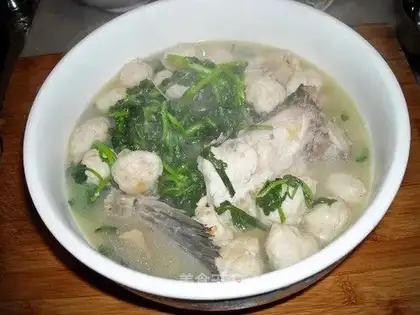
Fish ball Western vegetable soup
By MayChamplin
Recipe Recommendations
- fresh fish 500 grams
- sai Yeung Choi 500 grams
- salt appropriate amount
- Jiang 10 grams
- onion 2 pieces
- pepper 5 grams
- starch 1 teaspoon
- chicken essence appropriate amount
- oil appropriate amount
- salty and fresh
- cook
- half an hour
- ordinary
Steps for Fish ball Western vegetable soup

1
Raw materials: 500g fresh fish, 500g watercress
2
Use bamboo chopsticks to stir the fish paste vigorously in one direction. The fish surimi protein is sticky and appears transparent.
3
Remove the pot with clear water, moisten it with a spoon, hold the fish minced in your left hand, squeeze it into a meatball from the tiger's mouth, and catch it with the spoon in your right hand.
4
Put in a pan of water. The extruded fish balls float in clear water to prevent adhesion during cooking.
5
Cook slowly over minimum heat.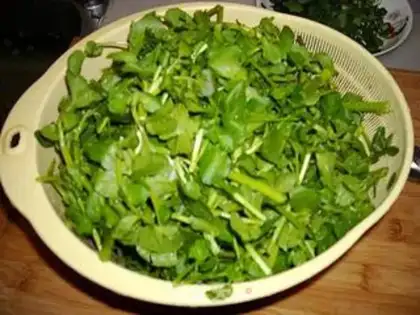
6
Pick and wash the watercress.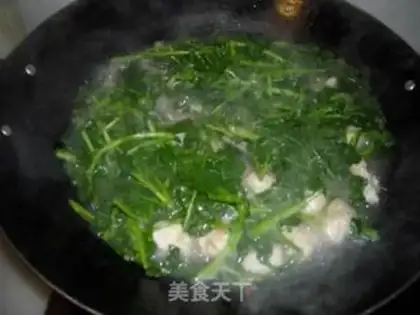
7
After the fish balls are cooked, bring to a boil over high heat, add the watercress.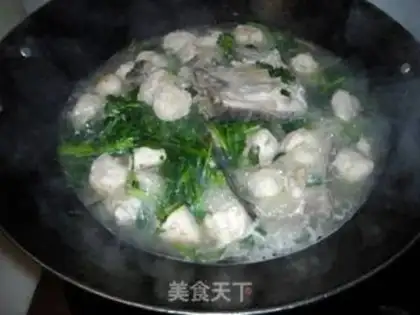
8
Blanch the watercress thoroughly and season it. (In order not to waste it, I boiled the fish bones and skin together and added two slices of ginger.)