Every season has its suitable vegetables, so what vegetables are good to eat in autumn? Traditional Chinese Medicine (TCM) emphasizes the balance of yin and yang, and diet should also be chosen according to the season. The healthy eating column recommends seven vegetables suitable for autumn consumption.
Cauliflower:
Tomato Cauliflower
Cauliflower is rich in vitamins, and every 200 grams of fresh cauliflower can provide adults with more than 75% of their daily vitamin A requirement. TCM has the saying "white color enters the lungs," and autumn is a season with a high incidence of respiratory infections. The white cauliflower is undoubtedly a timely health-preserving vegetable.
Bean Sprouts:
Oyster Sauce Chive and Bean Sprouts
The chlorophyll in bean sprouts can prevent colorectal cancer and significantly reduce lactic acid buildup in the body, thus helping to eliminate fatigue. TCM believes that bean sprouts are sweet and cool in nature, and have the effects of clearing heat and detoxifying, promoting urination, and relieving constipation.
Spinach:
Spinach Stir-fried with Eggs
Spinach is a vegetable with extremely high nutritional value. The content of carotene in spinach is much higher than in other vegetables. Although its ascorbic acid content is lower than that of chili peppers, it is higher than that of tomatoes. The vitamin K in spinach, which has a hemostatic effect, is the highest among leafy vegetables. The rich riboflavin also helps prevent oral ulcers, cheilitis, glossitis, and dermatitis.
Lettuce:
Oyster Sauce Stir-fried Lettuce with Chicken Mushroom
The potassium in lettuce helps promote urination, which is very beneficial for patients with hypertension and heart disease. In addition, people who are prone to coughing in autumn can also calm their coughs by eating more lettuce.
Bok Choy:
Bok Choy Stewed with Potatoes
Bok choy is slightly bitter and cold in nature, and it helps to regulate the intestines and stomach. Bok choy is very rich in vitamin C and calcium, and also contains phosphorus, iron, carotene, and vitamin B. There is also a type called cabbage, which is commonly known as Chinese cabbage. Regular consumption can benefit the heart and kidneys, and strengthen the spleen and stomach.
Carrot:
Carrot and Egg Cake
Carrots are sweet and neutral in nature, and eating them can tonify the spleen and strengthen the stomach. Carrots are best eaten stewed, and stir-frying is also a good method. Stewing can preserve over 93% of the carotene, and stir-frying can also preserve over 80%. However, when eaten raw or in a cold salad, the body can only absorb about 10% of the carotene.
Celery:
Celery with Dried Tofu
Celery is cool in nature, sweet, pungent, and non-toxic. It helps to calm the liver and strengthen the stomach, and is rich in protein, carotene, vitamin C, and amino acids. Celery can stimulate the central nervous system, promote gastric juice secretion, increase appetite, and has an expectorant effect.
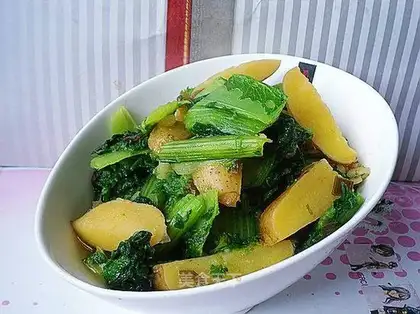 Stewed potatoes with cabbage
 Celery dry
 Tomato blossoms
 The chicken soup knife