Everyone knows Chinese cabbage, a vegetable that originated in our country, with a history of cultivation dating back to primitive society. Archaeologists have discovered a pottery jar containing cabbage seeds at the Banpo Neolithic site in Xi'an, tracing its history back at least 6,000 years. Chinese cabbage is a common vegetable in winter, and there are many ways to prepare it!
Chinese cabbage was introduced to the Joseon Dynasty of Korea during the Ming Dynasty and later became the main ingredient for Korean kimchi. The Korean drama "Dae Jang Geum" features a plot where the protagonist tries to grow "Song菜" (Chinese cabbage) introduced from the Ming Dynasty. Today, many countries around the world have introduced and cultivated Chinese cabbage.
Everyone knows Chinese cabbage, a vegetable that originated in our country, with a history of cultivation dating back to primitive society. Archaeologists have discovered a pottery jar containing cabbage seeds at the Banpo Neolithic site in Xi'an, tracing its history back at least 6,000 years. Chinese cabbage is a common vegetable in winter, and there are many ways to prepare it!
Chinese cabbage, also known as "Song"
Chinese cabbage is the most remarkable vegetable. Besides being rich in vitamins, sugars, proteins, crude fiber, and nutrients like calcium, phosphorus, and iron, its content of trace element zinc is higher than that in meat. It also contains molybdenum, which can inhibit the absorption of nitrosamines.
The "Compendium of Materia Medica" records: "Chinese cabbage, also known as Song, is sweet, warm, and non-toxic. It promotes the smooth flow of the intestines and stomach, relieves vexation in the chest, and quenches thirst from alcohol."
Why is Chinese cabbage called "Song"? There is a reason for this. According to "Pi Ya" by the Song Dynasty scholar Lu Dian: Chinese cabbage can withstand frost and snow, possessing the character of a pine tree. The character "Song" (菘) is a compound ideograph, hence the name.
Everyone knows Chinese cabbage, a vegetable that originated in our country, with a history of cultivation dating back to primitive society. Archaeologists have discovered a pottery jar containing cabbage seeds at the Banpo Neolithic site in Xi'an, tracing its history back at least 6,000 years. Chinese cabbage is a common vegetable in winter, and there are many ways to prepare it!
The Health Benefits of 10 Dishes with Chinese Cabbage
Chinese cabbage can be paired with a variety of ingredients in daily life, and each pairing has its unique effects. It is especially suitable for dietary supplementation in early winter. Let's take a look together.
Chinese Cabbage and Tofu Stew
1. Chinese Cabbage + Beef
This meat-and-vegetable pairing complements each other, providing comprehensive nutrition. It has the effect of strengthening the spleen and whetting the appetite, making it especially suitable for individuals with a weak constitution. It can also assist in treating weakness, fatigue, and lung-heat cough. Meanwhile, beef is rich in protein and other nutrients, which can tonify the spleen and stomach, and benefit essence and blood. Chinese cabbage is rich in crude fiber, which can promote gastrointestinal motility and prevent constipation.
2. Chinese Cabbage + Tofu
Tofu contains 40%-60% protein, with an absorption and digestion rate of over 90%, and contains only stigmasterol without cholesterol. With the action of Chinese cabbage, it not only promotes the absorption of B vitamins but also increases calcium and lysine, which is beneficial for strengthening bones and muscles, preventing osteoporosis, and lowering cholesterol. Eating Chinese cabbage with tofu is particularly suitable for patients with urinary and bowel difficulties, sore throat, and bronchitis.
3. Chinese Cabbage + Chestnuts
Chestnuts strengthen the spleen and kidneys, while Chinese cabbage nourishes yin and moistens dryness. Stewing chestnuts with Chinese cabbage can make the complexion fair and beautiful.
4. Chinese Cabbage + Milk
Fresh milk has the effects of tonifying deficiency, benefiting the lungs and stomach, nourishing the heart blood, and moistening the intestines. It has a certain therapeutic effect for those who are old, weak, lacking in energy, and mentally and physically fatigued. Chinese cabbage has the effect of clearing heat and moistening the lungs. Paired with fresh milk, it can tonify deficiency and clear and moisten the lungs and stomach.
5. Chinese Cabbage + Potatoes
Potatoes contain trace elements such as magnesium, iron, phosphorus, and potassium. With the action of Chinese cabbage, they can strengthen the spleen and stomach, aid digestion, reduce inflammation, and promote bowel movements, helping to speed up the excretion of waste that may cause cancer from the digestive tract.
Pork, Chinese Cabbage, and Vermicelli Stew
6. Chinese Cabbage + Pork
Pork is neutral in nature and sweet in taste, with the function of nourishing yin and moistening dryness. Chinese cabbage is rich in vitamins and zinc, which can prevent arteriosclerosis. Stir-frying lean pork with Chinese cabbage not only increases animal protein but also enhances skin elasticity, suppleness, and luster. It is a dish that patients with hypertension, coronary heart disease, cerebrovascular disease, scurvy, and chronic gastritis should often eat. It also helps prevent dry and rough skin. Eating Chinese cabbage with meat can not only add a fresh flavor to the meat but also reduce nitrites and nitrate substances in the meat, reducing the production of carcinogenic nitrosamines.
7. Chinese Cabbage + Carp
Eating Chinese cabbage with carp can supplement a large amount of protein, carbohydrates, vitamin C, and other nutrients, making it a dietary therapy for assisting in treating edema in pregnant women.
8. Chinese Cabbage + Soybean Sprouts
Eating them together can reduce lactic acid accumulation in the body, eliminate fatigue, and play a role in preventing various digestive tract malignant tumors such as colorectal cancer.
9. Chinese Cabbage + Aged Vinegar
Cut the cabbage stalks into small pieces, add scallions, ginger slices, a little chili, and a minimal amount of vegetable oil to the wok. Quickly spray with aged vinegar and stir-fry. This can soften and dilate blood vessels, relieve high blood pressure, inhibit the rise in blood sugar levels, and assist in treating colds by killing various bacteria.
10. Chinese Cabbage + Dried Shrimp
Chinese cabbage is rich in vitamin C, while dried shrimp is high in protein, calcium, and phosphorus. Eating them together has the effects of relieving heat and dryness, strengthening the kidneys and yang, nourishing yin and clearing the lungs, and strengthening the spleen and whetting the appetite. Regular consumption can prevent constipation, hemorrhoids, arteriosclerosis, colon tumors, and certain cardiovascular diseases. It can also effectively prevent gingival bleeding and scurvy. It is especially suitable for weak, tired, and those with lung-heat cough to eat regularly.
Chinese cabbage is tenacious in its vitality. In ancient times of war and turmoil, when crops began to fail, people would even rely on Chinese cabbage to get through the winter. For example, historical records state that during the peasant uprisings in the Jiangnan region during the Ming Dynasty, the farmland outside Yangzhou city was left untended and the harvest was poor, so the people relied on Chinese cabbage to survive the winter. Chinese cabbage is nutritious and inexpensive, making it a vegetable that is both healthy and cheap!
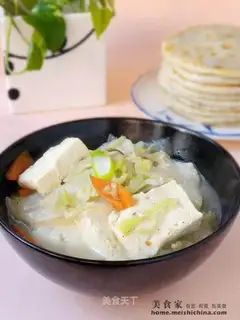 Stewed tofu with Chinese cabbage
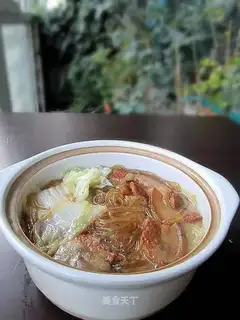 Pork cabbage stew